Filmlexikon.
Support
Trombone Shot
Camera · Terms

Trombone Shot

Murnau AI illustration
flow para roll shot take

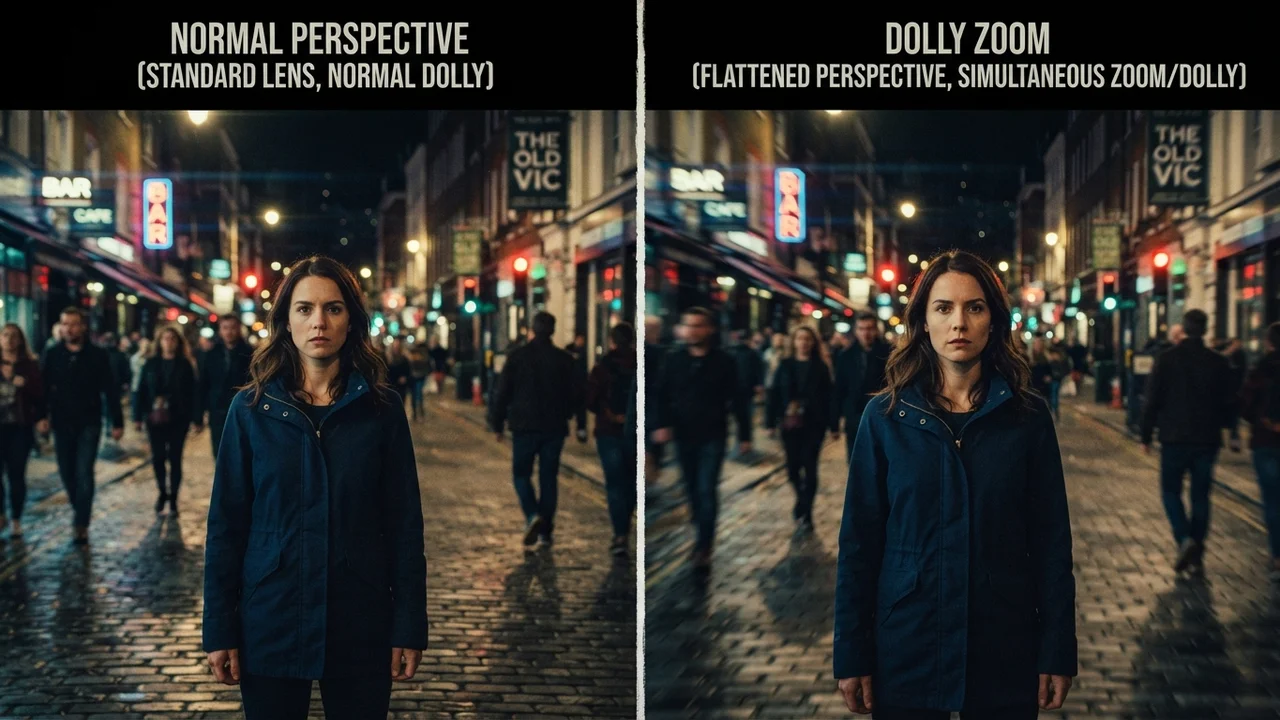
Dolly zoom: camera moves backward while lens zooms in, keeping subject static while background distorts perspectively. Hitchcock pioneered it in Vertigo (1958).

Technical Details

The execution requires precise synchronization between camera movement and zoom adjustment. In a typical setup, one begins with a 85mm focal length at a distance of 3 meters from the subject and moves in to 1.5 meters during an 8-12 second movement, while simultaneously zooming to 35mm. The framing of the main subject remains constant, while the field of view expands from 28° to 63°. Modern digital cameras allow for precise pre-programming of both movement parameters via motors with 0.1° accuracy. Variants include the reverse trombone shot (moving away + zooming in) and asymmetrical versions with different speed curves.

History & Development

Hitchcock developed the effect in 1958 with cinematographer Robert Burks for the tower scenes in "Vertigo." The technical execution was achieved with a Mitchell camera on tracks and a manually operated Cooke zoom lens 25-250mm. Steven Spielberg perfected the technique in 1975 in "Jaws" with more precise Panavision lenses. Since the 1990s, computer-controlled camera systems like Technocrane and Motion Control have enabled exact reproducibility. Digital technology has expanded the effect with post-production variants using artificial camera movements in 2.5D compositing.

Practical Use in Film

The effect is classically used for shock scenes or moments of realization. Scorsese used it in "Goodfellas" (1990) during Henry Hill's paranoia episodes with 40mm-85mm changes over 6-second moves. Peter Jackson employed digital versions for Frodo's ring visions in "The Lord of the Rings" (2001). Preparation requires exact markings for camera position and focus points. Difficulties arise from focus shifts during focal length changes and the need for even lighting across the entire movement range. Motorized systems like Preston Cinema Systems now allow for millimeter-accurate repetition.

Comparison & Alternatives

Unlike a simple dolly zoom, the trombone shot keeps the main subject consistently framed. Modern CGI alternatives like Volume Rendering in Virtual Production offer greater flexibility without physical camera movement. The Hitchcock zoom is distinguished by a purely backward camera movement with simultaneous zooming in. Push-pull shots combine similar elements without focal length changes. Lens whacking creates comparable perspective distortion through lens manipulation during the shot.

From the crafts

Perspectives

Cinematographer

Ich verwende den Posaunen-Effekt hauptsächlich für intensive emotionale Momente, wobei die präzise Koordination zwischen meinem Focus Puller und Dolly Grip entscheidend ist. Die größte Herausforderung liegt in der gleichmäßigen Schärfenachführung, da sich durch die Brennweitenänderung die Tiefenschärfe kontinuierlich verschiebt. Bei Verwendung von Zeiss Master Primes setze ich meist Follow Focus und Zoom Control von Preston ein, um reproducierbare Ergebnisse zu gewährleisten.

Director

Der Posaunen-Effekt verstärkt subjektive Wahrnehmungsveränderungen meiner Protagonisten - besonders bei Angstzuständen oder plötzlichen Erkenntnissen nutze ich diese Technik zur Visualisierung innerer Zustände. Die Verzerrung des Raumes um das konstant bleibende Gesicht erzeugt beim Zuschauer dieselbe Desorientierung wie beim Charakter. Ich plane diese Einstellungen meist als dramaturgische Höhepunkte, da sie sehr auffällig sind und sparsam eingesetzt werden müssen.

Producer

Ein Posaunen-Effekt kostet mich typischerweise 45-90 Minuten zusätzliche Drehzeit durch die komplexe Technik-Koordination und mehrere Probeläufe vor der eigentlichen Aufnahme. Die Ausrüstungskosten steigen um etwa 800-1200 Euro täglich für motorisierte Zoom- und Dollysysteme. Bei Außenaufnahmen plane ich Wetteralternativen ein, da Wiederholungen aufgrund unterschiedlicher Lichtverhältnisse problematisch werden - digitale Post-Production-Lösungen kosten etwa 2000-4000 Euro pro Einstellung.

More in the lexikon

Related terms

Test your knowledge

Quiz

1. Was beschreibt „Posaunen-Effekt" am besten?

2. Zu welchem Department gehört „Posaunen-Effekt"?

3. Wie viele verschiedene Fachperspektiven bietet dieser Eintrag?

Report an error
From the Filmfarm ecosystem

Understand visual language, budget productions, connect crew.

The Lexikon is part of the Filmfarm ecosystem — alongside budgeting (FilmBalance), an industry magazine (FilmCircus) and crew networking (FilmCall, CrewMesh). One shared vocabulary for the whole production.

FilmFarm FilmRadarComing soonFilmPulseComing soonFilmNumbersComing soonFilmCapitalComing soonFilmLabComing soonFilmBalanceComing soonFilmCircusComing soon