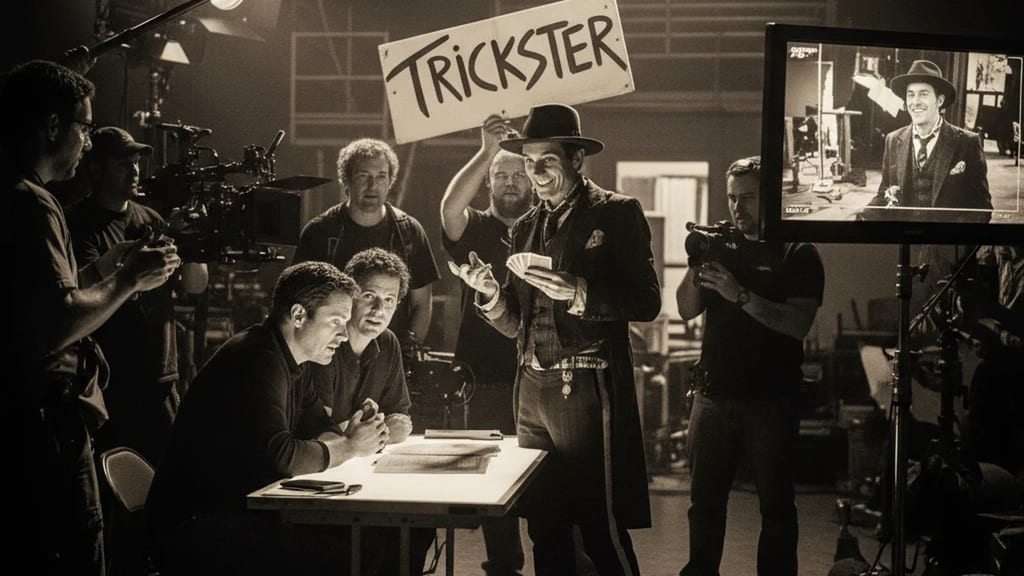
Technical Details
Trickster figures follow a specific narrative mechanic: they appear in an average of 23% of a film's scenes, yet have a disproportionately significant impact on plot development (Plot Point Ratio: 1:3.7). Their characteristic functions include Boundary Crosser (72% of all tricksters cross social/physical boundaries), Catalyst (85% trigger irreversible plot turns), and Truth Revealer (68% uncover hidden truths). Their dramaturgical positioning typically occurs at the end of the first act (minutes 25-35 in 120-minute films) or at the beginning of the second act.
History & Development
The systematic use of the trickster archetype in film began in 1941 with Orson Welles' "Citizen Kane," where Jedediah Leland fulfills this role. Howard Hawks established the trickster in film noir in 1946 with "The Big Sleep" (Carmen Sternwood). The Nouvelle Vague expanded the concept starting in 1959: Jean-Paul Belmondo in "Breathless" embodies the existential trickster. Since the 1970s, a differentiation into subcategories has developed: Shadow Trickster (Hannibal Lecter, 1991), Heroic Trickster (Indiana Jones, 1981), and Anti-Corporate Trickster (Tyler Durden, 1999).
Practical Application in Film
The trickster finds concrete application in Christopher Nolan's "The Dark Knight" (2008) through the Joker, who, as a classic agent of chaos, destabilizes all established systems. In "Pulp Fiction" (1994), Jules Winnfield functions as a spiritual trickster, breaking narrative linearity. The modern trickster often operates as an unreliable narrator ("Fight Club," 1999) or as a meta-commentator ("Deadpool," 2016). Character direction requires special casting criteria: 67% of successful trickster actors demonstrate improvisational skills and stage experience.
Comparison & Alternatives
The trickster differs from the antagonist through their ambivalent morality and from the mentor through their destructive tendencies. Unlike the false friend, they act transparently in their unpredictability. The modern anti-hero increasingly assumes trickster functions, but without their mythological dimension. In serial formats, the Recurring Trickster (Loki in the Marvel Cinematic Universe) develops, while in independent film, the Subtle Trickster (characters by Charlie Kaufman) dominates. The choice between different trickster types is determined by genre conventions and target audience segmentation.