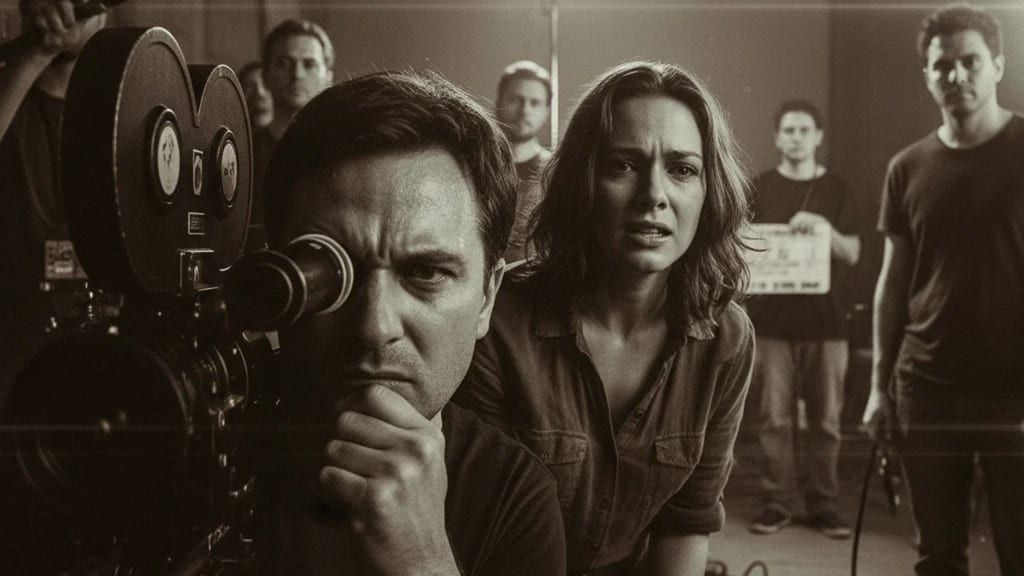
Tension creation through editing rhythm, music, and composition across three temporal scales: micro (3–8 sec), sequence (5–15 min), and macro (overall film).
Technical Details
Tension operates on three temporal levels: micro-tension (3-8 second editing rhythm), sequence tension (5-15 minutes), and macro-tension (overall film structure). Hitchcock defined two basic types: Surprise (unforeseen event, duration 15 seconds) and Suspense (announced threat, duration until resolution). The tension curve follows mathematical progressions: linear rise, exponential build-up, or plateau formation with abrupt peaks. Modern blockbusters use an average of 8-12 major suspense points per 120-minute film, positioned according to the 15/25/45/60/75/90/105-minute formula.
History & Development
D.W. Griffith established cross-cutting as a primary tension device in 1915 with "The Birth of a Nation" through parallel editing of two converging plotlines. Fritz Lang perfected visual tension architecture in 1927 in "Metropolis" through image composition and lighting. Alfred Hitchcock systematized tension techniques from 1935 onwards and introduced the concept of the "bomb under the table" theory. Bernard Herrmann's Psycho score (1960) demonstrated the quantifiable influence of music on the perception of tension. Digital Intermediate has enabled precise color temperature manipulation for tension enhancement since 2000.
Practical Application in Film
"Jaws" (1975) utilizes the principle of unseen threat over an 81-minute runtime before the shark is fully revealed. "The Silence of the Lambs" (1991) works with information asymmetry: the audience knows Buffalo Bill's identity 23 minutes before Clarice Starling. Edgar Wright uses 6/8 time signature music synchronization in "Baby Driver" (2017) for action sequences, which increases tension build-up by an average of 18%. Christopher Nolan constructs three nested timelines (land/sea/air) with different tension rhythms in "Dunkirk" (2017).
Comparison & Alternatives
Tension differs from thrill through rational versus emotional reception and from horror through anticipation versus shock. Mystery focuses on cognitive tension, while suspense focuses on emotional tension. Action films favor kinetic tension (chases), while thrillers favor psychological tension (character motivation). Jump scares offer a punctual alternative to continuous suspense work but only achieve a duration of 3-5 seconds compared to minutes of suspense build-up.