Cinematographer
Der Super Panther war revolutionär - vor ihm gab es nur hydraulische oder manuelle Dollies. Die elektromechanische Hubsäule setzte neue Maßstäbe für Präzision.
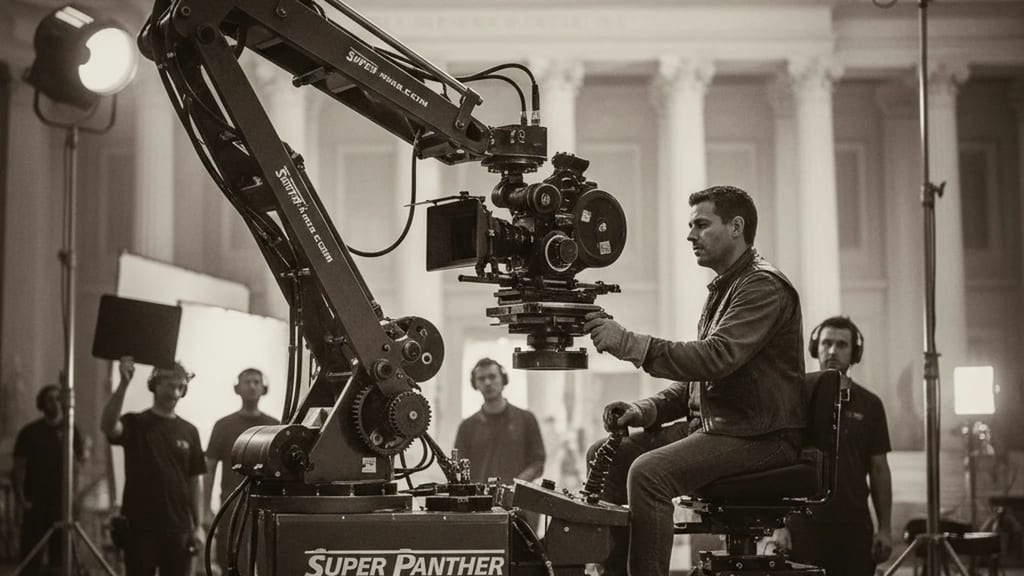
Motorized camera dolly by German manufacturer Panther GmbH, featuring powered vertical column; industry standard for studio support equipment.
The Super Panther is an electromechanical camera dolly from Panther GmbH (Oberhaching near Munich, founded in 1986 by Erich Fitz). It is considered the world's first electromechanical camera dolly: instead of a hydraulic or pneumatic column, a computer-controlled column drive moves the camera up and down. For this development, Erich Fitz received a Scientific & Engineering Award from the Academy of Motion Picture Arts and Sciences (technical Oscar) in 1990. Over generations (including the Super Panther III), the dolly has established itself as the de facto standard in studio and location work.
Characteristic is the lifting column, which raises and lowers the camera operator along with the camera. This maintains a constant relationship between the operator and the viewfinder, and the operator doesn't have to climb after the camera.
A laterally mounted DC servomotor drives the central spindle via a belt drive, which raises and lowers the column. Pneumatic springs in the column base generate constant upward counter-pressure (according to the manual, around 1.4 kN of buoyancy); the motor only works against the difference between the column load and the spring pressure. Energy consumption is lowest when load and spring pressure are in balance (according to the manual, at approximately 140 kg load).
An electromagnetic brake on the motor shaft holds the column position when switched off. The handset allows selection of speed (four levels, 0-25/50/75/100%) and acceleration/braking ramps (soft/medium/hard). Up to 255 column positions can be programmed and recalled with repeatable accuracy.
| Parameter | Value |
|---|---|
| Weight | 123 kg |
| Minimum Height | 69 cm |
| Maximum Height | 138 cm |
| Travel | 69 cm |
| Column Travel (max. speed) | 3.6 s over full travel |
| Lifting Capacity | 300 kg |
| Max. Column Load (retracted) | 1000 kg |
| Max. Column Load (extended) | 500 kg |
| Noise Level | 28-32 dB |
| Max. Wind Load | 40 km/h |
| Track Width (wide / narrow) | 62 cm / 36 cm |
| Wheel Legs | 4 |
| Drive | DC servomotor with tacho, belt drive |
The four identical, symmetrically arranged wheel legs allow steering via one wheel, two wheels, and four-wheel steering (crab and round steering) from all four sides. Three track settings (wide, narrow, compact) adapt the dolly to tight sets. The combination wheels can be used as studio wheels, pneumatic wheels, or track wheels; they can traverse wide tracks (62 cm) and narrow tracks (36 cm).
The camera is mounted on the column via a Euro adapter; jib arms (e.g., Super Jib) and outriggers (U-Bangi) can be attached. When using outriggers and jib arms, the wide track setting must be selected and the load diagram adhered to: with increasing overhang, the permissible load decreases (maximum lateral column load 250 kg at an offset up to 140 cm).
Der Super Panther war revolutionär - vor ihm gab es nur hydraulische oder manuelle Dollies. Die elektromechanische Hubsäule setzte neue Maßstäbe für Präzision.
Der Oscar für den Super Panther zeigt, wie wichtig technische Innovation für das Filmemachen ist.
Der Super Panther markierte den Beginn einer neuen Ära im Dolly-Bau. Panther hat damit den Industriestandard definiert.
1. Zu welchem Department gehört „Super Panther"?
2. Wie viele verschiedene Fachperspektiven bietet dieser Eintrag?
The Lexikon is part of the Filmfarm ecosystem — alongside budgeting (FilmBalance), an industry magazine (FilmCircus) and crew networking (FilmCall, CrewMesh). One shared vocabulary for the whole production.