Cinematographer
Aus DoP-Perspektive ist dieses Element essentiell für die visuelle Gestaltung. Es ermöglicht mir die gewünschte Farbstimmung und das ästhetische Bild konsistent umzusetzen.
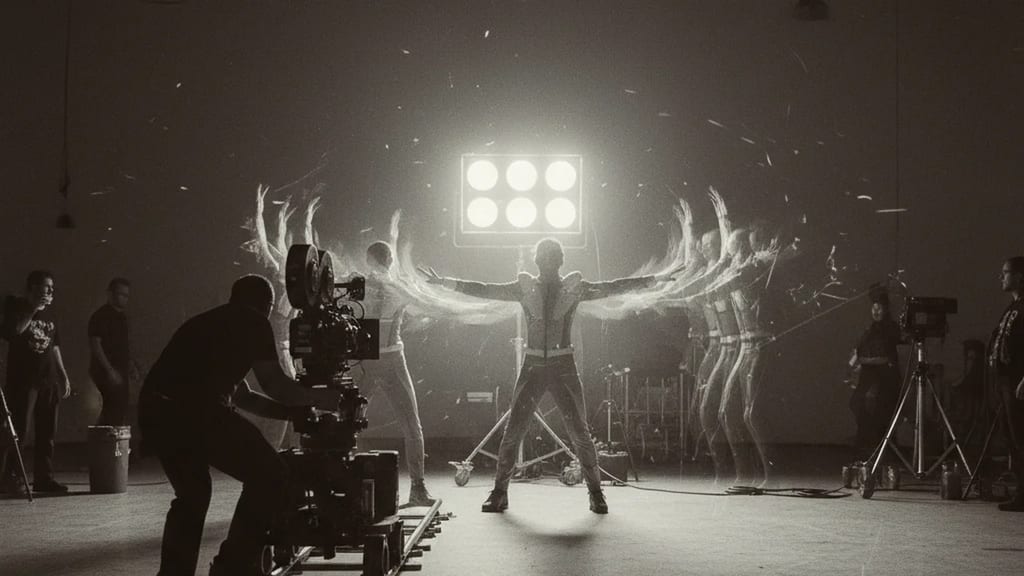
Rapid, rhythmic light pulses that break motion into discrete frozen frames, creating a stroboscopic or stop-motion appearance on set.
The Strobe Effect (German: Stroboskop-Effekt) does not refer to a specific brand or single device, but rather to a lighting effect: a rapid succession of short, intense, and regular flashes of light. When this pulsating stream of light hits a moving person or object, the continuous motion is visually broken down into a series of frozen snapshots. The eye perceives the movement as jerky or fragmented – the characteristic stop-motion or freeze-frame look.
The effect is produced by specially designed luminaires (strobes). Classically, these worked with a xenon flash tube (gas discharge), which emits a very bright, very short pulse of light per flash. In professional applications, LED strobes have largely prevailed today, offering more precise control via DMX and, in addition to pure flash operation, are usually also usable as continuous light and with color mixing. Many modern film and stage lights also have an integrated strobe function without being dedicated strobes.
The key parameters of a strobe effect are:
In professional environments, control is typically done via DMX512, usually through a dedicated channel for the strobe function. Important for camera work: The DMX protocol transmits its data packets at a comparatively low rate, which is why a clean, camera-compatible strobe should not be solely achieved by rapid dimming up and down via DMX. High-quality strobes therefore have an internal strobe engine that generates the flash timing within the fixture, decoupling it from fluctuations in the packet rate – this avoids uneven flash intervals.
In film, the Strobe Effect is used as a stylistic device – for example, for club, concert, and dance scenes, action and panic sequences, nightmare or horror moods, as well as for the deliberately choppy stop-motion look. A common set technique combines a strobe with a weaker continuous light against a dark background: the flash dominates the frozen moments, while the continuous light subtly outlines the movement in between.
A camera-specific challenge is the synchronization with the frame rate and shutter angle of the camera. If the flash frequency and exposure do not align, individual frames may appear with different brightness levels or flashes may be partially cut off. Depending on the desired look, the strobe is therefore either deliberately allowed to run freely or is synchronized with the camera as much as possible.
Strobe effects can trigger seizures in individuals with photosensitive epilepsy. A flash frequency of approximately 3 to 30 Hz is generally considered critical in the industry and should be avoided or used with caution in production design. On set, affected cast and crew members must be informed in advance; appropriate warning notices are customary for releases. Additionally, sufficient warning and break times, as well as the heat and power consumption of the devices, must be considered.
Aus DoP-Perspektive ist dieses Element essentiell für die visuelle Gestaltung. Es ermöglicht mir die gewünschte Farbstimmung und das ästhetische Bild konsistent umzusetzen.
Diese professionelle Lösung erhöht die Produktionseffizienz und reduziert Post-Production-Anforderungen. Sie ermöglicht flexible, schnelle Anpassungen während des Drehs.
Als Gaffer ist dies ein unverzichtbares Werkzeug meines täglichen Handwerkszeugs. Es ermöglicht mir professionelle Lichtkontrolle und schnelle Anpassungen auf Set, was Zeit spart und Qualität sichert.
1. Zu welchem Department gehört „Stroboskop-Effekt"?
2. Wie viele verschiedene Fachperspektiven bietet dieser Eintrag?
The Lexikon is part of the Filmfarm ecosystem — alongside budgeting (FilmBalance), an industry magazine (FilmCircus) and crew networking (FilmCall, CrewMesh). One shared vocabulary for the whole production.