Cinematographer
Aus DoP-Perspektive ist dieses Element essentiell für die visuelle Gestaltung. Es ermöglicht mir die gewünschte Farbstimmung und das ästhetische Bild konsistent umzusetzen.
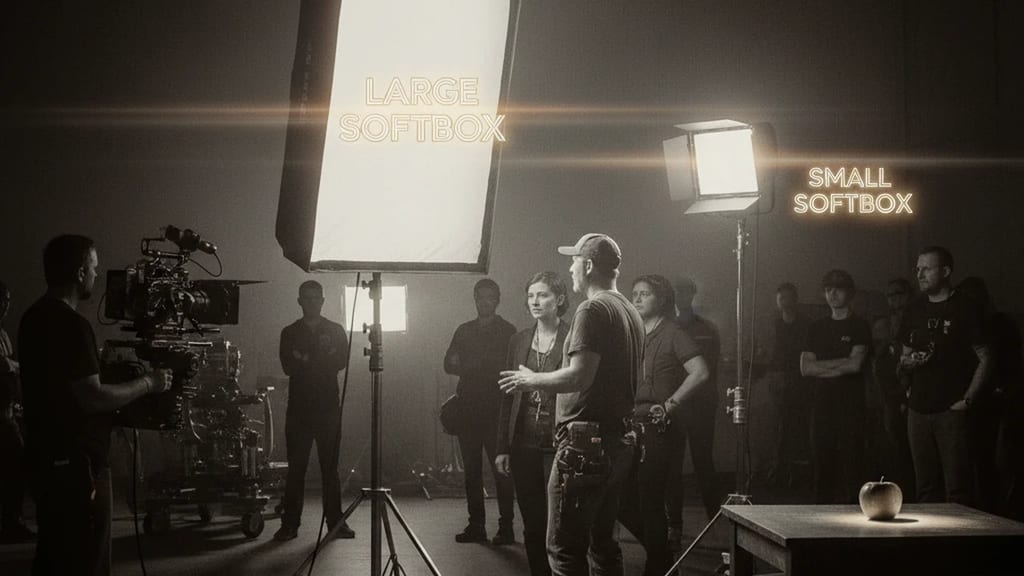
The physical size of a softbox determines light quality: larger light sources relative to subject produce softer shadows and gradients.
Softbox Size refers to the physical dimensions of a softbox's light-emitting surface – that is, the measurements of the diffusion material through which the light exits. This measurement is the most crucial factor in determining whether a softbox produces soft or hard light. General rule: The larger the illuminated surface appears relative to the subject, the softer the light becomes, and the smoother the transition from light to shadow.
What matters is not the absolute size, but the apparent size from the subject's perspective. A small softbox placed close to the subject can produce the same softness as a large softbox at a greater distance – with the difference that the light fall-off (Inverse-Square Law) is significantly faster with the close, small source.
The choice of size is always a compromise between light character, throw, and set space:
| Size Class | Light Character | Typical Use |
|---|---|---|
| Small / Strip | Higher contrast, harder shadow edges | Edge and contour light, product, tight accents |
| Medium | Balanced softness, versatile | All-round key light, interviews, portrait |
| Large / Octa | Very soft wrap, gentle gradients | Broad actor lighting, soft key, full body |
As a rule of thumb, the size should be roughly adapted to the area of the subject to be illuminated: smaller boxes are sufficient for head or medium close-up shots, while larger sources or multiple units are used for full body shots or larger areas.
Size and distance work together. When a softbox is brought closer to the subject, its apparent size increases and the light becomes softer – when it is pulled further away, it shrinks from the subject's perspective and the shadows become harder. At the same time, distance regulates brightness and, above all, the steepness of the light fall-off according to the inverse-square law: a large source allows for greater distance with consistently soft light, thus providing more even illumination across the depth of the scene.
When planning on set, softbox size is chosen based on the desired light character, available space, and the desired amount of light. Larger softboxes absorb more light and require correspondingly more powerful lights, but are less sensitive to small positional changes of the talent. Smaller boxes are lighter, quicker to position, and more controllable, but produce harder light and faster fall-off at the same distance.
Aus DoP-Perspektive ist dieses Element essentiell für die visuelle Gestaltung. Es ermöglicht mir die gewünschte Farbstimmung und das ästhetische Bild konsistent umzusetzen.
Diese professionelle Lösung erhöht die Produktionseffizienz und reduziert Post-Production-Anforderungen. Sie ermöglicht flexible, schnelle Anpassungen während des Drehs.
Als Gaffer ist dies ein unverzichtbares Werkzeug meines täglichen Handwerkszeugs. Es ermöglicht mir professionelle Lichtkontrolle und schnelle Anpassungen auf Set, was Zeit spart und Qualität sichert.
1. Zu welchem Department gehört „Softbox-Größe"?
2. Wie viele verschiedene Fachperspektiven bietet dieser Eintrag?
The Lexikon is part of the Filmfarm ecosystem — alongside budgeting (FilmBalance), an industry magazine (FilmCircus) and crew networking (FilmCall, CrewMesh). One shared vocabulary for the whole production.