Filmlexikon.
Support
Sigma FF Zoom
Camera · Equipment

Sigma FF Zoom

Murnau AI illustration
arri signature zoom canon flex zoom contra zoom dolly zoom dzofilm catta zoom hitchcock zoom leitz zoom zeiss compact zoom

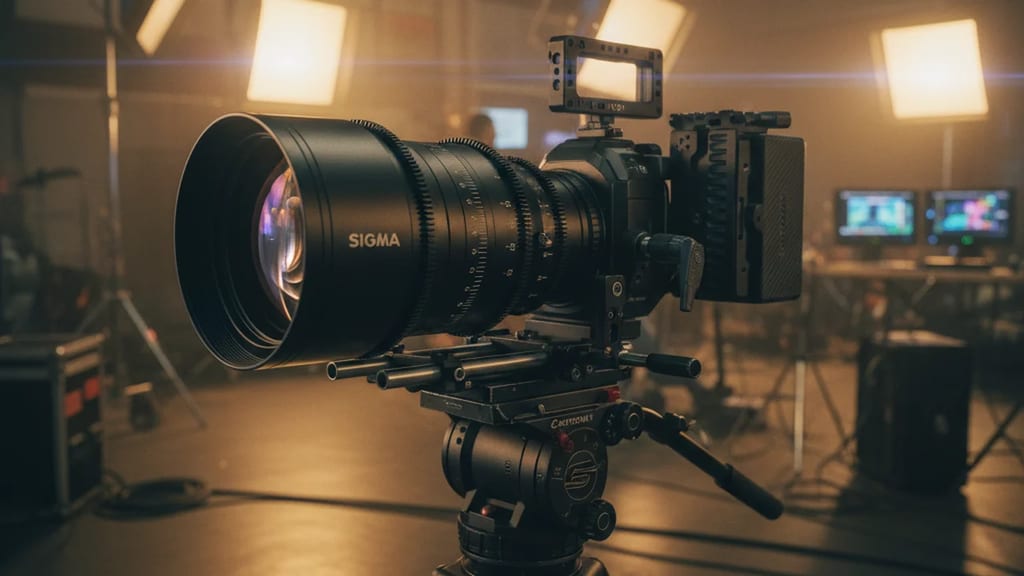
Sigma FF Zoom lenses offer constant T-stops (T1.5 at 18–35mm, T2.0 at 50–100mm) with 0.8 mod gears for follow focus systems as a budget-friendly cinema zoom alternative.

Technical Details

The Sigma 18-35mm T1.5 FF achieves a constant aperture of T1.5 across the entire zoom range, weighing 1.73kg with a 114mm filter diameter. The focus ring rotates 270° with a precise minimum focus distance of 0.3m. The 50-100mm T2.0 FF offers a constant T2.0 aperture and an 82mm filter thread at a weight of 1.49kg. All FF Zooms feature standardized 0.8 pitch gears for follow focus systems, internal focusing, and chromatic aberration correction through FLD and SLD glass elements.

History & Development

Sigma introduced the first 18-35mm F1.8 DC HSM Art for DSLR cameras in 2013, before the cinematic FF variant with T-stops followed in 2016. In 2017, Sigma expanded the series with the 50-100mm T2.0 FF. The lenses were developed in response to the growing demand for cost-effective alternatives to established cine zoom manufacturers like Angenieux or Fujinon. In 2019, the more compact 18-50mm T2.0 FF followed for lighter camera setups.

Practical Use in Film

Sigma FF Zooms are used in independent productions and Netflix series due to their price-performance ratio and high optical quality. The 18-35mm is suitable for handheld work in available light thanks to its T1.5 aperture. Documentary filmmakers appreciate the minimal breathing during zoom movements while shooting. The lenses fully cover Super 35mm, but vignette on full-frame sensors above 28mm focal length.

Comparison & Alternatives

Compared to Zeiss Compact Zooms, Sigma FF lenses offer higher light transmission at a third of the cost, but do not achieve their sharpness performance in the edge areas. Canon CN-E Zooms deliver comparable image quality at double the price and with better build quality. For budget productions, the Sigma FF Zooms represent an alternative to more expensive cine zooms, while high-end productions continue to rely on established manufacturers.
From the crafts

Perspectives

Cinematographer

Ich nutze das Sigma 18-35mm T1.5 FF hauptsächlich für Low-Light-Szenen, wo ich die offene Blende voll ausreizen kann - die Schärfeleistung bleibt auch bei T1.5 sehr gut. Der präzise Fokusring mit 270° Rotation gibt mir die Kontrolle für sanfte Schärfeverlagerungen, nur in den Ecken wird es bei offener Blende etwas weich.

Director

Mit dem konstanten T-Wert über den gesamten Zoombereich kann ich während der Aufnahme zoomen, ohne dass sich die Belichtung ändert - das gibt mir mehr Freiheit für spontane Bildkompositionen. Die geringe Atemschwankung ermöglicht es mir, Fokus-Pulls und Zooms gleichzeitig einzusetzen, ohne dass der Bildausschnitt ungewollt wandert.

Producer

Ein Sigma 18-35mm FF kostet etwa 8.000€ versus 25.000€ für einen vergleichbaren Zeiss Compact Zoom - bei 80% der optischen Leistung spare ich pro Drehtag erhebliche Equipmentkosten. Die robusten Gehäuse reduzieren Ausfallrisiken, und die Verfügbarkeit bei Verleihhäusern ist mittlerweile europaweit gegeben.

More in the lexikon

Related terms

Test your knowledge

Quiz

1. Was beschreibt „Sigma FF Zoom" am besten?

2. Zu welchem Department gehört „Sigma FF Zoom"?

3. Wie viele verschiedene Fachperspektiven bietet dieser Eintrag?

Report an error
From the Filmfarm ecosystem

Understand visual language, budget productions, connect crew.

The Lexikon is part of the Filmfarm ecosystem — alongside budgeting (FilmBalance), an industry magazine (FilmCircus) and crew networking (FilmCall, CrewMesh). One shared vocabulary for the whole production.

FilmFarm FilmRadarComing soonFilmPulseComing soonFilmNumbersComing soonFilmCapitalComing soonFilmLabComing soonFilmBalanceComing soonFilmCircusComing soon