Filmlexikon.
Support
Reaction Cut
Directing · Terms

Reaction Cut

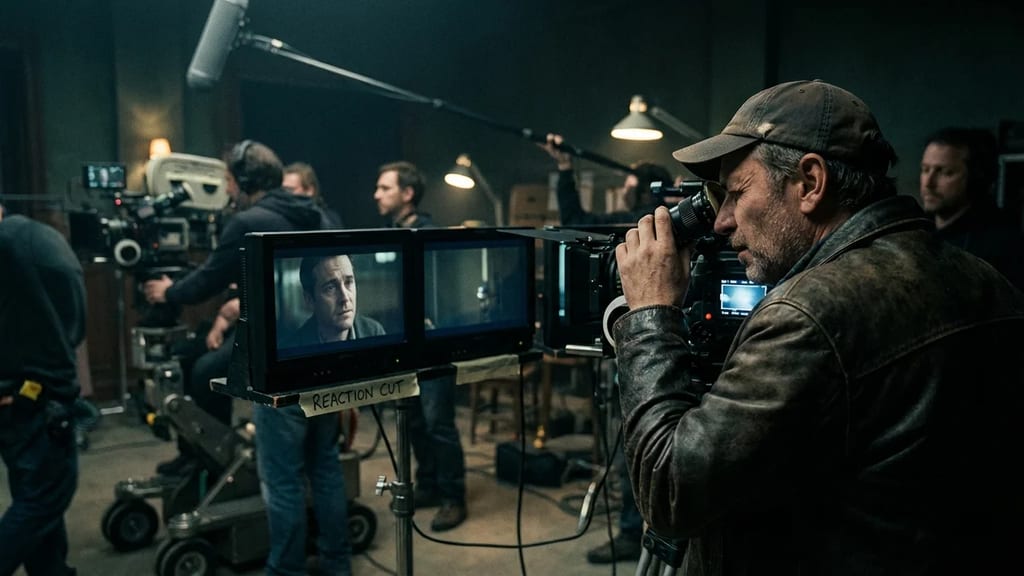
Murnau AI illustration
axial cut cross cut cross cutting cut cutter cutting on dialogue cutting on movement cutting rhythm

Cut to a character's reaction following an action or dialogue, typically shot in medium close-up to extreme close-up.

Technical Details

The reaction cut is usually shot in medium close-up to extreme close-up framing to precisely capture facial expressions. The camera is often set to a focal length of 85-135mm for a 35mm format to ensure natural proportions. Three main variants exist: the direct reaction cut (immediately following), the delayed (after 2-5 seconds), and the anticipatory (before the triggering action). The editing rhythm typically follows a 2:1 pattern – two seconds of action, one second of reaction.

History & Development

D.W. Griffith systematically used reaction cuts for emotional emphasis for the first time in "The Birth of a Nation" in 1915. In 1925, Sergei Eisenstein developed the theoretical foundation of dialectical montage through action-reaction chains with "Battleship Potemkin." Hollywood studios standardized the technique in the classic continuity system starting in 1930. François Truffaut revolutionized the spontaneous reaction cut with handheld camera use in "The 400 Blows" in 1959. Digital editing systems have enabled more precise frame-level timing control since 1995.

Practical Application in Film

A classic application can be found in Sergio Leone's "Once Upon a Time in the West" (1968) – the 12-minute opening sequence consists of 60% reaction cuts to ambient sounds. In dialogue scenes, the standard shot/reverse-shot pattern is used with inserted reactions from the non-speaking character. Horror films utilize the "startle cut" – a reaction cut after a shock moment, lasting 0.5-1 second. Comedy genres rely on "double takes" – a second reaction from the same person in an identical shot.

Comparison & Alternatives

The insert shot shows details rather than emotions, while the cutaway distracts from the main action. The master shot technique completely foregoes reaction cuts in favor of choreographed camera movements. Split-screen techniques show action and reaction simultaneously in a divided frame. Modern Steadicam operation replaces static reaction cuts with fluid camera pans between actors. The choice depends on the desired rhythm: reaction cuts accelerate the editing pace to 15-25 cuts per minute, whereas long takes remain under 5 cuts.

From the crafts

Perspectives

Cinematographer

Ich plane Reaktionsschnitte bereits beim Coverage-Shooting mit und verwende meist 85mm-135mm Brennweiten für natürliche Gesichtsproportionen. Die Beleuchtung muss konsistent zur Hauptszene bleiben, weshalb ich oft separate Setups mit angepasster Lichtführung fahre. Bei spontanen Reaktionen nutze ich zwei Kameras parallel - eine für die Haupthandlung, eine für kontinuierliche Reaktions-Coverage.

Director

Ich setze Reaktionsschnitte gezielt als emotionale Verstärker ein, besonders bei subtilen Wendepunkten in der Charakterentwicklung. Timing ist entscheidend - zu frühe Reaktionsschnitte nehmen der Haupthandlung die Wirkung, zu späte durchbrechen den emotionalen Fluss. Bei Komödien lasse ich bewusst eine halbe Sekunde Pause vor dem Reaktionsschnitt, um die Pointe zu verstärken.

Producer

Reaktionsschnitte verlängern die Drehzeit um durchschnittlich 15-20%, da zusätzliche Setups und Wiederholungen für verschiedene Reaktionsnuancen nötig sind. Ich kalkuliere pro Dialogszene 30 Minuten extra für Reaktions-Coverage ein. In der Postproduktion sparen sie jedoch Zeit, da Schnittfehler durch Reaktionseinschübe kaschiert werden können, was kostspielige Nachdrehe vermeidet.

More in the lexikon

Related terms

Test your knowledge

Quiz

1. Was beschreibt „Reaktionsschnitt" am besten?

2. Zu welchem Department gehört „Reaktionsschnitt"?

3. Wie viele verschiedene Fachperspektiven bietet dieser Eintrag?

Report an error
From the Filmfarm ecosystem

Understand visual language, budget productions, connect crew.

The Lexikon is part of the Filmfarm ecosystem — alongside budgeting (FilmBalance), an industry magazine (FilmCircus) and crew networking (FilmCall, CrewMesh). One shared vocabulary for the whole production.

FilmFarm FilmRadarComing soonFilmPulseComing soonFilmNumbersComing soonFilmCapitalComing soonFilmLabComing soonFilmBalanceComing soonFilmCircusComing soon