Technical Details
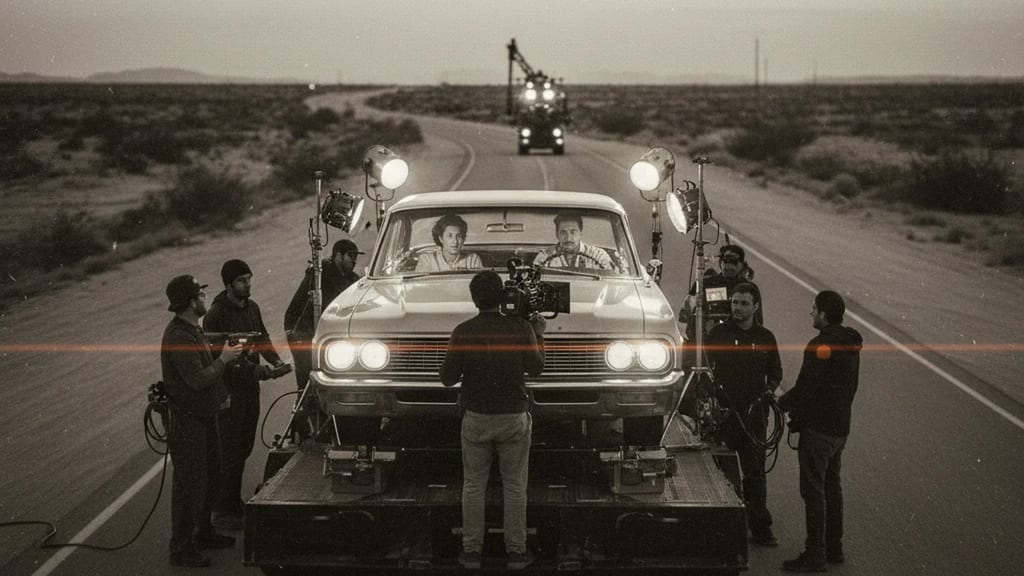
Modern process trailers achieve speeds of up to 80 km/h and feature hydraulic stabilization systems with ±15cm height adjustment. Rear projection is handled by 15,000-20,000 lumen projectors with 4K resolution. The carrier system consists of a 12-16 meter long low-loader with a reinforced chassis and a separate 125kVA generator. The screen uses special translucent material with a 1.8-2.2 gain factor for optimal light reflection. Three main variants exist: the standard process trailer for car shots, the poor man's process for budget productions with a smaller 3x2m screen, and the wide-screen process trailer with up to an 8x3m projection area for widescreen shots.
History & Development
The first process trailer system was developed in 1930 by Farciot Edouart for Paramount Pictures to replace the failure-prone studio rear projection. In 1935, the system became industry-standard after its success in "The Lives of a Bengal Lancer." In the 1950s, MGM introduced hydraulic stabilization, followed by the introduction of widescreen systems for CinemaScope productions in 1967. Since 2010, digital LED walls have increasingly replaced classic projection technology, while virtual production with LED volumes has dominated high-end productions since 2019.
Practical Use in Film
The system found classic application in "North by Northwest" (1959) for chase scenes, and in "Bullitt" (1968) for combined real/process shots. The trailer allows for controlled lighting conditions and wind speed while ensuring safety for expensive actors. A typical workflow involves background plates shot via a phantom ride with identical optics, followed by studio integration with a vehicle mock-up on set. Disadvantages include synchronization issues between vehicle movement and the background, as well as reflections in car windows under unfavorable lighting conditions.
Comparison & Alternatives
In contrast to static rear projection in the studio, the process trailer offers authentic vehicle vibrations and variable viewing angles. Car rigs on public roads are increasingly replacing process trailers for a documentary style, while green screen setups offer maximum post-production flexibility. LED walls like SkyPanels have provided superior color reproduction without projection hotspots since 2018. Virtual production stages use 270° LED volumes with real-time rendering for the highest image quality, but cost €50,000-€80,000 per shooting day compared to €8,000-€12,000 for classic process trailers.