Cinematographer
Aus DoP-Perspektive ist dieses Element essentiell für die visuelle Gestaltung. Es ermöglicht mir die gewünschte Farbstimmung und das ästhetische Bild konsistent umzusetzen.
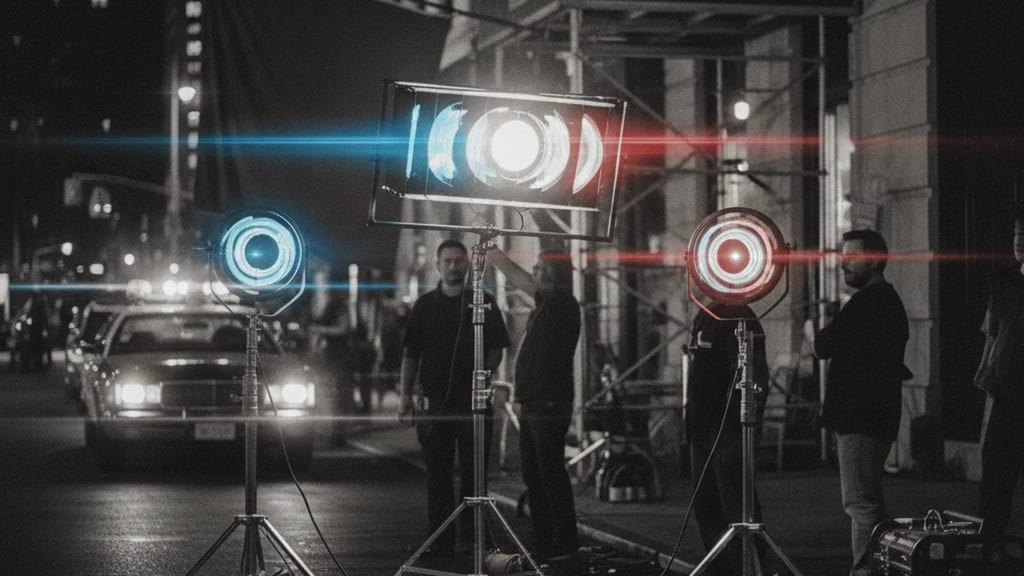
Strobe effect alternating red and blue light to simulate police vehicle emergency lights.
The Police Effect (also known as "Cop Light Effect", "Police Car Light Gag", or in US slang "Whirligig"/"Whirly-Gag") is not a single device, but a lighting effect: it mimics the pulsating, rotating lights of emergency vehicles – the red-blue flashing of police, fire, or ambulance vehicles. It is used to flood a scene with the impression of an approaching or stationary emergency vehicle, without the vehicle itself needing to be in the frame.
In Europe, pure blue lights dominate, while North American productions typically use the classic red-blue combination. The effect characteristically creates moving cones of light across walls, ceilings, and faces, and is preferably generated practically on set because the reflections and movement on real surfaces are difficult to achieve credibly in post-production.
Several methods have become established for the Police Effect:
To make the effect appear credible, the pulse frequency (typically in the single-digit Hertz range, often approx. 1–4 Hz), color, and intensity are adjusted to the scene. Programmable dimmer consoles or the fixture's own app allow for smooth panning and pulsing without motor noise – an advantage over purely mechanically spun rigs when recording live sound.
When using the camera, attention must be paid to the interplay between the flashing frequency and the shutter: rolling shutter sensors can show banding or partial exposures with harsh strobe patterns. Softer pulsing (instead of hard on/off) and synchronizing frequency and exposure time reduce such artifacts.
Aus DoP-Perspektive ist dieses Element essentiell für die visuelle Gestaltung. Es ermöglicht mir die gewünschte Farbstimmung und das ästhetische Bild konsistent umzusetzen.
Diese professionelle Lösung erhöht die Produktionseffizienz und reduziert Post-Production-Anforderungen. Sie ermöglicht flexible, schnelle Anpassungen während des Drehs.
Als Gaffer ist dies ein unverzichtbares Werkzeug meines täglichen Handwerkszeugs. Es ermöglicht mir professionelle Lichtkontrolle und schnelle Anpassungen auf Set, was Zeit spart und Qualität sichert.
1. Zu welchem Department gehört „Polizei-Effekt"?
2. Wie viele verschiedene Fachperspektiven bietet dieser Eintrag?
The Lexikon is part of the Filmfarm ecosystem — alongside budgeting (FilmBalance), an industry magazine (FilmCircus) and crew networking (FilmCall, CrewMesh). One shared vocabulary for the whole production.