Filmlexikon.
Support
Photosite
Camera · Technique

Photosite

Murnau AI illustration
stativkamera ps technik positive positive stock ps technik skater scope ps technik rehousing product shot

Individual light-sensitive element on a camera sensor, often confused with pixel.

Overview

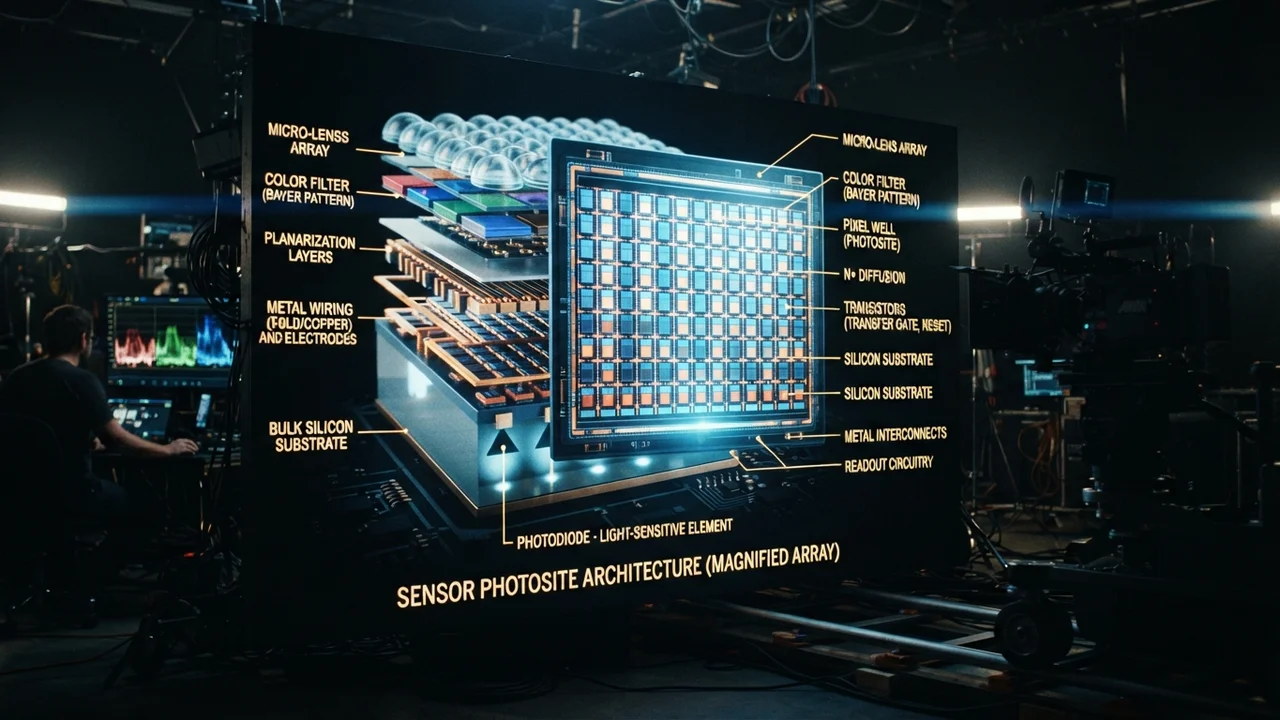
A photosite (also "sensel," from sensor element) is the smallest light-sensitive structural unit of a digital image sensor (CMOS or CCD). Millions of these cells are arranged in a grid on the sensor of a cinema or still camera. Each photosite collects incoming light and converts it into an electrical charge – the physical basis of every digital recording.

Important for understanding on set: A photosite is not the same as a pixel. The photosite is a physical component on the sensor; the pixel only emerges after conversion and processing (demosaicing) as a digital image point. As long as the signal is analog, one correctly speaks of photosites, not pixels.

Structure of a Photosite Cell

A single photosite cell typically consists of several superimposed layers:

  • Microlens: Funnels incoming light onto the light-sensitive area, thereby increasing light efficiency.
  • Color Filter: In color sensors, each cell is covered by a red, green, or blue filter (Color Filter Array). The Bayer pattern, which contains twice as many green filters as red or blue filters, is common.
  • Photodiode: The actual light-sensitive element that converts photons into electrical charge.
  • Readout Circuit: Associated electronics that pass on the collected charge.

Since a single photodiode is colorblind and only measures brightness, the color filter creates the color information. The missing color values for each image point are later interpolated from neighboring cells (demosaicing).

Significance on Set

The size of the photosites is a key parameter for image quality and thus also for lighting planning:

  • Light Sensitivity: Larger photosites collect more light and deliver a lower-noise image in low light or at high ISO values – relevant for low-light shoots and tight lighting setups.
  • Dynamic Range: The amount of charge a cell can store maximally (Full Well Capacity) depends on its physical size and, in part, determines how bright a detail can be before it clips.
  • Resolution vs. Sensitivity Trade-off: For a given sensor area, more photosites mean higher resolution but smaller individual cells. Conversely, more sensitivity and dynamic range require larger, and therefore typically fewer, cells. This explains why some cinema cameras deliberately opt for moderate resolution with large photosites.

In practice, this means: A sensor with large photosites is more forgiving of scarce light and gives lighting more leeway, while very high-resolution sensors with small cells demand more light or more careful exposure.

From the crafts

Perspectives

Cinematographer

Ich wähle Kameras bewusst nach Photosite-Größe aus – für "The Crown" nutze ich die ALEXA LF mit ihren großen 5,86 μm Photosites, weil sie mir zwei Blendenstufen mehr Spielraum in den Kerzenlicht-Szenen geben. Bei Actionsequenzen mit High-Speed-Aufnahmen muss ich den Lichtverlust durch kleinere effektive Belichtungszeiten pro Photosite kompensieren und gehe oft auf 3200 ISO statt meiner üblichen 800.

Director

Für mich bestimmt die Photosite-Technologie den Look meiner Filme – die organische Unschärfe großer Photosites bei schwachem Licht erzeugt eine intimere Stimmung als das harte Digital-Rauschen kleiner Sensoren. Bei "Moonlight" nutzte ich bewusst die großen Photosites der ARRI ALEXA, um diese weiche, träumerische Bildsprache zu erreichen, die mit hochauflösenden 8K-Sensoren technisch unmöglich gewesen wäre.

Producer

Photosite-Größe beeinflusst direkt meine Beleuchtungskosten – Kameras mit großen Photosites sparen mir 30-40% der Lighting-Trucks bei Night-Shoots. Allerdings kosten 4K-Sensoren mit großen Photosites wie die ALEXA LF 2.800€ pro Drehtag versus 1.200€ für eine Standard-ALEXA. Bei 40 Drehtagen macht das 64.000€ Mehrkosten, die sich aber durch reduzierte Grip- und Gaffer-Teams oft amortisieren.

More in the lexikon

Related terms

Test your knowledge

Quiz

1. Was beschreibt „Photosite" am besten?

2. Zu welchem Department gehört „Photosite"?

3. Wie viele verschiedene Fachperspektiven bietet dieser Eintrag?

Report an error
From the Filmfarm ecosystem

Understand visual language, budget productions, connect crew.

The Lexikon is part of the Filmfarm ecosystem — alongside budgeting (FilmBalance), an industry magazine (FilmCircus) and crew networking (FilmCall, CrewMesh). One shared vocabulary for the whole production.

FilmFarm FilmRadarComing soonFilmPulseComing soonFilmNumbersComing soonFilmCapitalComing soonFilmLabComing soonFilmBalanceComing soonFilmCircusComing soon