Technical Details
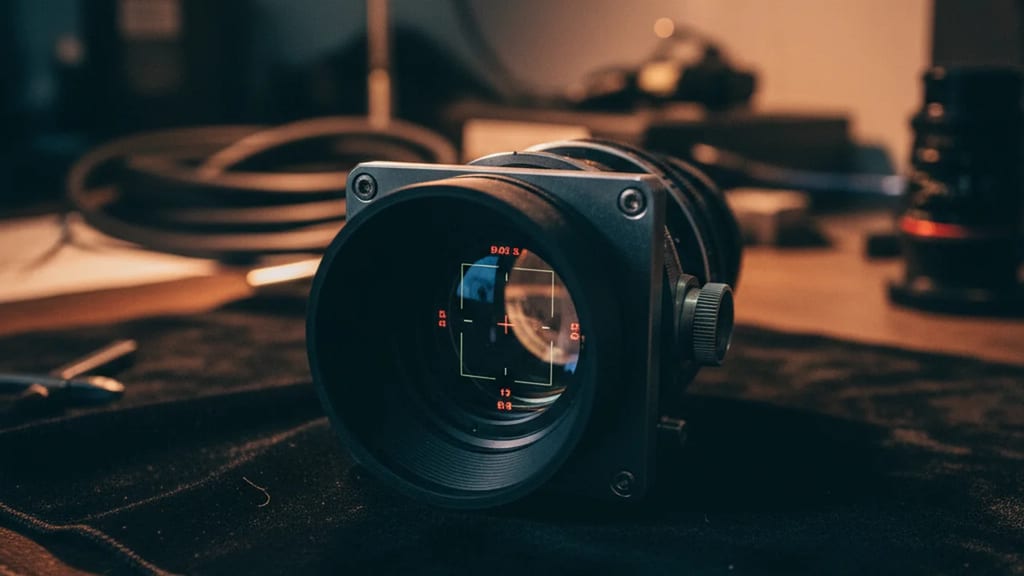
Optical viewfinders typically work with a magnification of 0.7x to 1.0x and achieve coverage of 90-100% of the actual image frame. Pentaprism designs in professional 35mm cameras like the Arriflex 35 III offer an exit pupil of 20-25mm with an eye relief of 15-20mm. Light transmission in high-quality systems ranges between 92-95%. Modern variants integrate diopter adjustment from -3 to +2 dpt and interchangeable focusing screens with various focusing aids such as a microprism ring or a split-image indicator.
History & Development
Arnold & Richter introduced the first practical single-lens reflex viewfinder for 35mm film cameras with the Arriflex 35 in 1937. This revolutionary approach enabled parallax-free operation with handheld cameras for the first time. In 1952, the Arriflex 16ST followed with an improved viewfinder system. In 1965, Panavision developed the Spinning Mirror system with the Panaflex, which allowed continuous viewing during shooting with a 180° shutter. The integration of video tap systems in the 1970s complemented optical viewfinders but did not fully replace them.
Practical Use in Film
Roger Deakins consciously used optical viewfinders for the complex Steadicam sequences in "1917" (2019), as the lag-free display enabled more precise camera movements. Vittorio Storaro relied on the optical viewfinders of Panaflex cameras for night shots in "Apocalypse Now" (1979), as they offered significantly cleaner image control in low light than early video taps. The workflow requires precise focusing screen calibration and regular adjustment of the mirror position, especially when changing lenses with different flange focal distances.
Comparison & Alternatives
Compared to electronic viewfinders (EVF), optical systems offer no latency, consume no power, and function more reliably at extreme temperatures. However, EVFs enable exposure preview, histogram display, and magnification for precise focusing. LCD monitors are increasingly replacing viewfinders for static shots, while high-resolution OLED viewfinders like the Zacuto Kameleon combine the advantages of both systems. Optical viewfinders remain standard for documentary handheld work and under extreme conditions where electronics might fail.