Filmlexikon.
Support
OLED Monitor
Camera · Equipment

OLED Monitor

Murnau AI illustration
client monitor electronic viewfinder evf on camera monitor optical viewfinder reference monitor flow

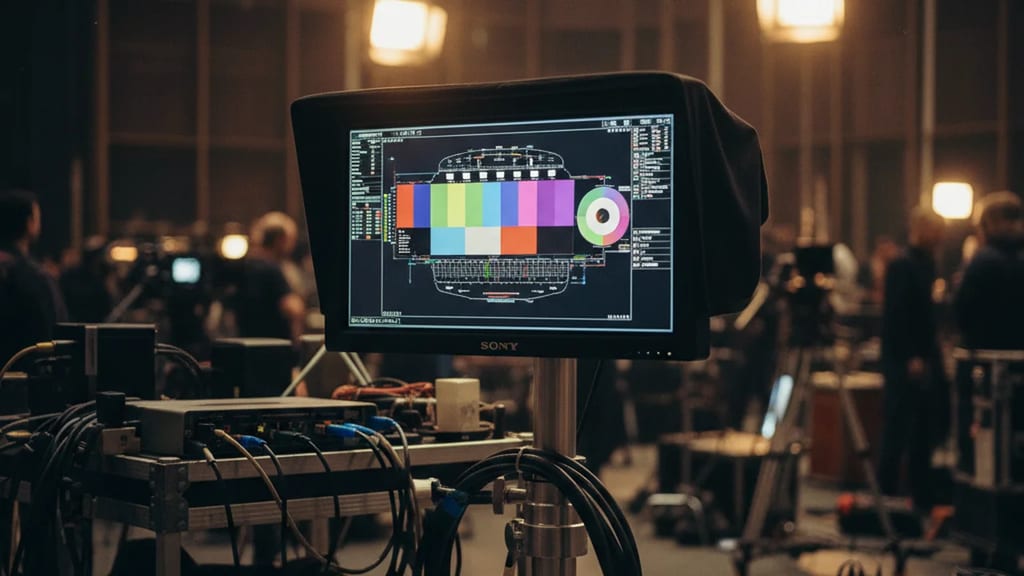
OLED monitor with organic light-emitting diodes delivering 0.0001 nits true blacks without backlight. Pixel-accurate black rendering for HDR mastering and color grading in DI suites.

Technical Details

Professional OLED monitors achieve peak brightness between 400-1000 nits with a black level of 0.0001 nits. The response time is under 0.1 milliseconds, significantly faster than LCD panels with 1-5 milliseconds. Current film production monitors offer 10-bit color depth and cover 99% of the DCI-P3 color space and 95% of Rec.2020. OLED panels work with three subpixel types: red, green, and blue organic molecules embedded in a thin layer between two electrodes. White OLED variants (WOLED) use additional color filters for more precise color reproduction.

History & Development

Sony launched the first commercial OLED monitor, the 11-inch XEL-1, in 2007. LG introduced the first large-format OLED TV in 2013, followed by professional broadcast monitors from 2016. Panasonic established OLED reference monitors for color grading with its BT series in 2018. Lifespan increased from an initial 5000 to over 100,000 hours today at half brightness. Burn-in issues of earlier generations have been minimized through pixel shifting and automatic brightness adjustment.

Practical Use in Film

OLED monitors serve as references in DI (Digital Intermediate) suites for color grading and HDR mastering. "Blade Runner 2049" (2017) used OLED technology for precise representation of extreme contrasts between darkness and neon light during post-production. On set, 17-24 inch OLED monitors function as Director's Monitors or Video Assists for camera crews. The low latency allows for real-time monitoring without delay. For HDR (High Dynamic Range) workflows, OLED displays offer the necessary contrast representation for correct evaluation of Dolby Vision or HDR10 content.

Comparison & Alternatives

Unlike LCD monitors with LED backlighting, OLEDs provide pixel-accurate black levels without blooming effects. Mini-LED monitors with local dimming achieve similar contrasts at higher peak brightness (up to 4000 nits), but with a thicker design. MicroLED technology promises OLED picture quality without degradation of organic materials but remains cost-intensive. For critical color work, OLED monitors compete with calibrated LCD reference monitors from Eizo or FSI, which, however, do not achieve the native black levels.
From the crafts

Perspectives

Cinematographer

Ich schätze OLED-Monitore am Set für ihre präzise Schwarzwertdarstellung – endlich sehe ich exakt, ob meine Schatten durchgezeichnet sind oder absaufen. Die praktisch verzögerungsfreie Darstellung hilft mir bei schnellen Kamerabewegungen, da ich ohne Latenz beurteilen kann, ob der Fokus sitzt. Allerdings muss ich bei Außenaufnahmen die begrenzte Spitzenhelligkeit bedenken und den Monitor entsprechend abschatten.

Director

Mit OLED-Monitoren erkenne ich am Set sofort, ob die gewünschte Stimmung visuell ankommt – besonders bei Low-Key-Szenen mit subtilen Helligkeitsabstufungen. Die exakte Kontrastdarstellung zeigt mir, ob emotional wichtige Details in dunklen Bildbereichen noch sichtbar bleiben. Ich kann Schauspielern präzise zeigen, wie Licht und Schatten ihr Gesicht modellieren, was die Zusammenarbeit beim Blocking verbessert.

Producer

OLED-Monitore kosten 3000-15000 Euro je nach Größe, haben aber eine Lebensdauer von 8-10 Jahren bei professionellem Einsatz. Die Anschaffung rechnet sich durch eingesparte Korrekturrunden in der Post, da wir Bildprobleme bereits am Set erkennen. Ich kalkuliere jedoch Ersatzgeräte ein, da OLED-Panels empfindlicher auf mechanische Belastung reagieren als robuste Broadcast-Monitore.

More in the lexikon

Related terms

Test your knowledge

Quiz

1. Was beschreibt „OLED-Monitor" am besten?

2. Zu welchem Department gehört „OLED-Monitor"?

3. Wie viele verschiedene Fachperspektiven bietet dieser Eintrag?

Report an error
From the Filmfarm ecosystem

Understand visual language, budget productions, connect crew.

The Lexikon is part of the Filmfarm ecosystem — alongside budgeting (FilmBalance), an industry magazine (FilmCircus) and crew networking (FilmCall, CrewMesh). One shared vocabulary for the whole production.

FilmFarm FilmRadarComing soonFilmPulseComing soonFilmNumbersComing soonFilmCapitalComing soonFilmLabComing soonFilmBalanceComing soonFilmCircusComing soon