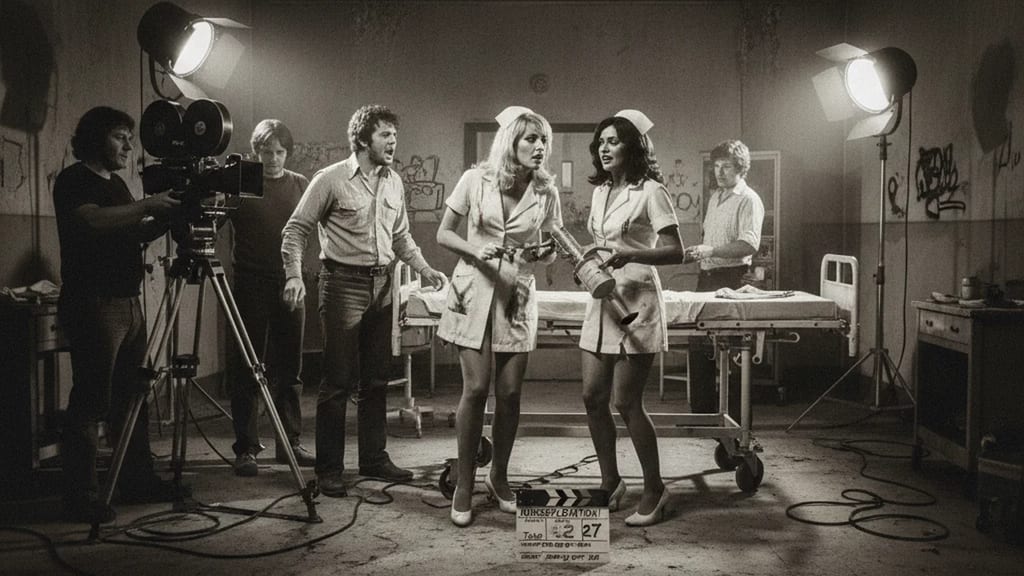
1970s B-movie subgenre — sexualized nurses in horror scenarios. Low-budget exploitation with nudity as marketing hook.
The seventies saw the emergence of a peculiar hybrid form that combined hospital settings with exploitation elements: low-budget films where the white coat costume was less work attire and more a marker. The calculation was brutally simple—sexualized nurses in horror or splatter contexts, nudity as a direct selling point on posters and in program guides. These productions ran parallel to the mainstream hospital wave (think established TV formats) but deliberately leveraged its ubiquity to justify B-movie budgets through genre hybridization.
The technical quality was low—overexposed, grainy color 16mm footage, if color film was used at all. Filming in actual available hospitals during night hours saved on set construction; often it was just two or three rooms, plus hallway scenes. The camerawork followed exploitation standards: close-ups on bodies, slow pans, minimal lighting for cost savings. Sound was post-dubbed or cheaply recorded live—often clearly audible through echo problems. Editing was functional, not elegance-oriented. Bloopers and continuity errors were simply left in if the scene achieved its goal.
The genre quickly disappeared again because visual effects and gore geometry became professionalized (see also: the development of the splatter film in the early eighties), and digital access options made the direct sale of nude scenes obsolete. Today, such films are curiosities—culturally historically interesting as a document of those production practices, but technically without substance. They show very precisely how exploitation logic functions: cost savings through sexualized staging instead of narrative quality, genre hybridization as a guise for cheap content recycling.
For students of low-budget strategies and exploitation aesthetics, the phenomenon remains insightful—less for artistic merit, but because it demonstrates how production constraints and market calculations directly translate into formal decisions (framing, lighting, editing rhythm).
Related terms
Quiz
1. Zu welchem Department gehört „Krankenschwestern-Exploitationfilm"?