Filmlexikon.
Support
Nikkor 35mm f/1.4
Camera · Technique

Nikkor 35mm f/1.4

Murnau AI illustration
flow para roll take

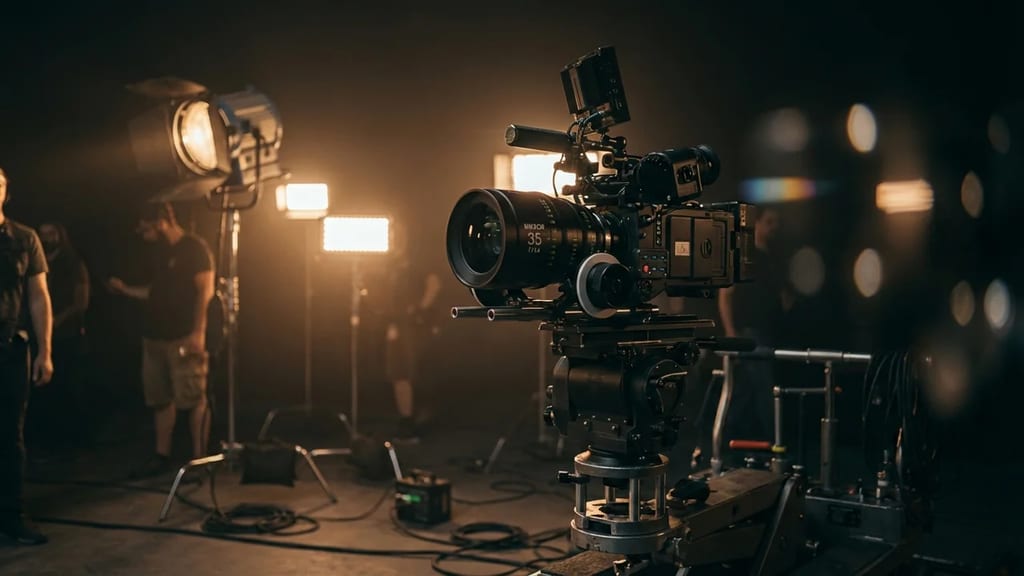
Fast Nikon wide-angle lens with f/1.4 maximum aperture — ideal for low-light shooting and shallow depth of field at 35mm.

Technical Details

The current AF-S version weighs 600 grams with a filter diameter of 67mm and a minimum focusing distance of 30 centimeters. The optical design comprises 10 elements in 7 groups, including two aspherical elements and one ED (Extra-low Dispersion) lens to correct chromatic aberrations. The Silent Wave Motor (SWM) enables near-silent autofocus with an adjustment speed of 0.2 seconds from infinity to close focus. The Nano Crystal Coat reduces reflections by up to 99% and prevents ghosting and flare.

History & Development

Nikon introduced the first Nikkor 35mm f/1.4 for the F-mount in 1970, designed as a manual AI lens. In 1988, the AF version with autofocus motor followed, and in 2010, the revised AF-S variant with improved optics and a faster focus motor. The Z-mount version for mirrorless cameras appeared in 2019 with a reduced weight of 415 grams and optimized edge sharpness. In parallel, an F1.8 S version has existed since 2020 as a more compact alternative.

Practical Use in Film

Roger Deakins used the Nikkor 35mm f/1.4 for interior sequences in "No Country for Old Men" (2007) to capture the natural lighting of Texan motels. The combination of wide-angle and fast aperture is particularly suitable for handheld shots in confined spaces as well as for available light situations without additional lighting. At its widest aperture, the lens produces a characteristic bokeh with 9 rounded aperture blades. Focus breathing is minimal, with a 3mm focal length shift between infinity and close focus.

Comparison & Alternatives

The Sigma 35mm f/1.4 Art offers comparable optical performance at 200 Euros less, but with a higher weight of 665 grams. The Canon RF 35mm f/1.8 IS Macro offers image stabilization and macro functionality at f/1.8. The Zeiss Distagon T* 35mm f/1.4 surpasses the Nikkor in edge sharpness and contrast, but costs twice as much. For productions with mixed camera systems, manufacturer-independent cine lenses like the Zeiss CP.3 35mm T2.1 are suitable.
From the crafts

Perspectives

Cinematographer

Ich nutze das Nikkor 35mm f/1.4 hauptsächlich für Available Light-Situationen, wo ich bei f/1.4 noch ISO 800 statt 3200 fahren kann - das bedeutet deutlich sauberere Bilder. Der schnelle Autofokus hilft mir bei dokumentarischen Arbeiten, während die geringe Naheinstellgrenze von 30cm interessante Perspektiven in beengten Räumen ermöglicht.

Director

Das 35mm gibt mir die perfekte Balance zwischen Weitwinkel-Dramatik und natürlicher Perspektive für emotionale Nahaufnahmen. Die große Blende bei f/1.4 isoliert Charaktere subtil vom Hintergrund, ohne die extreme Unschärfe einer 85mm - ideal für intensive Dialogszenen, wo ich den Raum noch spüren, aber den Fokus auf den Darsteller lenken will.

Producer

Mit 2.200 Euro liegt das Nikkor preislich zwischen Budget-Alternativen und Premium-Cine-Optiken, rechtfertigt aber den Aufpreis durch Zuverlässigkeit und Wiederverkaufswert. Das geringe Gewicht reduziert Gimbal- und Steadicam-Anforderungen, während die Kompatibilität zu älteren F-Mount Kameras Flexibilität bei gemischten Equipment-Parks bietet.

More in the lexikon

Related terms

Test your knowledge

Quiz

1. Zu welchem Department gehört „Nikkor 35mm f/1.4"?

2. Wie viele verschiedene Fachperspektiven bietet dieser Eintrag?

Report an error
From the Filmfarm ecosystem

Understand visual language, budget productions, connect crew.

The Lexikon is part of the Filmfarm ecosystem — alongside budgeting (FilmBalance), an industry magazine (FilmCircus) and crew networking (FilmCall, CrewMesh). One shared vocabulary for the whole production.

FilmFarm FilmRadarComing soonFilmPulseComing soonFilmNumbersComing soonFilmCapitalComing soonFilmLabComing soonFilmBalanceComing soonFilmCircusComing soon