Technical Details
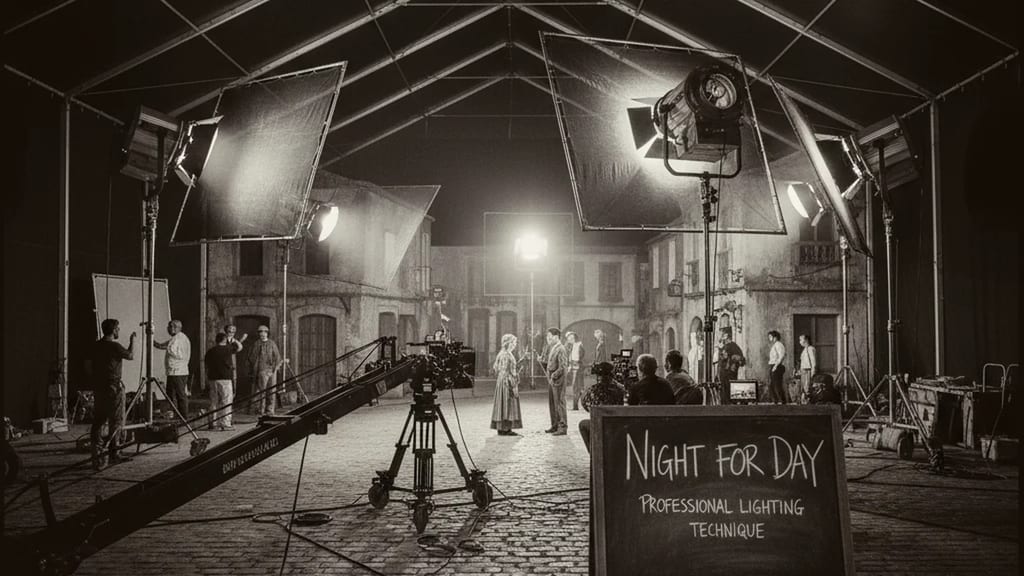
The classic night-for-day shot is achieved with an exposure correction of -2.5 to -4 EV compared to the daylight reading. Blue filters (CTB, Color Temperature Blue) with values between 1/4 and Full CTB shift the color temperature from 5600K to 3200-4500K. Polarizing filters eliminate reflections and enhance sky contrast. ND filters (Neutral Density) from 0.6 to 1.2 allow for severe underexposure at wide apertures. In the digital era, gray filters with a cyan component are often used, as color correction is more flexible in post-production.
History & Development
The technique developed in the 1930s out of necessity, as film emulsions had a light sensitivity of only ASA 25-50. The first documented applications can be found in 1932 in Howard Hawks' "Scarface." The term "Day for Night" became internationally established through François Truffaut's film of the same name in 1973. With the introduction of highly sensitive film emulsions from the 1980s onwards (Kodak Vision3 500T) and digital sensors with ISO values over 6400, the technique gradually lost importance for night shots but continues to be used for stylistic purposes.
Practical Use in Film
Steven Spielberg's "Jaws" (1975) used Day-for-Night extensively for the nocturnal shark sequences, as underwater shots in real night light were impossible. Mad Max: Fury Road deliberately employed the technique for the night chase to achieve maximum image sharpness and detail. The workflow requires careful planning: the sky must be excluded from the frame or obscured by objects, as it appears unnaturally bright even when underexposed. Practical light sources (car headlights, windows) are over-dimensioned by approximately 4-8 times to appear realistic after underexposure.
Comparison & Alternatives
In contrast to real night shots, Day-for-Night offers absolute depth of field and motion blur at short shutter speeds. Modern alternatives include LED arrays with 50,000+ lux output for real night lighting or high-ISO cameras like the Sony FX6 (native ISO 12800). Virtual Production with LED walls is increasingly replacing Day-for-Night, as skies and environments can be rendered photorealistically. Day-for-Night is chosen for complex action scenes, animal shots, or when natural lighting is impossible.