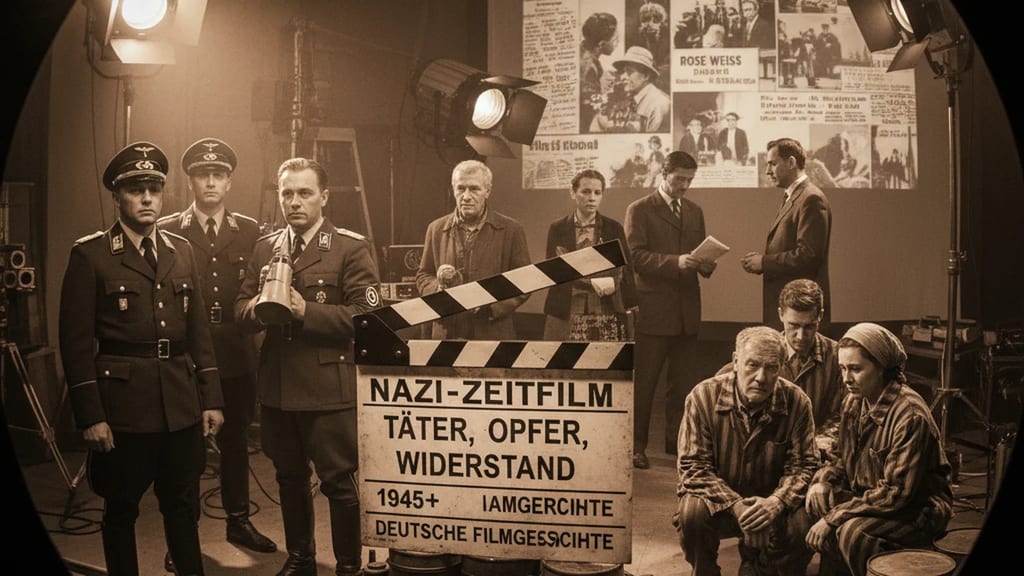
Fiction film addressing the Nazi era — perpetrators, victims, resistance as focal points. German cinema since 1945 grapples with this subject through varying lenses and debate.
The engagement with the Nazi era in feature films is not a genre in the classic sense — it is a constant negotiation of guilt, memory, and representational ethics that runs through German-language film history since 1945. Whether you are working with this material as a screenwriter, director, or editor, you immediately face the question: Who is telling this story, and from what perspective? The impact of a scene depends less on dramaturgical conventions than on how you position the viewer — should they identify, understand, condemn, or be horrified?
Early West German productions (1950s–60s) often dealt with the subject indirectly or through the lens of resistance — a kind of moral absolution for society. Later, from the 1970s onwards, the perspective sharpened: films like those by Fassbinder or Syberberg inquired about continuities, susceptibility, and the banality of evil. This was formally riskier, emotionally more burdensome. Today, you work with an audience that no longer accepts simple good-versus-evil narratives — the interest is directed towards ambivalences, perpetrator perspectives, survivor memories, and the question of how to visually convey the ineffable without aestheticizing it.
Practically, this means: when you use historical material — documentary footage, locations, props — you must not work decoratively. The camera itself becomes a medium of reflection. Some directors opt for distance and coldness (formal rigor, long takes), others for proximity and unease (found footage aesthetics, handheld camera). Both approaches have their justification, but without a clear stance, every tone sounds wrong. Music, for example, must not be manipulative; editing must remain transparent. And casting — who plays the perpetrator, who the victim? — is not a neutral choice.
In editing, you constantly work with the tension between historical authenticity and cinematic necessity. You ask: Do I show the atrocities directly or by implication? How long do I hold a shot? The answer does not depend on artifice rules, but on what emotional and intellectual reaction you expect — and whether you give the viewer space for processing. It is about responsibility in the editing itself.
Related terms
Quiz
1. Zu welchem Department gehört „Nazifilm"?