Filmlexikon.
Support
Lomo Round Front
Camera · Terms

Lomo Round Front

Murnau AI illustration
15lb sandbag 20 c stand 216 diffusion 250 diffusion 251 diffusion 25lb sandbag 35lb sandbag 40 c stand

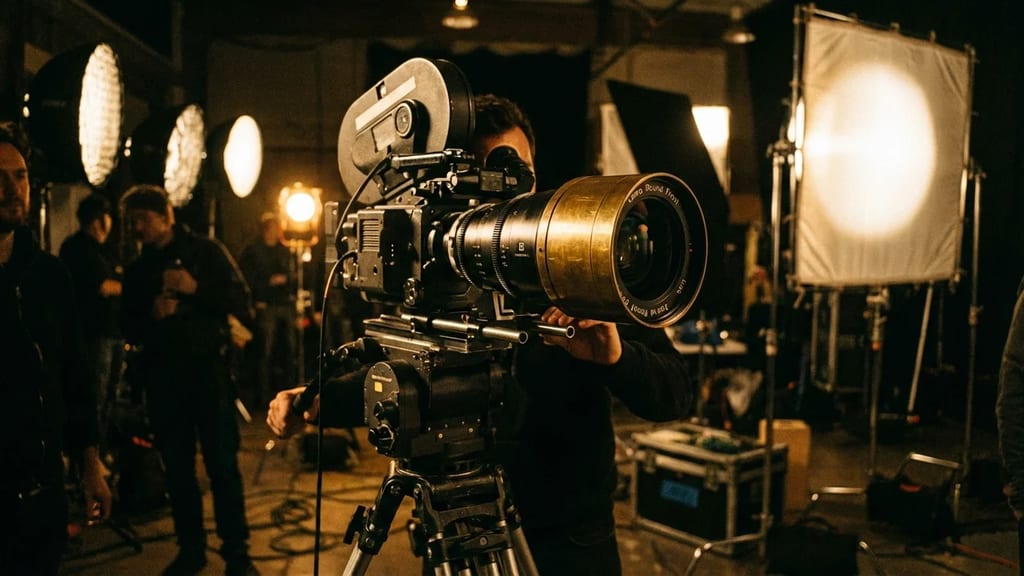
Soviet anamorphic lenses (1962–1985) by LOMO with T2.8–T3.5, distinctive blue lens flares and oval bokeh circles from 2.0x compression.

Technical Details

The Lomo Round Front series includes focal lengths from 35mm to 150mm with a constant aperture of T2.8-T3.5. The flange focal distance is 52mm for PL mount adaptations; they were originally designed for Soviet cameras with 45.5mm. The lenses weigh between 2.8kg (35mm) and 4.2kg (150mm) and measure 140-180mm in length. The front lens has a diameter of 95mm across all focal lengths. Characteristic features include blue lens flares, resulting from special multi-layer coating, as well as oval bokeh circles due to anamorphic compression.

History & Development

LOMO developed these lenses in 1962 for Soviet cinema as an alternative to Western CinemaScope systems from Panavision and Bausch & Lomb. Production ran until 1985, with approximately 2,000 units produced. After the collapse of the Soviet Union, many lenses found their way to the Western market. Since 2010, specialists like Iron Glass Adapters have been adapting them for modern PL mount cameras.

Practical Use in Film

Alejandro G. Iñárritu used Lomo Round Front lenses in "The Revenant" (2015) to enhance the raw wilderness atmosphere. The characteristic blue flares and soft rendering at wide apertures complemented the naturalistic available light scenes. The workflow requires de-squeezing in post-production with a de-squeeze factor of 2.0x. The shallow depth of field at T2.8 allows for strong subject isolation, while the oval bokeh circles lend the image a distinctive aesthetic.

Comparison & Alternatives

Compared to modern anamorphic lenses like the Panavision C-Series or ARRI Master Anamorphic, Lomo Round Front lenses exhibit stronger optical aberrations and less corrected distortion. While Zeiss Supreme Prime Radiance or Atlas Orion offer controlled lens flares, the Soviet lenses produce more unpredictable, organic effects. For clean-look productions, modern systems are better suited, whereas Lomo Round Front lenses remain indispensable for character-driven, artistic image looks.
From the crafts

Perspectives

Cinematographer

Ich verwende Lomo Round Front für Projekte, die eine organische, imperfekte Ästhetik brauchen - die blauen Flares und die weiche Zeichnung bei offener Blende geben mir einen Look, den ich mit modernen Objektiven nicht hinbekomme. Das Gewicht von über 3kg pro Objektiv macht Handheld-Aufnahmen anstrengend, aber auf dem Stativ sind sie absolut stabil und die Schärfeführung ist trotz des sowjetischen Baujahrs präzise genug für 4K-Produktionen.

Director

Diese Objektive transportieren für mich eine nostalgische, leicht melancholische Stimmung durch ihre charakteristischen optischen Eigenarten - perfekt für Period Pieces oder Geschichten, die eine gewisse Entrücktheit brauchen. Die unvorhersagbaren blauen Lens Flares entstehen nicht auf Knopfdruck wie bei digitalen Effekten, sondern reagieren organisch auf Lichtquellen und geben jeder Szene eine authentische, analoge Anmutung.

Producer

Ein Set kostet etwa 15.000-20.000 Euro, deutlich günstiger als moderne Anamorphic-Serien, aber die Beschaffung dauert oft Wochen und Ersatzteile sind rar. Die Objektivadaption für moderne Kameras muss ich zusätzlich einkalkulieren, und mein DoP braucht mehr Zeit für die Schärfeführung - unterm Strich rechtfertigt der einzigartige Look aber die zusätzlichen 10-15% Drehtage für ambitionierte Projekte.

More in the lexikon

Related terms

Test your knowledge

Quiz

1. Was beschreibt „Lomo Round Front" am besten?

2. Zu welchem Department gehört „Lomo Round Front"?

3. Wie viele verschiedene Fachperspektiven bietet dieser Eintrag?

Report an error
From the Filmfarm ecosystem

Understand visual language, budget productions, connect crew.

The Lexikon is part of the Filmfarm ecosystem — alongside budgeting (FilmBalance), an industry magazine (FilmCircus) and crew networking (FilmCall, CrewMesh). One shared vocabulary for the whole production.

FilmFarm FilmRadarComing soonFilmPulseComing soonFilmNumbersComing soonFilmCapitalComing soonFilmLabComing soonFilmBalanceComing soonFilmCircusComing soon