Overview
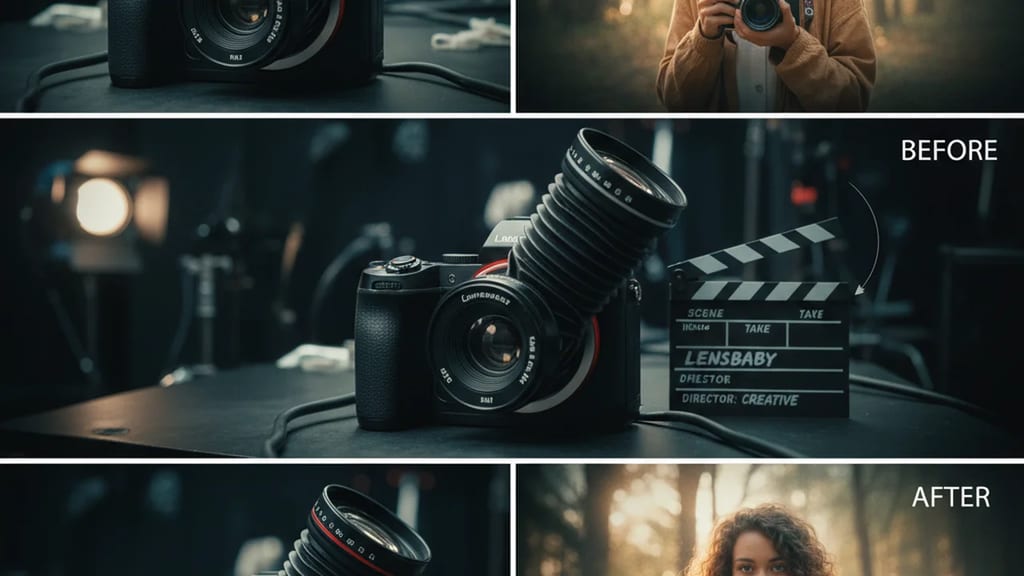
Lensbaby is a US-based lens manufacturer headquartered in Portland, Oregon, founded in 2004 by Craig Strong and Sam Pardue. The company does not produce lighting or grip equipment, but rather photo and video lenses for creative and selective-focus effects. Characteristic is a sharp "sweet spot" in the center of the image, surrounded by intentionally blurry, soft, or distorted edge areas – a look that cannot be achieved with classic, optically corrected lenses.
The term "Lensbaby" is often used generically on set for the look it produces ("shooting in Lensbaby style"), but strictly speaking refers to the brand or the respective product. Unlike a motorized tilt-shift lens, most Lensbabys operate purely manually.
Principle of Operation
Lensbaby lenses are consistently manual (manual focus, manual aperture). Two design principles are common:
- Tilt/Shift Mechanism: In the Composer series, the optics are housed in a ball-and-socket mount that can be tilted in any direction. Tilting shifts the sharp area out of the center of the image – similar to the Scheimpflug principle of a tilt lens, but controllable freehand.
- Optic Swap System: Various interchangeable optics can be inserted into the housing (e.g., Composer Pro II) and swapped in seconds. Each optic delivers its own character (Sweet/Edge/Twist, among others).
In addition, there are prime lenses without a tilt mechanism (e.g., the Velvet series) with a soft, glowing soft-focus look, the strength of which is controlled by stopping down.
Examples from the Range
| Product | Type | Key Specs (according to manufacturer/dealer) |
|---|
| Composer Pro II | Tilt housing with Optic Swap | Metal housing, tilt 0–15° in any direction; Sweet-50 optic with aperture f/2.5–22 |
| Velvet 56 | Soft-focus prime lens | 56 mm, aperture f/1.6–16, 1:2 macro |
| Velvet 85 | Soft-focus prime lens | 85 mm, aperture f/1.8–16, 1:2 macro |
On-Set Usage
For moving images, the availability as a PL mount (in addition to EF, Sony E, MFT, etc.) is particularly relevant: this allows Lensbaby optics to be used directly on cinema cameras. They are used specifically for dream, memory, or hallucination sequences, music videos, and stylized inserts where a defined sharp island look or a nostalgic, soft image is desired.
Practical notes: Since focus and tilt are manual and interdependent, focus pulling is demanding; a follow focus only helps to a limited extent, as the position of the focal plane shifts when tilting. The maximum aperture is conservative depending on the optic, which is why such setups are usually well-lit.