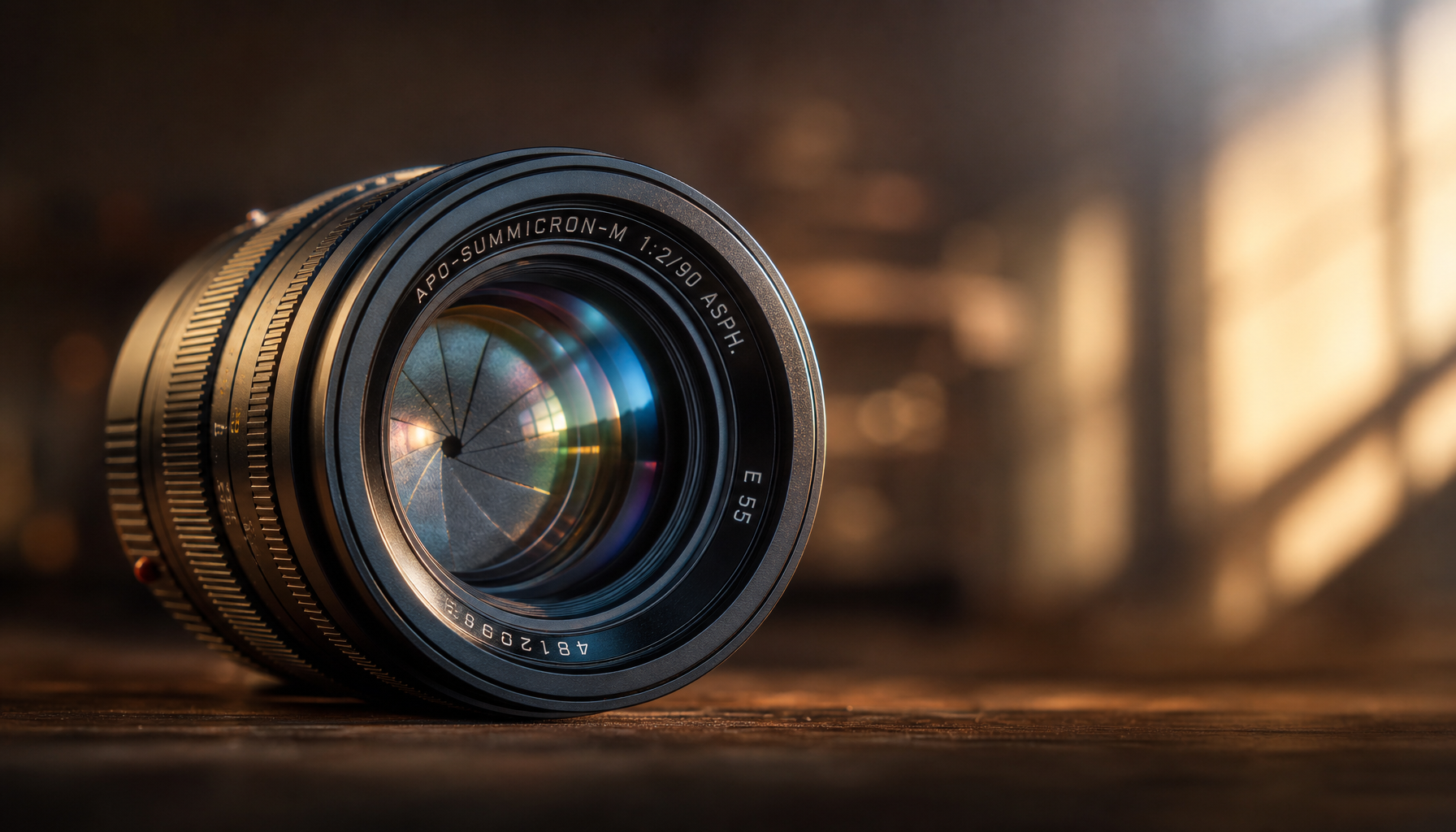
The sum of a lens's rendering traits beyond sharpness: flare behavior, bokeh, contrast, color rendition, focus falloff and distortion — the signature of a piece of glass.
Lens Character is the term for when two technically perfect lenses tell the same subject differently. It refers to the sum of all imaging properties beyond pure resolution: How does the glass flare? How does it render out-of-focus areas? How does the focus fall off towards the edges? How cool or warm does it render skin tones? How much contrast does it lose in backlight? It is this sum that transforms a tool into a signature.
What Constitutes Character
In lens tests and flare libraries, character is broken down into individual dimensions: flare behavior (streaks, spots, caustics, veiling glare), bokeh geometry (round, oval, swirl, onion rings), sharpness fall-off from center to edge, color characteristics of the coating, distortion, focus breathing. Vintage series usually have a lot of character because their flaws were not corrected; modern designs are cleaner and therefore more interchangeable. This has led to a dedicated market for "characterful" glass — from Soviet lenses with swirl bokeh to reissues of classic designs with intentionally vintage behavior.
The Choice in Practice
Lens choice is one of the earliest look decisions for a project, and it's rarely based on sharpness values. DPs test series side-by-side on the same subject — a face, backlight, highlights — and decide based on what the glass does to the image. The character must fit the story and be maintained throughout the film: changing the series mid-project will be noticeable precisely where character becomes visible — in flares, bokeh, and skin tones.
Tips from Practice
- Test character on the subject, not on a test chart — resolution charts show exactly the dimension that is not the focus here.
- When lens matching mixed sets, match character dimensions individually: color can be graded, but bokeh geometry and flare behavior cannot.
- Take sample variation seriously: with vintage glass, each sample has its own character — the test sample should be the shooting sample.
Related terms
Quiz
1. Was beschreibt „Objektiv-Charakter" am besten?
2. Zu welchem Department gehört „Objektiv-Charakter"?