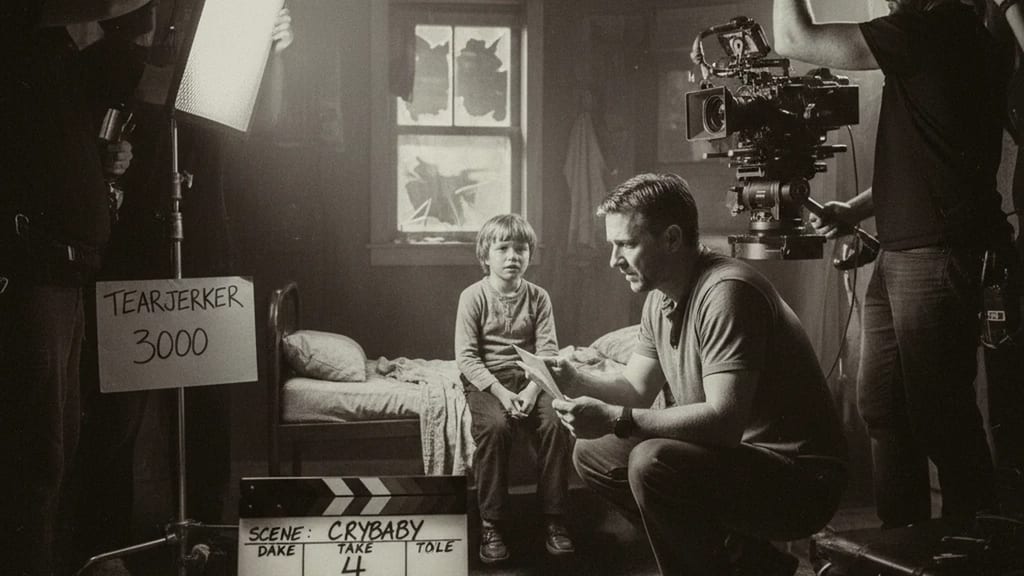
Deliberate exploitation of child actors to manufacture emotional impact — cheap tear-jerking without narrative justification. Manipulation masquerading as drama.
You know the scene: a child crying, dying, or suffering — and you immediately feel that the film is trying to manipulate you with it instead of telling you a story. That's kidsploitation. It works because viewers become emotionally defensive as soon as children are on screen. Who wants to appear heartless, defending themselves against a crying child? This technique capitalizes on precisely that. The filmmaker exploits the biological and cultural empathy reflex — without the scene being narratively justified.
On set and in the edit, you can recognize kidsploitation by scenes with children appearing isolated, being overlong, or their emotional intensity being completely disproportionate to the story's necessity. Example: A child is shown in close-up, looking sad — for a full 20 seconds — while the plot could simply move on. Or: the child is injured/endangered, but this danger had no build-up time in the dramaturgy. It was inserted because it works. That's the difference from legitimate emotional work with young actors, which arises organically from the story's conflict.
Many productions consciously use this as a cheap dramatic tool. Viewers question themselves less critically — who wants to appear tough? This generates tears that have nothing to do with cinematic logic. A child in danger is always a story amplifier, but only if that danger has been built up. If it comes out of nowhere, it's exploitation.
A good antidote: in the edit, pay attention to whether a scene with children is necessary or just effective. Necessary means it drives the plot or character development forward. It's effective nonetheless — but without any benefit other than a cheap emotional hit. That's a lack of craftsmanship. Strong directors dare to shorten or cut scenes with children if they don't serve the narrative. That's professional integrity instead of audience manipulation.
Related terms
Quiz
1. Was beschreibt „Kidsploitation" am besten?
2. Zu welchem Department gehört „Kidsploitation"?