Technical Details
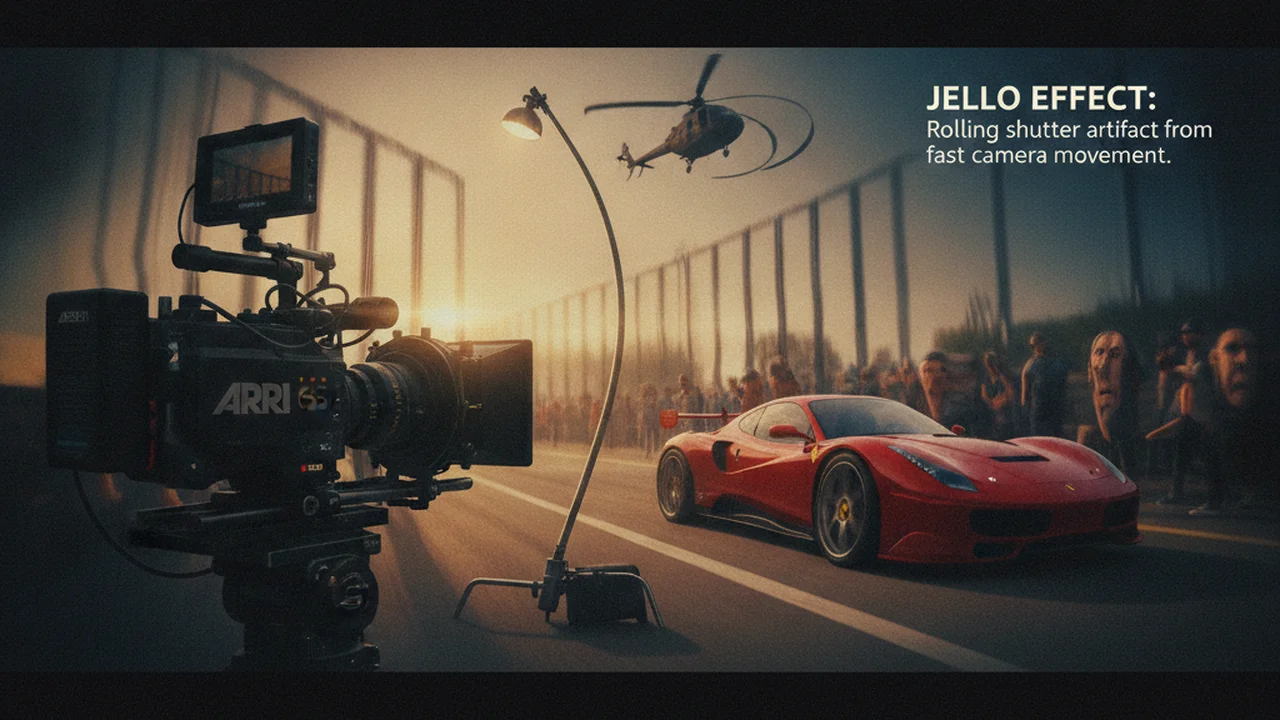
CMOS sensors read image data sequentially from top to bottom, with each line being read out approximately 1/60,000 to 1/120,000 of a second later than the previous one. For a typical 4K sensor with 2160 lines and 1/60,000 second per line, the total readout time is 36 milliseconds. During this time span, objects or the camera can move, leading to different positions of the same objects in different image lines. The effect intensifies proportionally to the speed of the movement and is particularly pronounced with fast pans, vibrating objects, or rotating propellers.
History & Development
The Jello Effect first appeared in the late 1990s with the first digital CMOS video sensors. While early CCD sensors used a Global Shutter and read out all pixels simultaneously, CMOS manufacturers opted for Rolling Shutter for cost reasons. Canon brought the effect to a wide filmmaking community in 2008 with the 5D Mark II. Since then, manufacturers have developed various compensation mechanisms: electronic image stabilization with gyroscope data, mechanical sensor stabilization, and since 2019, the first affordable Global Shutter CMOS sensors for professional applications.
Practical Use in Film
In "Cloverfield" (2008), the deliberately employed Jello Effect amplified the hectic, documentary aesthetic of the handheld camera sequences. Action films avoid the effect through mechanical gimbal systems or Steadicam rigs that eliminate micro-vibrations. For drone shots, DJI Inspire and similar systems compensate for the effect using 3-axis gimbals with 0.02° precision. Music videos occasionally use the amplified Jello Effect as a stylistic device by deliberately forgoing stabilization and choreographing fast movements.
Comparison & Alternatives
Global Shutter cameras like the Phantom TMX or Sony FX6 (Global Shutter mode) eliminate the effect entirely but cost 3-5 times more than comparable Rolling Shutter models. Mechanical image stabilization reduces the effect by 80-90%, while purely electronic systems achieve only 40-60% compensation. CCD sensors do not exhibit the Jello Effect but are 10 times more expensive at the same resolution and consume significantly more power. For static shots or slow movements, Rolling Shutter remains the most economical solution.