Filmlexikon.
Support
JDC Xtal Express
Camera · Terms

JDC Xtal Express

Murnau AI illustration
flow para roll take

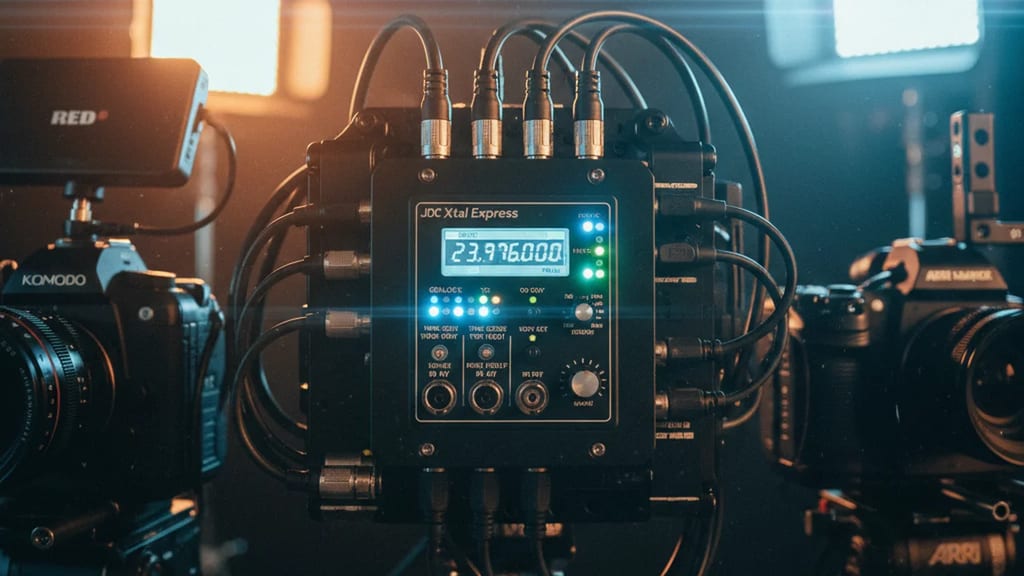
JDC Xtal Express: 1974 electronic camera speed module with quartz oscillator for precise frame rate synchronization in multi-camera setups.

Technical Details

The JDC Xtal Express operates with a voltage-controlled crystal oscillator (VCXO) that stabilizes the camera's motor speed via a phase-locked loop (PLL). The module weighs 340 grams and measures 152 x 89 x 38 mm. Power consumption is 120 mA at 12V DC. The system automatically compensates for temperature fluctuations between -10°C and +60°C, maintaining frame rate deviation below 0.002 fps at a target speed of 24 fps. Variants existed for standard 24fps production as well as for PAL-compatible 25fps recordings.

History & Development

Jean-Luc Godard Cinema Systems developed the Xtal Express in 1974 in response to synchronization problems in multi-camera setups of the Nouvelle Vague. Its first commercial application occurred in 1975 in documentaries by Cinéma Vérité directors. In 1978, the American JDC Corporation acquired the technology and standardized it for Hollywood productions. The system reached its peak in the 1980s before digital controls replaced it. The last production run left the manufacturing facility in 1994.

Practical Application in Film

Steven Spielberg's "Indiana Jones" (1981) utilized the Xtal Express for precise synchronization between main and second cameras during action sequences. Ridley Scott used the system on "Blade Runner" (1982) for exact speed adjustment between miniature and live-action shots. The typical workflow required a 15-minute warm-up period before shooting began. Advantages lay in its drift-free long-term stability and interference-free operation during temperature fluctuations. Disadvantages arose from the additional weight and power consumption, equivalent to 45 minutes of battery life.

Comparison & Alternatives

The Xtal Express differs from mechanical centrifugal governors through its electronic precision without mechanical wear. Unlike early servo systems, it operates without external reference signals. Modern alternatives such as the Preston Light Ranger or digital camera controls offer greater flexibility with programmable speeds. However, the Xtal Express remains relevant in vintage camera setups and specialized applications where its proven reliability surpasses mechanical solutions. Collectors today pay 800-1200 Euros for functional units.

From the crafts

Perspectives

Cinematographer

Ich schätze am Xtal Express die absolute Zuverlässigkeit bei langen Einstellungen – einmal kalibriert, läuft es 12 Stunden ohne Drift. Bei Handheld-Aufnahmen stört allerdings das zusätzliche Gewicht von 340 Gramm spürbar, besonders bei bereits schweren 35mm-Setups. Die 15-minütige Aufwärmphase plane ich fest in meine Vorbereitungszeit ein.

Director

Das System gibt mir die Sicherheit, spontane Mehrfach-Angles ohne Sync-Probleme zu drehen – perfekt für improvisierte Dialoge oder unvorhersehbare Momente. Die konstante 24fps-Geschwindigkeit sorgt für den gewünschten natürlichen Motion-Look, ohne die Micro-Schwankungen billiger Motorsysteme. Bei emotionalen Szenen kann ich mich voll auf die Performance konzentrieren, statt auf technische Synchronisation zu achten.

Producer

Das Xtal Express kostet zwar 1200 Dollar Anschaffung plus 100 Dollar tägliche Wartung, spart aber teure Post-Sync-Korrekturen. Ein defektes Gerät bedeutet 4-6 Stunden Produktionsausfall, daher kalkuliere ich immer ein Backup-System mit ein. Die eingesparten Kosten bei der Nachsynchronisation amortisieren die Investition bereits nach drei Drehtagen.

More in the lexikon

Related terms

Test your knowledge

Quiz

1. Zu welchem Department gehört „JDC Xtal Express"?

2. Wie viele verschiedene Fachperspektiven bietet dieser Eintrag?

Report an error
From the Filmfarm ecosystem

Understand visual language, budget productions, connect crew.

The Lexikon is part of the Filmfarm ecosystem — alongside budgeting (FilmBalance), an industry magazine (FilmCircus) and crew networking (FilmCall, CrewMesh). One shared vocabulary for the whole production.

FilmFarm FilmRadarComing soonFilmPulseComing soonFilmNumbersComing soonFilmCapitalComing soonFilmLabComing soonFilmBalanceComing soonFilmCircusComing soon