Filmlexikon.
Support
Iscorama 42
Camera · Terms

Iscorama 42

Murnau AI illustration
flow iscorama para roll take

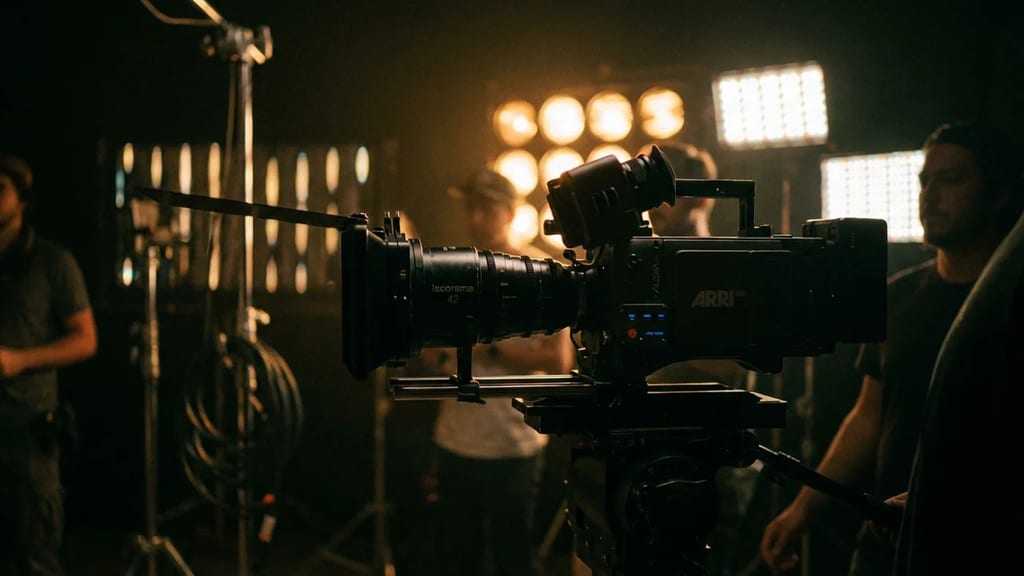
ISCO Optic anamorphic adapter from the 1960s with 1.33x horizontal squeeze, producing 2.39:1 aspect ratio and distinctive oval bokeh characteristics.

Technical Details

The Iscorama 42 operates with a dual-prism system and features integrated focusing with a close focus range from 2 meters to infinity. The optics compress the image horizontally by a factor of 1.33, resulting in an aspect ratio of 2.39:1 after de-squeezing in post-production. The lens has multi-layer coating and works optimally with prime lenses between 50mm and 85mm focal length. The front thread diameter is 58mm, and the aperture scale of the used prime lens remains fully functional.

History & Development

ISCO Optic developed the Iscorama 42 in the 1960s, initially for 16mm film productions and projectors. Production ran until the early 1980s, with various versions being produced, including the rare Iscorama 54 with a larger front thread. After production ceased, the Iscorama 42 became a cult item among filmmakers, especially after 2008 when DSLR videography became popular. Today, units fetch prices between 3,000 and 8,000 Euros on the used market.

Practical Use in Film

The Iscorama 42 produces the characteristic horizontal lens flares and oval bokeh of anamorphic optics. Indie directors like Shane Carruth used it for low-budget productions to achieve the Cinemascope look. The workflow requires horizontal de-squeezing by 133% in post-production. Advantages include its compact design and the ability to use standard photo lenses. Disadvantages are its limited light transmission, as the front attachment lens costs about one stop of light, and the complex focusing via two separate rings.

Comparison & Alternatives

Unlike modern anamorphic lenses such as the Cooke Anamorphic/i or Zeiss CZ.2, the Iscorama 42 functions as an adapter in front of a spherical prime lens. More affordable alternatives include the Rectilux CoreDNA (1,200 Euros) or SLR Magic Anamorphot (800 Euros), which, however, offer less optical quality. Professional alternatives like Hawk V-Lite or Atlas Orion cost 10-20 times as much, but provide consistent aperture values and better sharpness performance. The Iscorama 42 remains the first choice for filmmakers who want to achieve an authentic vintage anamorphic look on a limited budget.
From the crafts

Perspectives

Cinematographer

Das Iscorama 42 zwingt mich zu präziser Fokussierung, da beide Ringe - Grundobjektiv und Adapter - synchron bedient werden müssen. Die charakteristischen ovalen Highlights und horizontalen Flares entstehen nur bei direkten Lichtquellen im Bildbereich, weshalb ich mein Licht-Setup entsprechend plane. Bei Offenblende verliere ich etwa eine Stufe Lichtstärke, kompensiere das aber durch die emotionale Wirkung des 2,39:1-Formats.

Director

Das Iscorama 42 verleiht meinen Bildern sofort eine kinohafte Anmutung, die das Publikum unbewusst mit großen Produktionen assoziiert. Die horizontalen Lens Flares nutze ich gezielt für emotionale Höhepunkte oder um Tageslicht-Szenen eine warme, nostalgische Stimmung zu geben. Der Cinemascope-Rahmen zwingt mich zu bewussteren Kompositionen und unterstützt besonders Landschaftsaufnahmen und Dialogszenen mit mehreren Personen.

Producer

Ein Iscorama 42 kostet mich einmalig 4.000-6.000 Euro, spart aber Mietkosten für teure anamorphe Objektiv-Sets von 1.500 Euro pro Drehtag. Die Investition amortisiert sich nach 4-5 Drehtagen gegenüber professionellen anamorphen Optiken. Allerdings plane ich 20% mehr Zeit für Kamera-Setup ein, da die Dual-Focus-Bedienung komplexer ist und mehr Takes für perfekte Schärfe benötigt werden.

More in the lexikon

Related terms

Test your knowledge

Quiz

1. Was beschreibt „Iscorama 42" am besten?

2. Zu welchem Department gehört „Iscorama 42"?

3. Wie viele verschiedene Fachperspektiven bietet dieser Eintrag?

Report an error
From the Filmfarm ecosystem

Understand visual language, budget productions, connect crew.

The Lexikon is part of the Filmfarm ecosystem — alongside budgeting (FilmBalance), an industry magazine (FilmCircus) and crew networking (FilmCall, CrewMesh). One shared vocabulary for the whole production.

FilmFarm FilmRadarComing soonFilmPulseComing soonFilmNumbersComing soonFilmCapitalComing soonFilmLabComing soonFilmBalanceComing soonFilmCircusComing soon