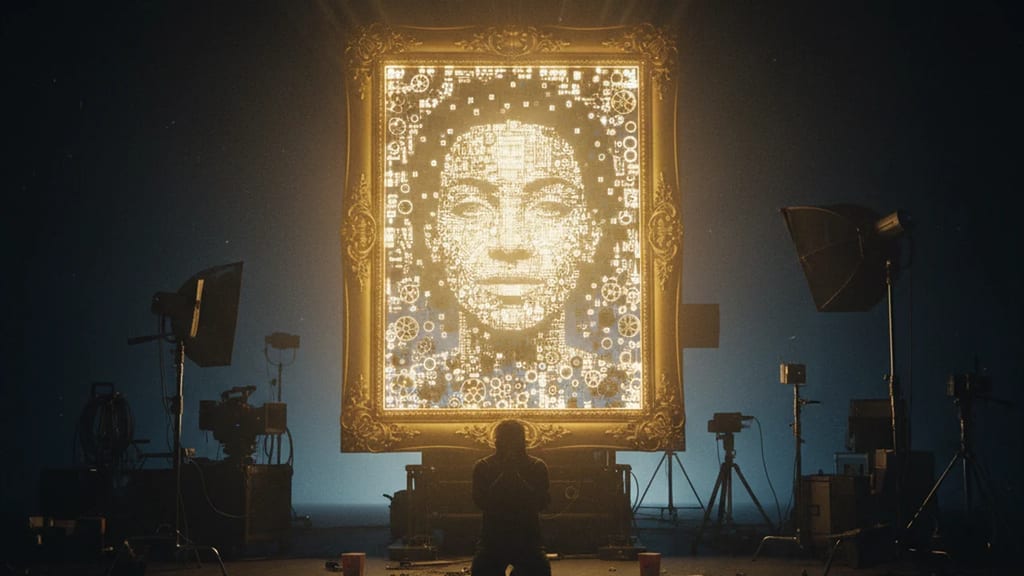
Fetishistic devotion to images and icons on screen — visual beauty prioritized over narrative substance. Cinema as image worship rather than storytelling.
You're in the editing room and suddenly realize: the director shot an entire scene where the lead actress is just standing there. Long take. Perfect lighting. No plot point, no information — just the person on screen because they look good. This is iconolatry at its core: the image becomes a relic, the screen a chapel. It's no longer about story, but about the veneration of the visual itself.
In practical everyday life, this is clearly evident. You know it from casting: a star is cast not because they can play the role, but because their face sells. The camera then frames them preferentially — close-ups, soft lighting, medium shots that emphasize the silhouette. Some edits consistently follow this logic: the best shot remains because it is beautiful, not because it is narratively necessary. This can work — but it quickly comes across as hollow posturing.
The difference to true visual storytelling lies in the intent. When Fellini uses a longer take of a person, the shot conveys character, atmosphere, psychological state — it tells a story with images. Iconolatry, on the other hand, is narcissistic: the image worships itself. This is particularly visible in certain genres — high-fashion films, opulent historical epics, music videos that masquerade as cinema. The visual quality is often breathtaking, but narratively cumbersome or empty.
Practically on set, this often means: excessive, long rehearsals for the perfect pose, camera movements that simply look good — without advancing the dramaturgy. As a cinematographer, you quickly notice this: you're asked to venerate instead of show. This has its place — stylization can be a conscious choice — but unconscious iconolatry weakens any film. It turns the screen into a poster.
Related terms
Quiz
1. Zu welchem Department gehört „Ikonomanie"?