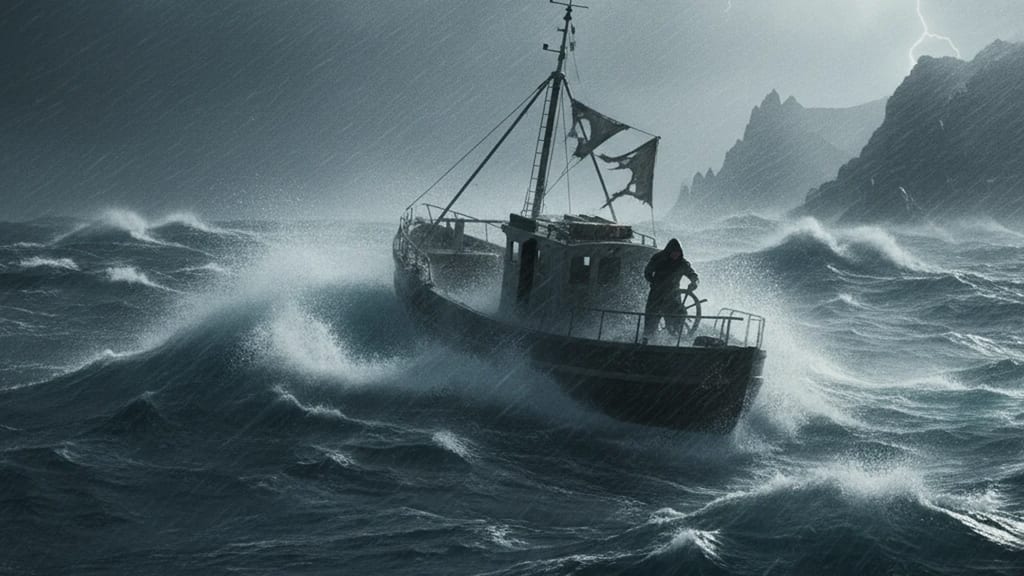
Suspense on open water or coastlines — isolation, natural forces, nowhere to run. Jaws, The Perfect Storm, All Is Lost define the formula.
The high-seas thriller thrives on an elemental truth: the sea is an antagonist that does not negotiate. Those in distress on the open sea or coast cannot simply sail away — the escape route itself becomes the trap. This constellation creates a physical and psychological release of pressure that can never be authentically replicated in a studio. The water, the isolation, the knowledge that help is hours or days away — this generates a state of suspense without artificial tricks.
In practice, this means for direction and cinematography: you work with the perspective of confinement. In Jaws, it was brilliantly simple — the camera stays on the boat while the monster operates below the waterline. The horror arises in the imagination. In All Is Lost, Chandor had only one man, a sailboat, and the elements. The camera becomes the survivor — shaky, limited, panicked. This is not shaky cam for aesthetic reasons, but narrative necessity.
The mise-en-scène is forced into minimalism. You have few locations — the ship, the life raft, perhaps a coastline. This compels you to convey emotional intensity through editing, sound, and the actors' performances. The soundtrack functions differently here than in a land-based thriller — some of the best high-seas scenes require less music, more natural sounds. The creaking of the ship, the wind, the water against the hull. That is your orchestra.
The external threat — whether sea, storm, or a biological phenomenon like in Jaws — creates an objectivity that intensifies personal conflicts. In a high-seas thriller, internal and external conflicts typically collapse. The captain must deal with his conscience AND the sea. The ship becomes a metaphor for the inner state.
A practical note on shooting: The real sea is impatient and costly. Many modern high-seas thrillers work with tanks, green screen, and water simulation. This works if the emotional truth is right — if not, it immediately feels artificial. The isolation must feel like loneliness, not like a set.
Related terms
Quiz
1. Zu welchem Department gehört „Hochseethriller"?