Technical Details
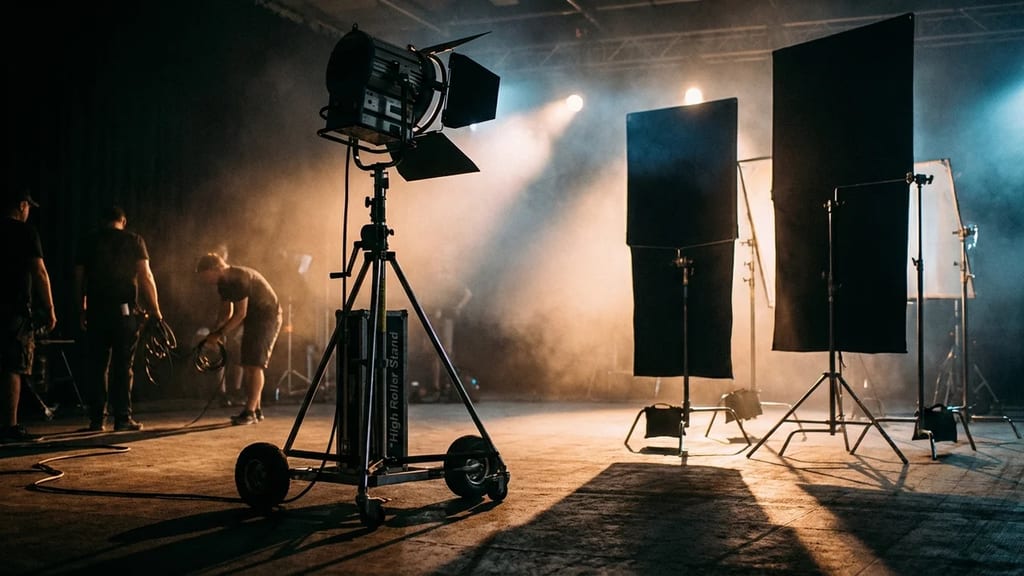
The High Roller Stand consists of a 5-section telescopic tube made of anodized aluminum with a tube diameter of 102 mm at the base element. The pneumatic system includes a 12V compressor, a 19-liter pressure tank, and a precision regulating valve for stepless extension. The base measures 2.1 x 2.1 meters with a tare weight of 68 kg and features four lockable heavy-duty casters with a 150 mm diameter. Modern variants like the Avenger A5050CS reach a height of 12.2 meters, while more compact models are limited to 9.1 meters. An automatic safety valve prevents uncontrolled pressure loss in case of leaks.
History & Development
Matthews Studio Equipment introduced the first High Roller Stand in 1983 for the film production "Blade Runner," after Ridley Scott required monumentally high lighting positions for the futuristic cityscapes. Avenger perfected the concept in 1987 with the A5050 model, which was the first to feature remote control for the pneumatic system. In 1995, manufacturers like Matthews and Kupo integrated safety cables and emergency release valves following several accidents on the set of "Batman Forever." Since 2010, LED arrays have increasingly replaced heavy HMI lights, leading to more efficient payload utilization.
Practical Application in Film
Christopher Nolan used High Roller Stands for "The Dark Knight" (2008) to position 6K HMI lights at a height of 11 meters and illuminate the Gotham skyline. For "Mad Max: Fury Road," they were used to simulate daylight in night desert scenes with 18K HMI fixtures. Setup requires a three-person rigging team and 25 minutes of preparation time, including pressurization. Disadvantages include susceptibility to wind from Beaufort scale 4 upwards and reliance on a 220V power supply for the compressor.
Comparison & Alternatives
Unlike a camera crane, the High Roller Stand is exclusively for lighting positioning and achieves precise, static positions. Scissor lifts offer mobile operation but require level ground and only reach a height of 8 meters. Modern drone lights are replacing High Roller Stands for moving light sources, while permanently installed truss systems are more economical for studio builds. For exterior shots with limited space, the High Roller Stand remains unrivaled due to its compact footprint.