Technical Details
Hampshire Frost is a 0.13mm thick polyester film with embedded micro-particles that create controlled light diffusion over a 30° angle. The color temperature remains almost unchanged at 5600K (+50K deviation), while the Color Rendering Index (CRI) is 98. The film is available in standard sizes from 610mm x 686mm to roll variants of 1.22m x 7.62m and can withstand temperatures up to 70°C without deformation. Variants include Hampshire Heavy Frost (Lee 251) with stronger diffusion and reduced transmission of 45%, and Hampshire Light Frost (Lee 200/1) with minimal diffusion at 75% transmission.
History & Development
Lee Filters developed Hampshire Frost in 1976 as an alternative to the then-common tissue paper diffusers, which often posed a fire hazard. British cinematographer Chris Menges first used the film in 1978 on "Babylon" and established it as the standard for natural daylight diffusion. In 1985, the heat-resistant version for tungsten lamps was introduced, followed in 1992 by the UV-stabilized variant for exterior shoots. Today, Hampshire Frost is a standard piece of equipment in every lighting department and is emulated by manufacturers like Rosco (3008 Tough Frost) and Arri (L2.79320.0) with similar specifications.
Practical Use in Film
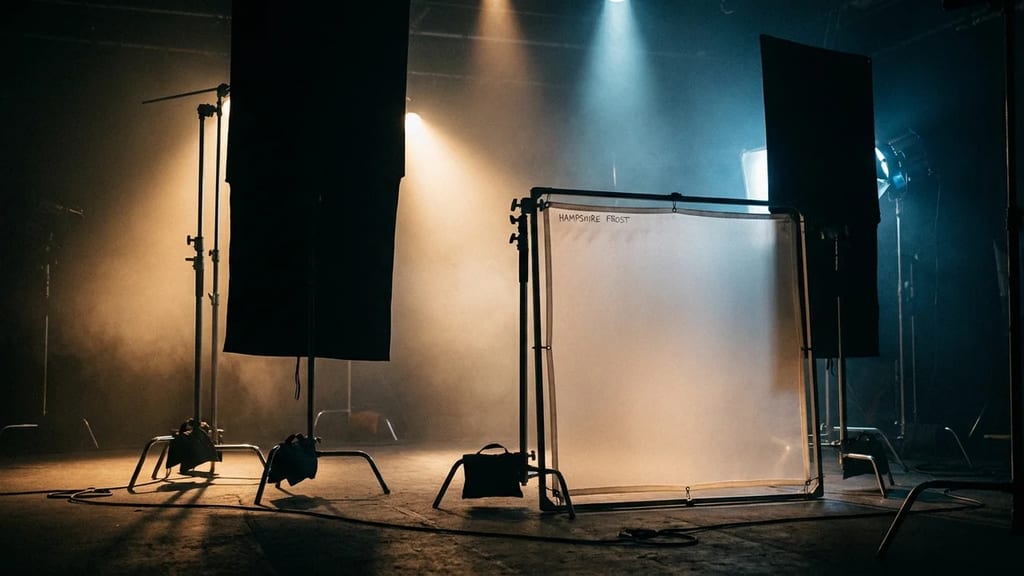
Hampshire Frost is primarily used to soften HMI lights and LED panels, especially for facial lighting and window keys. Roger Deakins used the film extensively on "Blade Runner 2049" for the futuristic interiors, while Emmanuel Lubezki employed it on "The Revenant" for the natural forest scenes. The typical workflow involves mounting it in scrim frames in front of the light source or directly onto softboxes. The advantage is even illumination without hard shadows; the disadvantage is noticeable light loss and potential reflections at unfavorable angles.
Comparison & Alternatives
Unlike Grid Cloth (216 Diffusion), Hampshire Frost does not change the direction of light, only diffuses it. Opal Frost (Lee 410) offers stronger diffusion with higher light loss, while Silent Grid Cloth combines lower diffusion with better transmission. Modern LED panels with built-in diffusion are increasingly replacing external films but rarely achieve the uniform characteristic of Hampshire Frost. For budget productions, cheaper tracing paper is often used, but it delivers significantly more uneven results.