Filmlexikon.
Support
Gobo
Lighting · Terms

Gobo

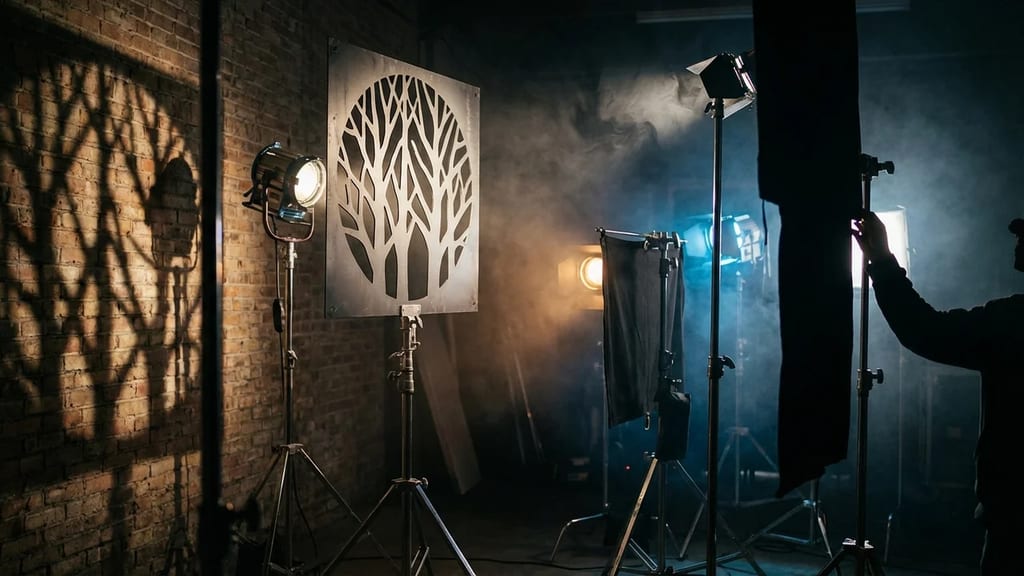
Murnau AI illustration
20 c stand 40 c stand c stand arm c stand mini c stand sliding leg c stand grip head grip

Metal or glass template mounted in front of a light fixture to project patterns, shadows, or textures onto surfaces.

Technical Details

Steel gobos are manufactured from 0.1-0.3mm thick stainless steel foil using laser cutting or etching and reach temperatures up to 300°C in continuous operation. Glass gobos allow for color gradients and finest details up to 150 DPI, but are more temperature-sensitive and limited to a maximum power of 2000W. Modern LED spotlights often use digital gobo wheels with 6-8 interchangeable positions. Rotating gobos spin at 0.1-300 rpm and create moving light effects. The sharpness of the projection depends on the distance to the projection surface: at a distance of 3m, profile spotlights achieve an edge sharpness of less than 2mm.

History & Development

Theater lighting technicians were already using primitive metal stencils in front of arc lamps around 1920. In 1934, the company Century Lighting developed the first standardized gobo sizes for Broadway productions. Kodak introduced photographic gobos in 1962, which consisted of exposed glass plates. With the introduction of moving lights by Vari-Lite in 1981 at Genesis concerts, motorized gobo wheels became standard. Today, LCD and DLP projectors enable over 16 million projectable colors and patterns in 4K resolution.

Practical Use in Film

Roger Deakins used Venetian blind gobos in "Blade Runner 2049" (2017) for the characteristic venetian blind shadows in Deckard's apartment. In night scenes, window frame gobos cost-effectively create the impression of moonlight through windows without complex location lighting. Standard workflows place gobos 50-150cm in front of the light source for soft edges or directly at the spotlight for sharp contours. Breakup gobos simulate leaf shadows and reduce the artificial appearance of uniform illumination. Disadvantages include light loss of 20-60% depending on the pattern density and possible heat distortions with metal gobos.

Comparison & Alternatives

While gobos project static patterns, modern media servers allow for variable content but cost 50-100 times more. Cookies (Cucoloris) made of wood or cardboard create similar effects but are less sharp and less durable. Digital gobos in moving lights offer rotation and morphing between patterns but require more complex cabling and DMX programming. For static scenes, classic gobos remain the first choice due to their simplicity and reliability, while moving projections require digital solutions.

From the crafts

Perspectives

Cinematographer

Ich verwende Water-Gobos regelmäßig, um lebendige Reflexionen auf Gesichtern zu erzeugen - das schafft eine organische Bewegung, die selbst bei statischen Dialogszenen Dynamik ins Bild bringt. Bei Außenszenen nutze ich Leaf-Pattern-Gobos mit 2K-HMIs um harte Sonnenschatten aufzubrechen, da sie natürlicher wirken als Diffusion und trotzdem die Lichtrichtung erhalten. Die Schärfe reguliere ich über den Abstand: nah am Scheinwerfer für grafische Effekte, 1-2 Meter entfernt für subtile Texturen.

Director

Ich setze Gobos gezielt ein, um emotionale Zustände zu visualisieren - Gefängnisgitter-Patterns für Gefangenschaftsgefühle oder zerrissene Strukturen bei inneren Konflikten der Figuren. In "Der Untergang" haben wir Trümmer-Gobos verwendet, um die Zerstörung bereits in der Beleuchtung der Bunkerszenen anzudeuten. Wichtig ist mir, dass das Muster die Handlung unterstützt und nicht ablenkt - manchmal projiziere ich nur auf Wände oder Hintergründe, nie direkt auf Gesichter der Hauptdarsteller.

Producer

Ein Set aus 20 Standard-Gobos kostet 400-800 Euro und ist über Jahre wiederverwendbar - deutlich günstiger als digitale Alternativen für wiederkehrende Muster. Bei Außenszenen spare ich damit teure Grip-Aufbauten, da ein einzelner Gobo komplexe Schattenmuster erzeugt, für die ich sonst mehrere Netze und Frames bräuchte. Allerdings müssen individuelle Gobos 2-3 Wochen vor Drehbeginn bestellt werden, was Spontaneität in der Lichtgestaltung einschränkt und präzise Prep-Planung erfordert.

More in the lexikon

Related terms

Test your knowledge

Quiz

1. Was beschreibt „Gobo" am besten?

2. Zu welchem Department gehört „Gobo"?

3. Wie viele verschiedene Fachperspektiven bietet dieser Eintrag?

Report an error
From the Filmfarm ecosystem

Understand visual language, budget productions, connect crew.

The Lexikon is part of the Filmfarm ecosystem — alongside budgeting (FilmBalance), an industry magazine (FilmCircus) and crew networking (FilmCall, CrewMesh). One shared vocabulary for the whole production.

FilmFarm FilmRadarComing soonFilmPulseComing soonFilmNumbersComing soonFilmCapitalComing soonFilmLabComing soonFilmBalanceComing soonFilmCircusComing soon