Overview
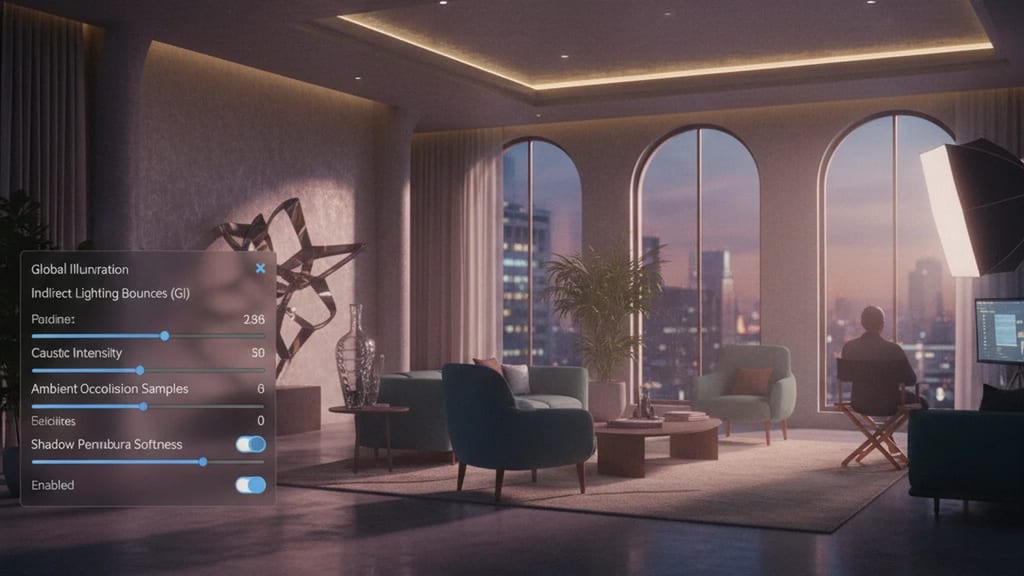
Global Illumination (shortened to GI, German for "global lighting", also known as indirect lighting) is not a physical lighting or grip device, but a collective term for algorithms in 3D computer graphics. GI calculates how light in a scene propagates not only directly from the light source, but also through multiple reflections off surfaces. In film, GI is therefore not created on set, but in the renderer – for example, in VFX, computer-generated imagery (CGI), and animation.
The contrast is direct lighting, which only considers light that travels directly from the source to the viewing camera. GI supplements this with "light bounces," where rays are reflected from one surface to the next. Without this component, rendered images appear flat; with GI, interior scenes in particular gain credibility.
Typical Effects
GI depicts a range of lighting phenomena that occur daily in the real world:
- Color Bleeding: The color of a wall "stains" adjacent surfaces because the reflected light carries its color.
- Indirect Illumination: Areas without direct light are brightened by reflected light from the surroundings instead of remaining completely black.
- Soft shadows and inter-reflections between objects.
- Caustics: focused light patterns created by refraction in transparent material or by reflection.
Methods
Various approaches exist for calculating GI, differing in accuracy and computation time. Commonly mentioned methods include:
| Method | Characteristics |
|---|
| Path Tracing | Stochastic ray tracing with multiple bounces; high image fidelity, computationally intensive |
| Radiosity | Surface-based method for diffuse lighting; stable, without specular highlights |
| Photon Mapping | Two-pass method, particularly suitable for caustics |
| Ambient Occlusion | Approximation for shading in crevices and contact areas |
Other techniques commonly used in practice include Image-Based Lighting, Metropolis Light Transport, and real-time solutions such as Screen-Space Global Illumination and Lumen.
Use in Production
GI calculations are classically computationally expensive and are therefore predominantly used in offline rendering, for example, for VFX shots and animated films where maximum image fidelity is paramount. Point-based GI variants were extensively used in animated features due to their relative speed. In contrast, there are real-time approaches with pre-calculated lightmaps and light probes, as used in game engines and increasingly in virtual production (LED volumes). Hybrid workflows often combine baked GI with real-time reflections.