Filmlexikon.
Support
Front Anamorphic
Camera · Technique

Front Anamorphic

Murnau AI illustration
rear anamorphic lomo anamorphic round front square front lomo square front

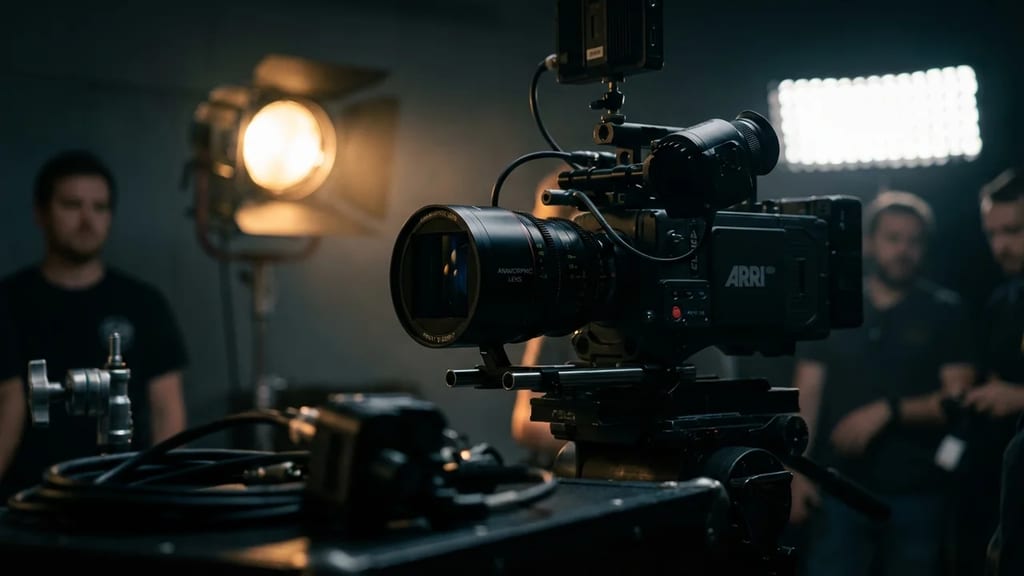
Front anamorphic lens that compresses the image at a 2:1 squeeze ratio, producing characteristic oval bokeh and horizontal lens flares.

Technical Details

Front anamorphic lenses compress the image with a squeeze factor of 2:1, transforming a 2.39:1 aspect ratio into a 1.195:1 format that fits within the 1.37:1 area of 35mm film. The focal length of the primary lens is not altered by the front anamorphic adapter, but the effective aperture shifts by approximately half a stop. Typical diameters are 138mm, 142mm, or 162mm, depending on the primary lens used. The cylindrical optics produce characteristic oval bokeh circles and horizontal lens flares.

History & Development

The first front anamorphic adapter was developed by Gottschalk & Sons in 1926 for Henri Chrétien's Hypergonar system. 20th Century Fox adapted this technology in 1952 for CinemaScope, bringing it to commercial use for the first time with "The Robe." Panavision revolutionized the technique in 1954 with the Auto Panatar Front Anamorphic adapter, which delivered sharper images and less distortion. Modern manufacturers such as Hawk, Cooke, and Atlas now produce high-quality front anamorphic adapters with multi-coating and reduced chromatic aberration.

Practical Use in Film

Sergio Leone used front anamorphic adapters in his Western epics like "Once Upon a Time in the West" (1968) for their characteristic panoramic shots. Christopher Nolan employs Panavision front anamorphic adapters in "Dunkirk" (2017) and "Tenet" (2020) to seamlessly integrate IMAX sequences with anamorphic 35mm footage. The workflow requires special viewfinders with anamorphic markings and monitors with a de-squeeze function. Disadvantages include light loss, increased weight on the lens, and the need for specialized matte boxes.

Comparison & Alternatives

Unlike rear anamorphic adapters, which are built between lens elements, front anamorphic adapters can be flexibly combined with various primary lenses. Modern alternatives include fully anamorphic lenses such as the Panavision C-Series or Arri Master Anamorphic, which operate without auxiliary lenses. Digital alternatives like the RED Weapon 8K with a 17:9 sensor or the Alexa LF with Open Gate can record widescreen formats without anamorphic optics, but they forgo the characteristic anamorphic image aesthetic.
From the crafts

Perspectives

Cinematographer

Als DoP schätze ich Front-Anamorphote für ihre Flexibilität – ich kann sie mit meinen bevorzugten Spherical-Objektiven kombinieren und bekomme trotzdem den charakteristischen anamorphen Look mit den horizontalen Flares. Die ovalen Bokeh-Kreise und die leichte Unschärfe an den Bildrändern geben meinen Aufnahmen eine organische, filmische Qualität, die rein digitale Breitbild-Lösungen nicht erreichen.

Director

Front-Anamorphote ermöglichen mir eine intimere Beziehung zwischen Charakteren und Landschaft – die horizontale Kompression verstärkt die emotionale Nähe in Nahaufnahmen, während Totalen eine epische Weite erhalten. Die charakteristischen Lens Flares nutze ich gezielt als visuelles Motiv, besonders in Gegenlicht-Situationen, um bestimmte Momente zu akzentuieren und eine nostalgische, cineastische Atmosphäre zu schaffen.

Producer

Front-Anamorphote bedeuten zusätzliche 15.000-25.000 Euro Mietkosten pro Dreh, aber sie machen Standard-Objektive "premium-tauglich" für internationale Verwertung. Der Zeitaufwand für Setup und Fokus-Pulling steigt um etwa 20%, dafür spare ich mir teure anamorphe Objektivsets. Wichtig ist die frühe Abstimmung mit Post-Production wegen der De-Squeeze-Workflows und eventuelle IMAX-Delivery-Anforderungen.

More in the lexikon

Related terms

Test your knowledge

Quiz

1. Zu welchem Department gehört „Front-Anamorphot"?

2. Wie viele verschiedene Fachperspektiven bietet dieser Eintrag?

Report an error
From the Filmfarm ecosystem

Understand visual language, budget productions, connect crew.

The Lexikon is part of the Filmfarm ecosystem — alongside budgeting (FilmBalance), an industry magazine (FilmCircus) and crew networking (FilmCall, CrewMesh). One shared vocabulary for the whole production.

FilmFarm FilmRadarComing soonFilmPulseComing soonFilmNumbersComing soonFilmCapitalComing soonFilmLabComing soonFilmBalanceComing soonFilmCircusComing soon