Cinematographer
Aus DoP-Perspektive ist dieses Element essentiell für die visuelle Gestaltung. Es ermöglicht mir die gewünschte Farbstimmung und das ästhetische Bild konsistent umzusetzen.
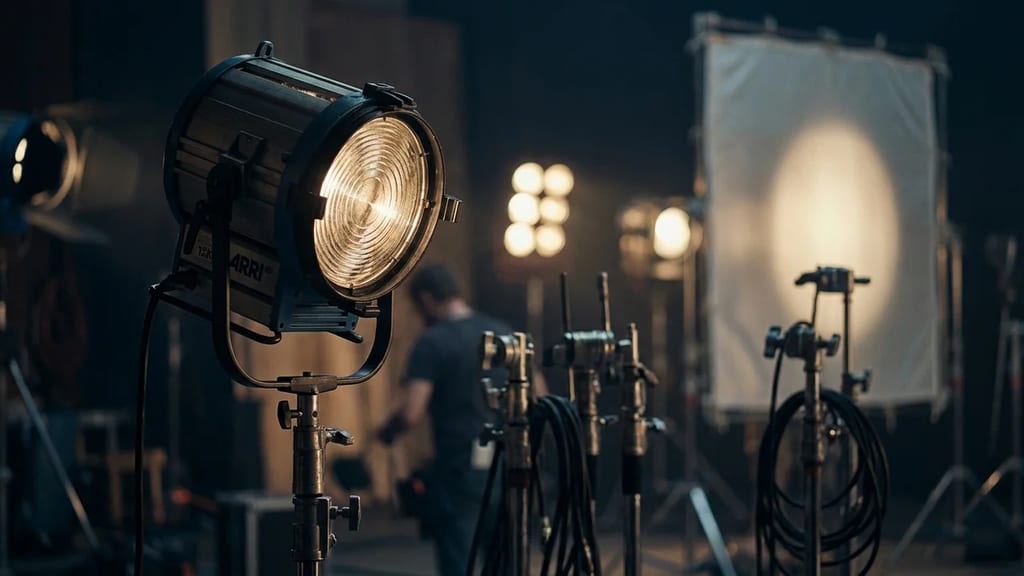
Stepped condenser lens with concentric rings used in film lights to produce a soft-edged beam adjustable from spot to flood focus.
The Fresnel lens (named after the French physicist Augustin-Jean Fresnel, who developed the principle for lighthouses in the 1820s) is a stepped converging lens. Instead of a uniformly thick glass body, it consists of concentric, prism-like rings (steps) that replicate the refractive effect of a full glass lens while remaining significantly thinner and lighter. In film lighting, "Fresnel" refers both to the lens itself and, as a shorthand, to the entire type of fixture ("Fresnel spotlight," "Fresnel") in which this lens is placed in front of the light source.
Characteristic features are the typical ring structure visible from the rear and the usually frosted (ribbed) outer surface, which further diffuses the light. This results in the distinctive light pattern: a comparatively uniformly illuminated cone with a soft edge.
The main advantage of the Fresnel spotlight is its focusability. The light source and reflector can be moved relative to the lens – usually via a knob or lever on the rear of the housing. This allows the light cone to be adjusted steplessly between two end positions:
Through this adjustment range, a Fresnel typically covers an area of approximately 10–15° (narrow) to around 50–60° (wide), depending on the unit; common examples include the ARRI 650 Plus (approx. 14.5° spot / 52° flood) or the Aputure F10 (15°–45°). Individual units achieve narrower spots or wider floods, so the specific range depends on the respective model. The light intensity is relatively constant across the width of the cone and has a soft edge, making the Fresnel suitable as a controllable, directed key light as well as a wash light. Compared to open-face fixtures, a Fresnel diffuses significantly less spill.
Fresnel spotlights traditionally come with tungsten light sources (incandescent, approx. 3200 K) and increasingly with LED engines. Tungsten Fresnels provide an appreciated, very popular light color but generate a lot of heat. LED Fresnels run cooler and are often color temperature variable (bi-color or RGB), making them more practical for small or enclosed sets. The lens itself is a replaceable optical element in many systems (e.g., in modular LED spotlights where a Fresnel front lens can be swapped for other optics).
The Fresnel is one of the most frequently used directional spotlights in film and TV. Due to its controllable cone, which can be adjusted from hard-edged to soft, it is suitable for key and backlight as well as for targeted accent lighting. For further beam shaping, barn doors are mounted directly on the housing to cut off spill and precisely limit the light. Common accessories also include gel frames for color and correction filters, as well as scrims for brightness reduction. Common fixture classes range from compact units (e.g., 300 W / 650 W Tungsten) to large studio Fresnels.
Aus DoP-Perspektive ist dieses Element essentiell für die visuelle Gestaltung. Es ermöglicht mir die gewünschte Farbstimmung und das ästhetische Bild konsistent umzusetzen.
Diese professionelle Lösung erhöht die Produktionseffizienz und reduziert Post-Production-Anforderungen. Sie ermöglicht flexible, schnelle Anpassungen während des Drehs.
Als Gaffer ist dies ein unverzichtbares Werkzeug meines täglichen Handwerkszeugs. Es ermöglicht mir professionelle Lichtkontrolle und schnelle Anpassungen auf Set, was Zeit spart und Qualität sichert.
1. Zu welchem Department gehört „Fresnel-Linse"?
2. Wie viele verschiedene Fachperspektiven bietet dieser Eintrag?
The Lexikon is part of the Filmfarm ecosystem — alongside budgeting (FilmBalance), an industry magazine (FilmCircus) and crew networking (FilmCall, CrewMesh). One shared vocabulary for the whole production.