Filmlexikon.
Support
French New Wave Editing
Theory · Terms

French New Wave Editing

Murnau AI illustration
french new wave post new wave yugoslav black wave

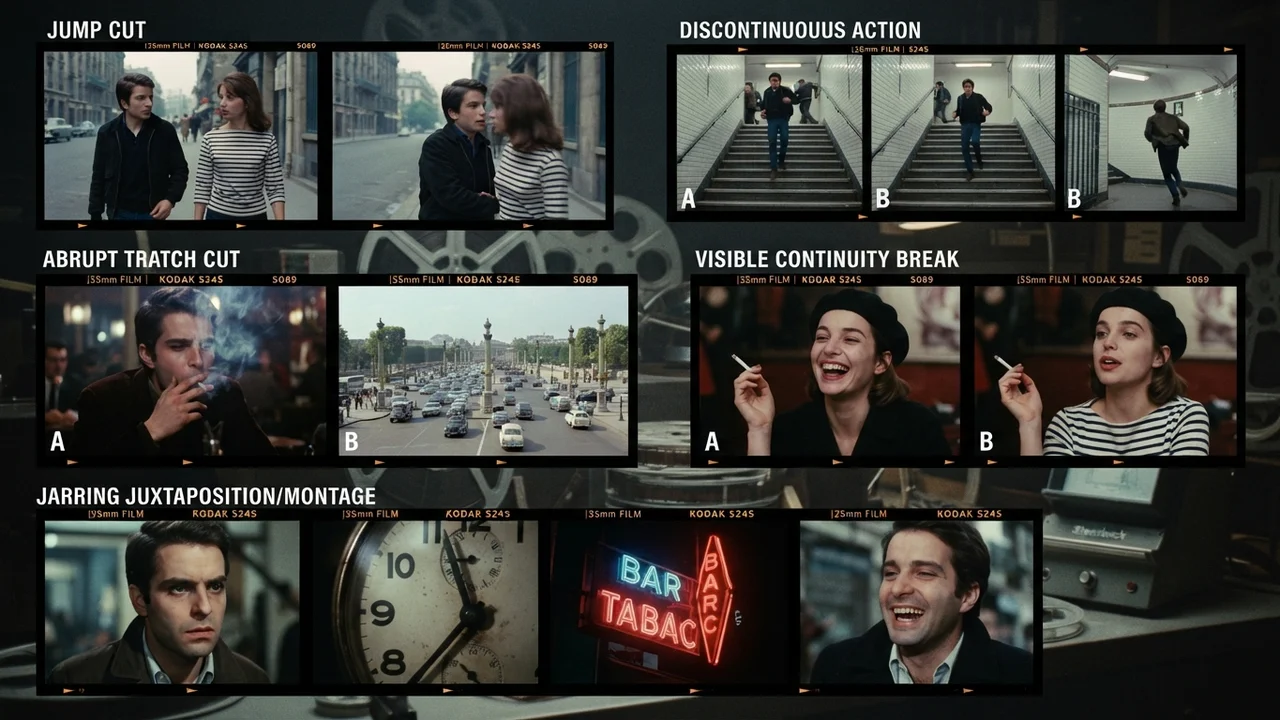
Editing technique of the French New Wave using jump cuts (camera movement under 30°), freeze frames, and asynchronous cuts that deliberately expose the montage.

Technical Details

Jump cuts are created by removing footage from a continuous shot, with the camera position changing by less than 30 degrees – in contrast to the Hollywood standard of at least 45 degrees. Typical jump lengths are between 12 and 48 frames at 24fps. Freeze frames are generated by repeating the same single frame, usually lasting 72-192 frames. Handheld shots with the Éclair NPR show deliberate image instability of ±2-5 degrees fluctuation. Asynchronous cuts separate picture and sound edits by 6-24 frames, allowing dialogue to flow across cut boundaries.

History & Development

Jean-Luc Godard established the systematic use of jump cuts in "Breathless" in 1960 – originally to shorten the 90-minute rough cut to 87 minutes. François Truffaut already used freeze frames as a narrative element in "The 400 Blows" in 1959. Jacques Rivette experimented with real-time sequences of up to 8 minutes without cuts in "Paris Belongs to Us" in 1961. These techniques influenced New Hollywood (Arthur Penn, Dennis Hopper) from 1967 onwards, and later Dogme 95 films and modern independent cinema.

Practical Application in Film

"Breathless" contains over 150 jump cuts in 87 minutes of runtime. Truffaut's freeze frame at the end of "The 400 Blows" lasts exactly 8 seconds. Agnès Varda's "Cléo from 5 to 7" (1962) follows a real-time structure with visible clocks as continuity anchors. French New Wave editing reduces production costs through less coverage material but requires precise planning of shot sequences. Modern editors use these techniques in Avid or Premiere by deliberately shortening clips without repositioning.

Comparison & Alternatives

In contrast to classical Hollywood editing with the 180-degree rule and invisible transitions, French New Wave editing deliberately makes the montage visible. While Soviet montage (Eisenstein) creates meaning through the collision of different shots, here rhythm is generated by temporal compression within the same shot. Modern mumblecore films and found-footage horror use similar techniques but replace analog imperfection with digital simulation. Social media editing with TikTok cuts follows related principles, but with a higher editing frequency of 1-3 seconds per shot.

From the crafts

Perspectives

Cinematographer

Ich muss bei Nouvelle-Vague-Projekten weniger Coverage drehen, dafür aber längere Takes mit bewussten Kamerabewegungen planen, da Jump Cuts aus einer kontinuierlichen Fahrt entstehen. Die Belichtung muss über 3-5 Minuten konstant bleiben, da nachträgliche Farbkorrekturen die Jump Cuts zu auffällig machen würden. Handheld-Sequenzen erfordern kontrollierte Unruhe – nicht verwackelt, sondern organisch schwankend.

Director

Ich verwende Jump Cuts gezielt für psychologische Verdichtung – ein 5-minütiges Gespräch wird durch 8-12 Sprünge auf 90 Sekunden komprimiert, ohne Dialogzeilen zu verlieren. Freeze Frames setze ich als Interpunktion ein, um dem Zuschauer 3-4 Sekunden Reflexionszeit zu geben. Die Technik funktioniert besonders bei Charakterstudien, wo innere Zustände wichtiger sind als äußere Handlung.

Producer

Nouvelle-Vague-Schnitt reduziert meine Drehtage um 20-30%, da weniger Einstellungsgrößen benötigt werden – aber die Postproduktion verlängert sich um eine Woche für präzise Jump-Cut-Timing. Ich kalkuliere 15% weniger Rohfilm oder Speicherkarten, spare aber nichts bei der Farbkorrektur, da jeder Frame-Sprung exakt abgestimmt werden muss. Internationale Distributoren mögen diese Ästhetik nur bei Arthouse-Titeln.

More in the lexikon

Related terms

Test your knowledge

Quiz

1. Zu welchem Department gehört „Nouvelle-Vague-Schnitt"?

2. Wie viele verschiedene Fachperspektiven bietet dieser Eintrag?

Report an error
From the Filmfarm ecosystem

Understand visual language, budget productions, connect crew.

The Lexikon is part of the Filmfarm ecosystem — alongside budgeting (FilmBalance), an industry magazine (FilmCircus) and crew networking (FilmCall, CrewMesh). One shared vocabulary for the whole production.

FilmFarm FilmRadarComing soonFilmPulseComing soonFilmNumbersComing soonFilmCapitalComing soonFilmLabComing soonFilmBalanceComing soonFilmCircusComing soon