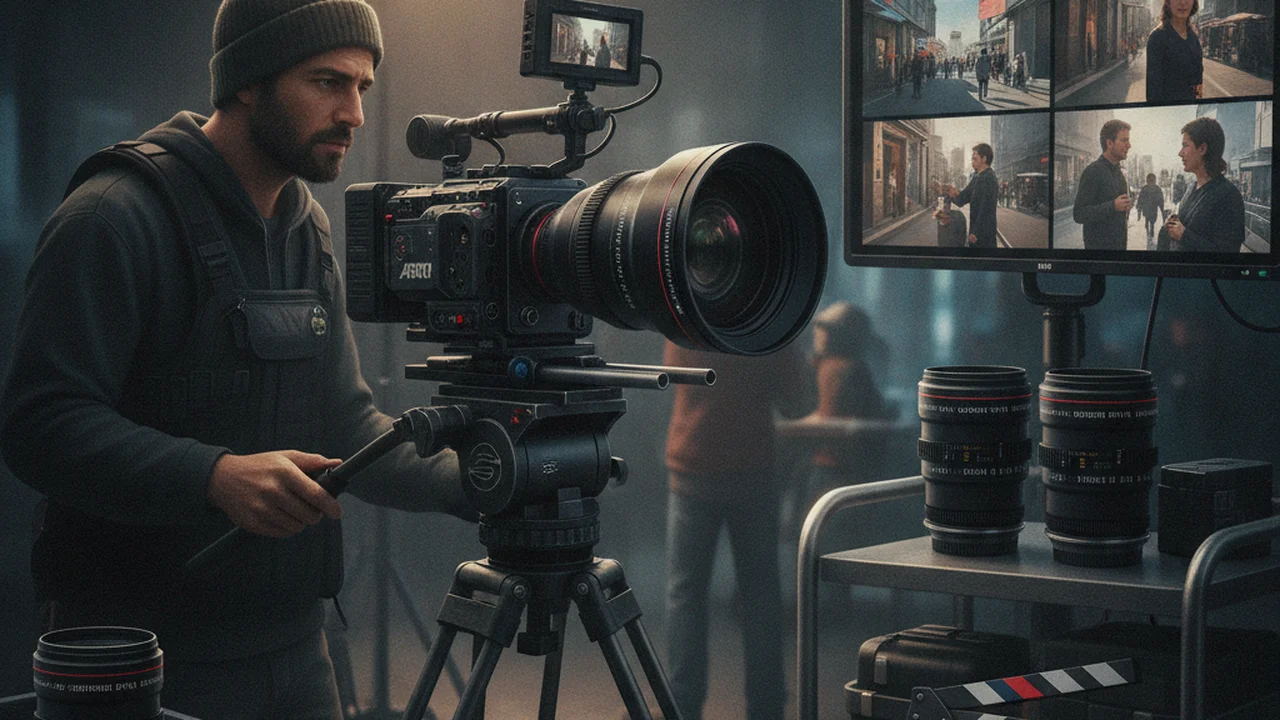
The self-imposed rule of shooting an entire film on a single focal length — restriction as a tool to force a consistent, distinctive visual language.
Most productions bring a whole set of focal lengths to set to optimally solve every framing problem. Some DPs consciously go the opposite way: one film, one lens. The limitation is not a makeshift solution, but a design tool—it forces a consistent perspective and makes the image recognizable at a glance.
Why it works
A fixed focal length determines the relationship between camera and subject: if you want to get closer, you have to move the camera, not zoom. With an ultra-wide (e.g., 10.5mm), this means physically getting close to the characters—the space distorts, the proximity becomes physically palpable. It is precisely these forced decisions that build a unique world.
The compromises
An ultra-wide single lens makes close-ups a challenge—the camera has to be centimeters away from the face, with a real risk of collision during movement. Lighting becomes more difficult because the wide angle of view constantly captures the lamps. And some shots that would be trivial with a longer focal length have to be reconfigured or sacrificed. Those who stick to the rule trade convenience for identity.
Classification
The single-lens shoot is a methodology, not a piece of equipment—it works with any lens, from vintage primes to modern tunable optics. It is related to the idea of finding a clear signature through self-imposed limitations (one light source, one location, one take).
Related terms
Quiz
1. Zu welchem Department gehört „Ein-Objektiv-Dreh"?