Cinematographer
Die NPR war die erste Kamera, mit der ich echten Dokumentarfilm machen konnte – rausgehen, Menschen filmen, ihre Worte aufnehmen. Vorher war das unmöglich oder unbezahlbar. Sie hat meinen Beruf verändert.
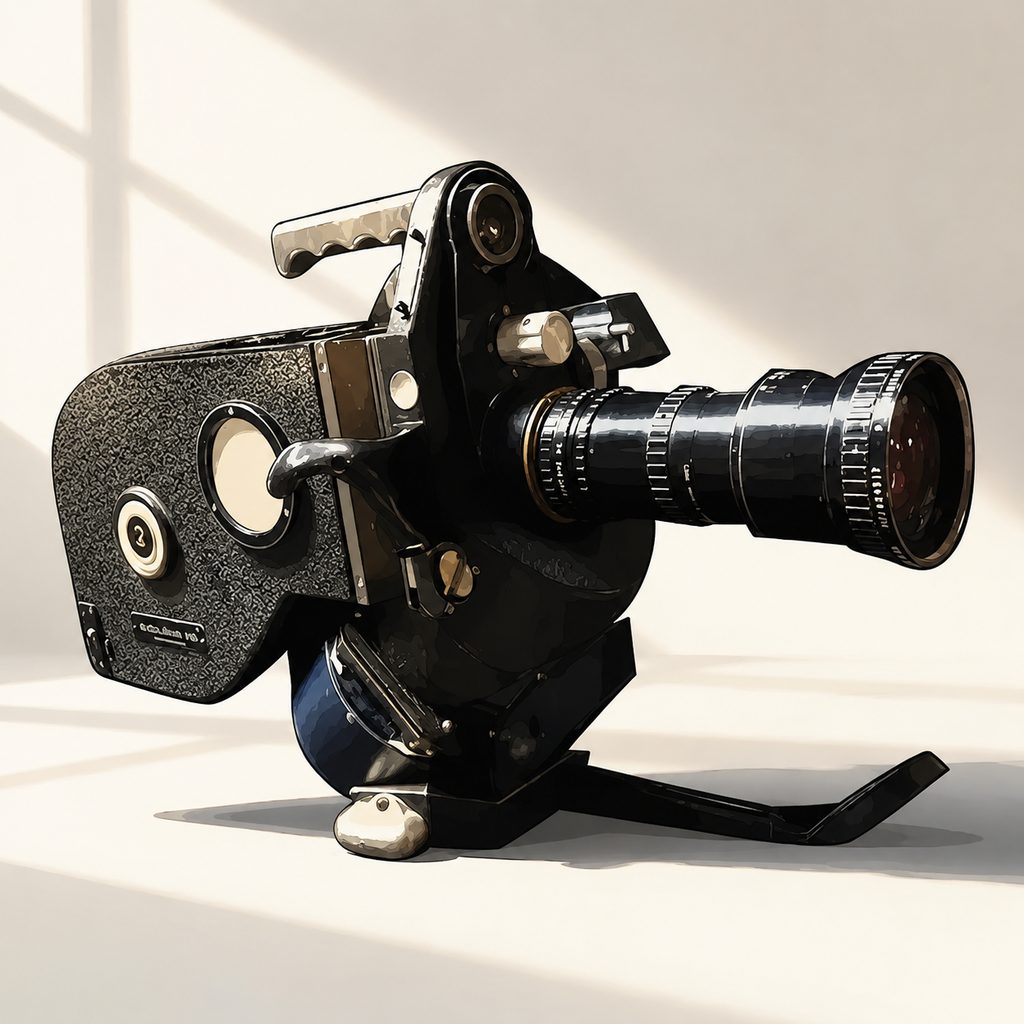
16mm camera with dampened mirror system, since 1963. Quiet enough for sync sound handheld work. Reflex viewfinder shows exactly what the lens sees — no parallax, precise framing while shooting.
The Eclair NPR (1963) – "NPR" stands for Noiseless Portable Reflex – was the first truly quiet, handheld 16mm film camera. With an operating noise of approximately 25 dBA, it enabled sync sound for handheld shots for the first time and revolutionized documentary filmmaking. Cinema Vérité and Direct Cinema would not have been possible without it.
| Feature | Value |
|---|---|
| Format | 16mm |
| Weight (Body) | 4.5 kg |
| Frame Rate | 8–40 fps |
| Shutter | 180° |
| Noise Level | ~25 dBA |
| Mount | C-Mount / Eclair |
| Magazine Capacity | 120m (400ft) |
The NPR enabled two revolutionary movements:
| Film | Year | Director |
|---|---|---|
| Chronique d'un été | 1961 | Jean Rouch |
| Le Joli Mai | 1963 | Chris Marker |
| Shoah | 1985 | Claude Lanzmann |
| Film | Year | Director |
|---|---|---|
| Primary | 1960 | Drew Associates |
| Salesman | 1969 | Maysles Brothers |
| Grey Gardens | 1975 | Maysles Brothers |
| Harlan County, USA | 1976 | Barbara Kopple |
French ethnologist and filmmaker Jean Rouch was crucial to the NPR's development:
TRADITIONAL: COAXIAL (NPR):
[Feed] [Feed]
 | |
 v v
[Camera] [Camera]
 | ^
 v |
[Take-up] [Take-up]

→ Wide sideways → Compact vertically
Advantage: Better balance for shoulder work.
| Camera | Noise Level | Weight | Sync Sound |
|---|---|---|---|
| Eclair NPR | ~25 dBA | 4.5 kg | Yes |
| Auricon | ~30 dBA | 6.5 kg | Yes |
| Bolex H16 | ~45 dBA | 2.2 kg | No |
| Arriflex 16 ST | ~40 dBA | 4.0 kg | No |
Conclusion: The NPR was the quietest professional camera of its time.
The classic documentary combination:
| Equipment | Function |
|---|---|
| Eclair NPR | Image |
| Nagra III/IV | Sound |
| Sennheiser 416 | Shotgun Microphone |
| Clapper Board | Synchronization |
| Variant | Year | Special Feature |
|---|---|---|
| NPR | 1963 | Original |
| NPR GV | 1967 | Improved viewfinder |
| NPR Super 16 | 1970s | Super-16 conversion possible |
The Eclair NPR is no longer produced, but:
| Aspect | Details |
|---|---|
| Used Price | €1,500–€4,000 |
| Availability | Rare, but available |
| Service | Specialized workshops |
| Spare Parts | Limited |
Die NPR war die erste Kamera, mit der ich echten Dokumentarfilm machen konnte – rausgehen, Menschen filmen, ihre Worte aufnehmen. Vorher war das unmöglich oder unbezahlbar. Sie hat meinen Beruf verändert.
Mit der NPR konnte ich Realität filmen, nicht nur inszenieren. Jean Rouch hat mit ihr eine neue Filmsprache erfunden. Für Dokumentarfilmer war sie so wichtig wie die Arriflex für den Spielfilm.
Die NPR machte professionelle Dokumentarfilme mit kleinem Budget möglich. Zwei Leute, eine Kamera, ein Nagra – das war alles. Sie demokratisierte das Genre.
1. Was beschreibt „Eclair NPR" am besten?
2. Zu welchem Department gehört „Eclair NPR"?
3. Wie viele verschiedene Fachperspektiven bietet dieser Eintrag?
The Lexikon is part of the Filmfarm ecosystem — alongside budgeting (FilmBalance), an industry magazine (FilmCircus) and crew networking (FilmCall, CrewMesh). One shared vocabulary for the whole production.