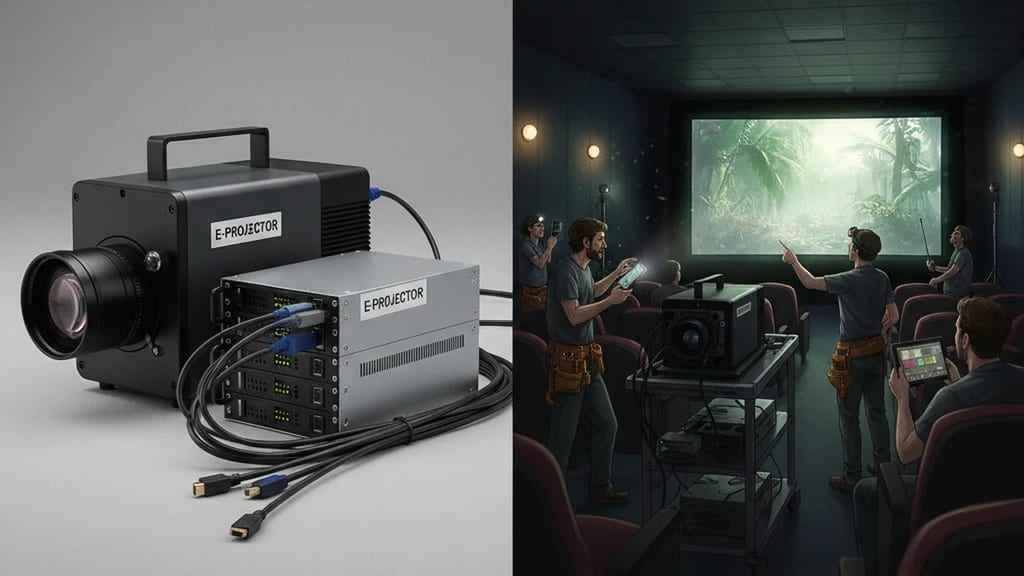
Unspecified digital cinema projection — between DCI and commercial projectors. Cheaper than DCI, but image quality less controlled; no fixed standard.
You're in the edit suite, and your producer asks if the file will also play in smaller cinemas – without the expensive DCI certifications. This is the reality of E-Cinema: digital projection in cinema auditoriums that cannot or do not want to afford a full DCI infrastructure. It's neither television nor true DCI standard – but the practical compromise between them.
E-Cinema runs on standard computer projectors, LED systems, or more affordable digital cinema equipment that doesn't meet strict SMPTE certifications. The problem: there's no unified technical specification. While DCI precisely dictates 4096 × 2160 pixels, specific color spaces (DCI-P3), and lamp stability, E-Cinema accepts anything between 2K and 4K – depending on what the operator has. Some cinemas have Sony F65 projectors, others work with standard high-end projectors. The consequence: your grading decisions end up with completely different color reproduction on screen.
In practice, this means for your work: you cannot rely on a consistent output chain. For DCI titles, you create a DCP (Digital Cinema Package), test in an authorized cinema monitor, and know that the next 500 cinemas will look identical. For E-Cinema releases, you need robust grading that still works on poorly calibrated, brighter projectors – less contrast fine-granularity, larger safety margins in the shadow and highlight areas. Many European and Asian arthouse cinemas, second-run theaters, and smaller metropolitan multiplexes use E-Cinema. Festivals also resort to it when they don't work exclusively with DCI operators.
The technical preparation differs fundamentally from the DCI workflow (see also: DCI-P3, Digital Cinema Package, Colorspace). You typically encode to H.264 or ProRes, deliver in multiple versions (2K and 4K), and give operators greater flexibility in playback. Quality control is less deterministic – you ensure that your image composition remains legible even on poorer hardware. This sounds like a step backward, but it has become economically indispensable for hundreds of smaller cinemas.
Related terms
Quiz
1. Zu welchem Department gehört „E-Cinema"?