Technical Details
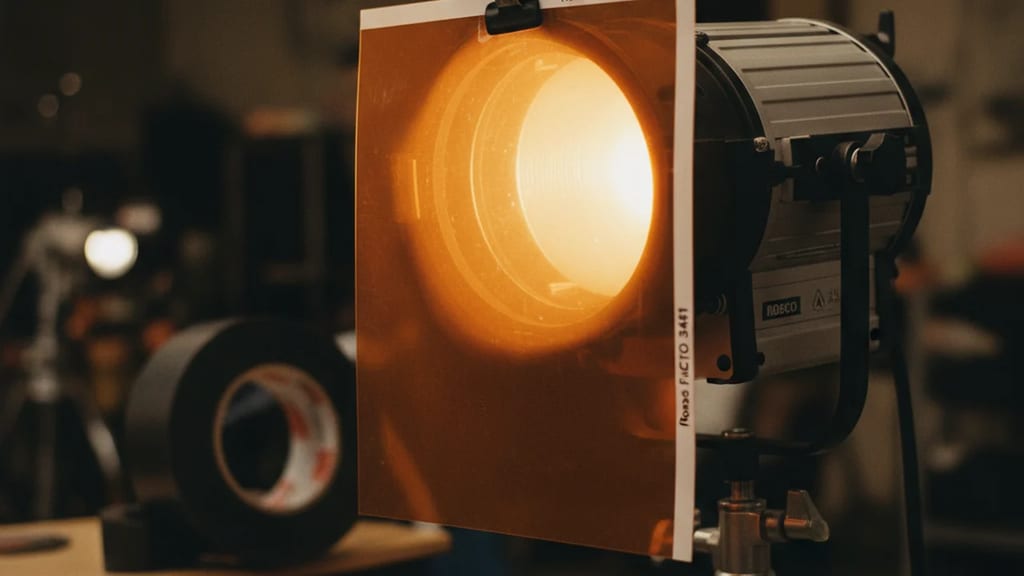
CTO gels are manufactured in various density gradations: Full CTO reduces 2400K, 3/4 CTO approximately 1800K, 1/2 CTO reduces 1200K, and 1/4 CTO approximately 600K. The gels are made of heat-resistant polyester with a thickness of 0.125mm and can withstand temperatures up to 150°C. Manufacturers like Lee Filters (Orange 204), Rosco (3407), or GAM offer different transmission values: Full CTO transmits about 60% of the original light, thus reducing the light output accordingly. The spectral transmission primarily filters out blue wavelengths between 400-500nm.
History & Development
Lee Filters developed the first standardized CTO gels for television and film production in 1971. Previously, cinematographers used improvised solutions like amber glass or colored gelatin filters. Rosco followed in 1975 with a competing system. The introduction of HMI lights in the 1970s increased the demand for precise color temperature corrections. Modern LED panels with variable color temperature have reduced the use of CTO gels since 2010, but they remain standard for window treatments and with tungsten lights.
Practical Use in Film
For interior shots with mixed lighting, the lighting department applies CTO gel to windows to match incoming daylight to the 3200K artificial lighting. Cinematographer Roger Deakins used large-scale CTO window treatments for the warm interior scenes in "Blade Runner 2049" (2017). Alternatively, HMI lights are fitted with CTO to be used as artificial light sources. The light loss due to the gel requires correspondingly stronger lights or longer exposure times. For night shots, daylight lights equipped with CTO gel create warm accent lights without additional tungsten fixtures.
Comparison & Alternatives
CTB gel (Color Temperature Blue) works in the opposite way, converting 3200K to 5600K. Plus Green and Minus Green correct magenta-green shifts in addition to color temperature. Variable LED panels replace CTO gels for fixture correction, but not for window treatments. Color temperature mixing modes of modern cameras reduce correction effort but require precise white balance workflows. ND-CTO combination gels combine neutral density with color temperature correction for exterior shots with open apertures.