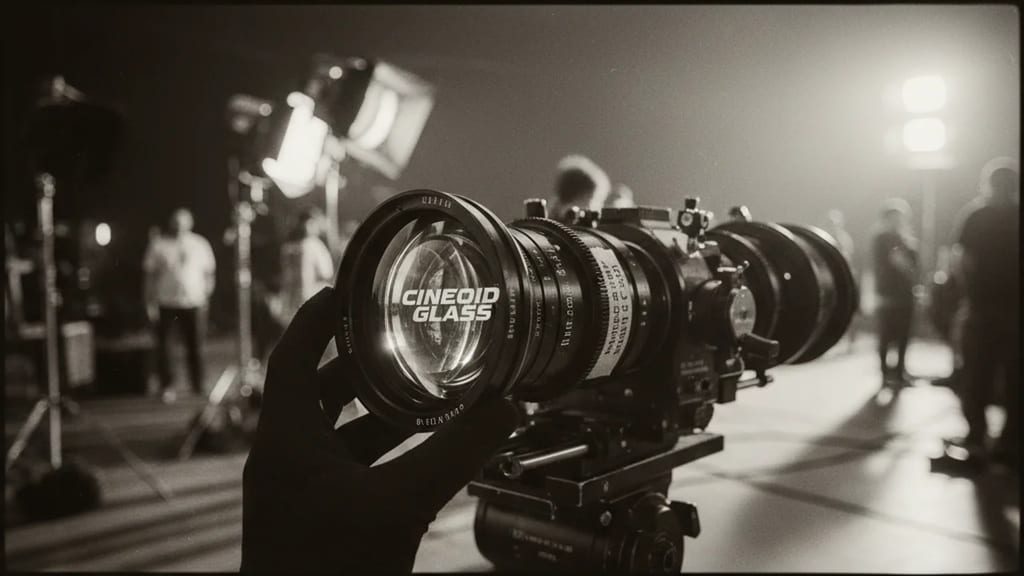
Specialized lens glass with minimal dispersion and aberration — delivers extreme sharpness across focus range. Standard in high-end cinema lenses.
When shooting with high-end cine lenses, you immediately notice the difference: these glasses maintain consistent sharpness across the entire focus range — without color fringing, without softening in the corners. This is thanks to a special optical composition that minimizes dispersion and spherical aberration. Dispersion is the problem where light is broken down into different wavelengths upon refraction — red refracts differently than blue. With standard lenses, you see this as a fine color smudge on high contrasts. Cineoid glass solves this through precise glass alloys and multi-layer coatings that direct all wavelengths identically.
Practically, this means you can consistently work with wider aperture openings — T/2.8 or wider — without image quality collapsing. On a digital camera with an 8K sensor, every optical flaw is magnified infinitely. With standard lenses, you immediately see chromatic aberration in post-production, especially on textured objects like treetops or building facades. With cineoid glass? Practically non-existent. Focus remains clean across the entire subject area — whether close-up or background.
Manufacturing is complex. Each element is ground with high precision, and the air gaps between the lenses are in the micrometer range. This is reflected in the price: a 24mm cine lens with true optical standards quickly costs 50,000–100,000 Euros. But if you're shooting for a feature film or need UHD productions without retouching overhead, these aren't toy expenses — they are fundamental investments. Zoom lenses with this glass quality are even rarer and more expensive.
On set, you primarily need these glasses under two conditions: first, when you want to work with extreme apertures and shallow depth of field — otherwise, optical flaws become visible as a shimmering blur. Second, when your post-grading becomes extremely critical — color casts from aberration distort your entire color correction. With cineoid glass, you save hours there. Longevity is another point: these optics last 20–30 years, while standard zoom lenses show optical wear after 5–10 years.
Related terms
Quiz
1. Was beschreibt „Kino-Glas" am besten?
2. Zu welchem Department gehört „Kino-Glas"?