Filmlexikon.
Support
CBR
Camera · Technique

CBR

Murnau AI illustration
cbb cooled back boilerplate vbr camera car cable cam

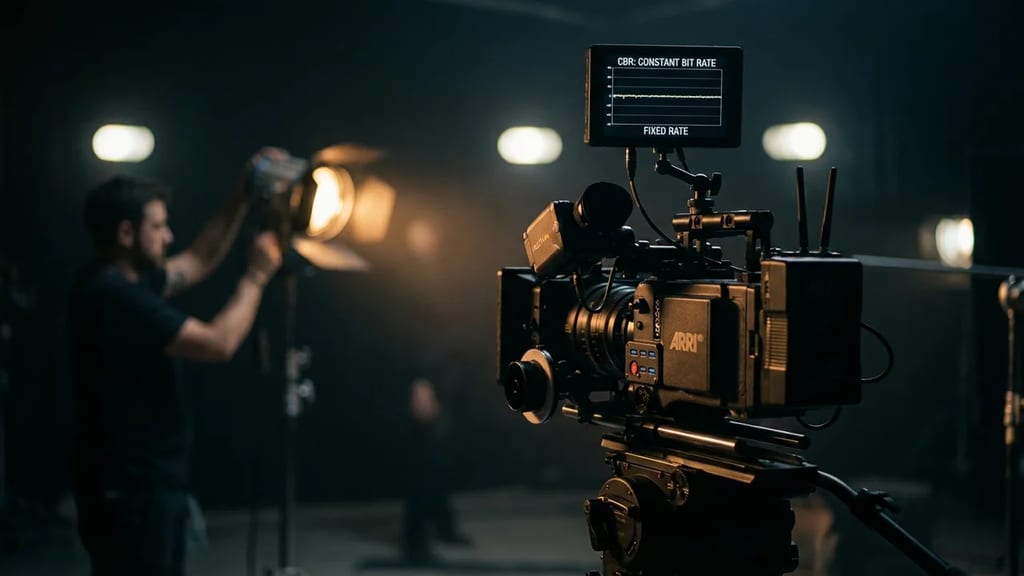
Constant Bit Rate encoding maintaining fixed data rate throughout the video.

Technical Details

CBR encoding works with fixed time windows (usually 1 second) in which exactly the specified amount of data is used. With complex image content featuring many details or fast movements, quality can decrease as fewer bits are available. Simple scenes with static images, on the other hand, waste storage space. Standard CBR values: DVD 9.8 Mbps, Blu-ray 25-40 Mbps, Digital Cinema Packages (DCP) 250 Mbps. The MPEG-2 codec uses CBR by default, while H.264 and H.265 support both modes.

History & Development

CBR emerged in 1993 with the first MPEG-1 implementations, as early hardware decoders could only process constant data rates. The 1995 DVD specification mandated CBR encoding to ensure compatibility with simple decoders. From 2003 onwards, more powerful processors also enabled Variable Bitrate (VBR), but CBR remained dominant for broadcast applications. Streaming services have primarily used CBR for live broadcasts since 2010.

Practical Application in Film

Television broadcasters use CBR for live transmissions, as the constant data rate prevents buffering issues. "Avatar" (2009) used CBR encoding for its 3D cinema copies at 125 Mbps per eye. Netflix encodes live streams with CBR 6-8 Mbps, while on-demand content uses VBR. In action films with complex explosion scenes, CBR often leads to visible compression artifacts because there are not enough bits available for the high image complexity.

Comparison & Alternatives

Variable Bitrate (VBR) adjusts the data rate to the image complexity and achieves better quality at the same file size. Constrained VBR (CVBR) combines both approaches with a maximum bitrate ceiling. CBR is suitable for real-time applications and hardware with limited buffer capacity. VBR is used for archiving and on-demand streaming, where quality is more important than constant data rates. Modern codecs like AV1 prefer VBR modes for optimal efficiency.
From the crafts

Perspectives

Cinematographer

Ich muss bei CBR-Workflows besonders auf gleichmäßige Ausleuchtung achten, da starke Helligkeitssprünge zu Blocking-Artefakten führen. Schnelle Kamerabewegungen oder komplexe Texturen wie Laub oder Wasser werden bei niedrigen CBR-Raten matschig, deshalb plane ich solche Einstellungen entsprechend. Bei Live-Übertragungen bevorzuge ich statischere Kameraführung, um die konstante Bitrate optimal zu nutzen.

Director

CBR zwingt mich zu bewussteren Entscheidungen bei actionreichen Sequenzen, da zu viele schnelle Schnitte die Bildqualität verschlechtern können. Ich plane Dialogszenen und ruhige Momente strategisch nach komplexen Actionsequenzen, damit sich die Codierung "erholen" kann. Bei Live-Produktionen achte ich darauf, dass visuell anspruchsvolle Szenen nicht zu lange andauern, um Qualitätsverluste zu minimieren.

Producer

CBR vereinfacht meine Kalkulation der Speicher- und Übertragungskosten, da ich exakt vorhersagen kann, wie viel Bandbreite benötigt wird. Für Broadcast-Verträge ist CBR oft vorgeschrieben, was die technischen Spezifikationen klar definiert. Die Postproduktion wird günstiger, da weniger Testläufe für die Bitrate-Optimierung nötig sind, dafür muss ich höhere Datenraten einkalkulieren als bei VBR.

More in the lexikon

Related terms

Test your knowledge

Quiz

1. Zu welchem Department gehört „CBR"?

2. Wie viele verschiedene Fachperspektiven bietet dieser Eintrag?

Report an error
From the Filmfarm ecosystem

Understand visual language, budget productions, connect crew.

The Lexikon is part of the Filmfarm ecosystem — alongside budgeting (FilmBalance), an industry magazine (FilmCircus) and crew networking (FilmCall, CrewMesh). One shared vocabulary for the whole production.

FilmFarm FilmRadarComing soonFilmPulseComing soonFilmNumbersComing soonFilmCapitalComing soonFilmLabComing soonFilmBalanceComing soonFilmCircusComing soon