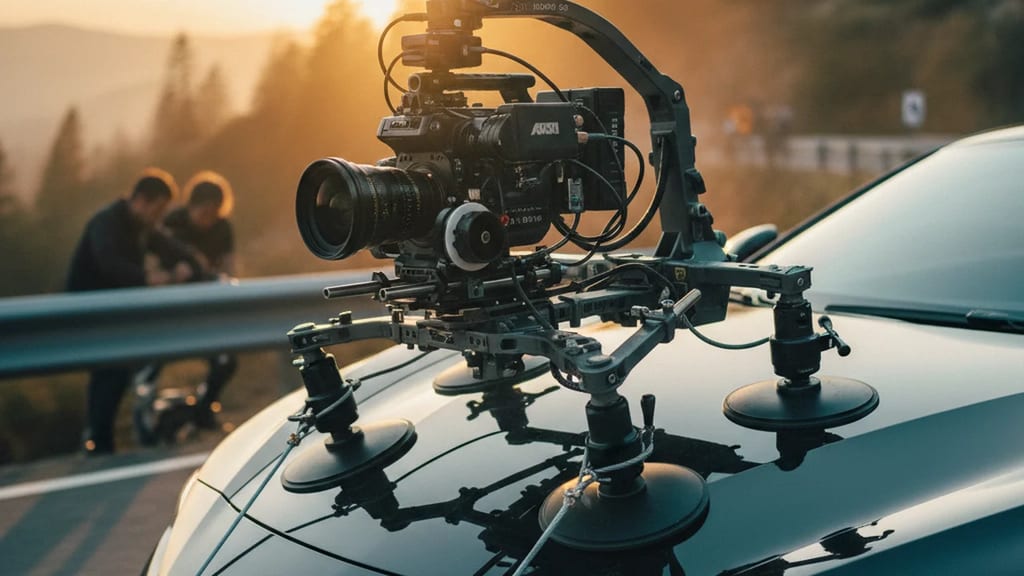
Camera mounting rig for vehicles using suction cups, magnets, or clamps for exterior or interior placement. Enables dynamic driving shots from hood, side window, or rear perspectives.
Technical Details
Modern car mounts consist of a base element (suction cup, magnetic base, or clamp), a ball joint for 360° rotation, and a camera plate with a 1/4"-20 or 3/8"-16 thread. Suction cup variants achieve holding forces of 150-300 kg with a diameter of 20-30 cm. Magnetic mounts use neodymium magnets with 80-150 kg of holding force. Professional systems like the Matthews Car Mount Kit offer hydraulic damping and weigh 8-12 kg. Vibration dampers reduce tremors by 70-85% at frequencies between 20-200 Hz.
History & Development
The first documented car mount was used by Claude Lelouch in 1966 for "A Man and a Woman," mounting an Arriflex 35 IIC on a Porsche, thereby achieving characteristic subjective driving sequences. In 1968, Peter Bogdanovich developed the first suction cup system for "Targets." The breakthrough came in 1971 with William Friedkin's "The French Connection" and its famous chase scene under the Elevated Train in Brooklyn. Since 2010, digital systems with remote control and live monitoring have dominated.
Practical Use in Film
"Baby Driver" (2017) used 37 different car mount positions for choreographed driving scenes. "Mad Max: Fury Road" (2015) mounted up to eight cameras simultaneously on modified vehicles. Typical positions: hood for driver reactions, side windows for profile shots, tailgate for pursuit scenes. Digital car mounts enable remote control over a range of 500 meters and live transmission in 4K resolution. Disadvantages: wind noise above 60 km/h, limited battery life (45-90 minutes), vibrations on poor road conditions.
Comparison & Alternatives
Gimbal systems like the DJI Ronin offer image stabilization but weigh 2-4 kg more and cost €8,000-€15,000 compared to €500-€2,000 for static car mounts. Drone pursuit is increasingly replacing external camera vehicles but requires flight permits. Crash cams use robust housings for stunt sequences and can withstand impacts up to 50g. Interior rigs with telescopic poles allow simultaneous shots of the driver and the road without external mounting.