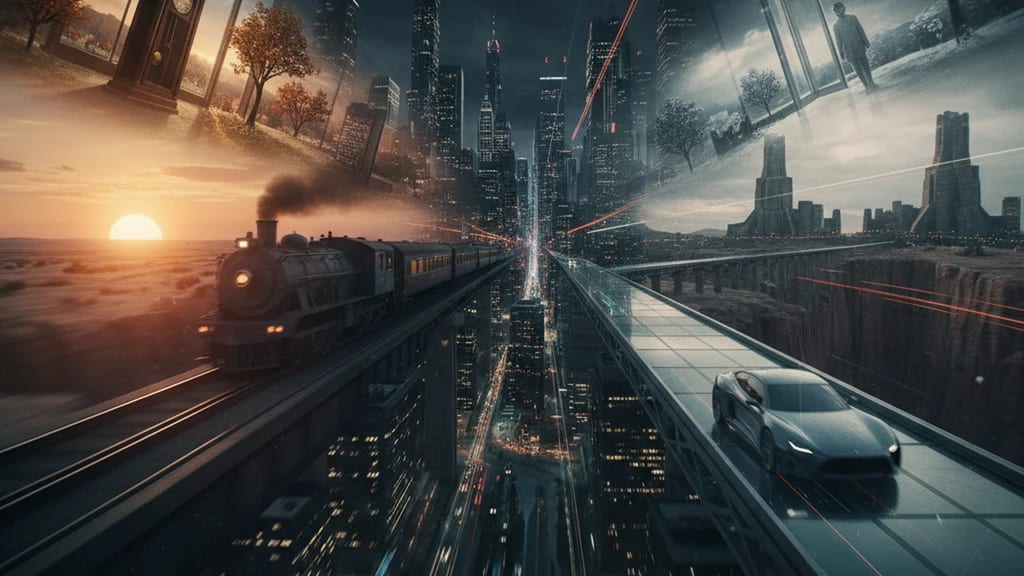
Transitional material between two main scenes — montage, establishing shots, travel. Connects locations or time jumps while maintaining momentum and mood.
You need your protagonist to get from the office to her apartment, but the journey itself tells nothing — then you are precisely in the realm of the bridge sequence. It is not a mistake in the script, but a conscious decision: you show something new without breaking the tension. A fast car ride through the city, the view from the taxi window at street signs, people on the sidewalk — these images not only bridge time and space, but also breathe the film itself, giving it air between the heavy scenes.
In editing, the bridge sequence works differently than a pure ellipsis, which simply omits something. Here, you consciously insert material that creates context or adjusts the emotional temperature. A slow tracking shot of a taxi ride lowers the energy before a quiet dialogue setup; a fast-cut montage run builds tempo. On set, you often shoot these sequences incidentally — not the main scene, but essential buffer shots. The classic example: the director finishes with scene A and then shoots the exterior shots of the journey while the actors are already changing costumes for scene B.
Practically, the bridge sequence only works if you take it seriously. It is not filler material. It needs a visual idea — color palette, movement, rhythm — that fits the overall aesthetic. Some directors use bridge sequences to change the image: from the confined apartment to the vastness of the street, from daylight to night. This is not only practical but also dramatically valuable. In thriller contexts, a bridge sequence can also ratchet up tension — the taxi drives slower, the music becomes more intense, cuts become shorter.
In digital editing, you have the freedom to adjust or expand bridge sequences afterward. Sometimes you only notice in the rough cut that a transition is too abrupt — then you add another short driving shot or an establishing cut. This saves you reshoots. But beware: too many bridge sequences, inserted too often, and the film becomes sluggish. The rhythm of the entire edit must be right.
Related terms
Quiz
1. Zu welchem Department gehört „Zwischensequenz"?