Technical Details
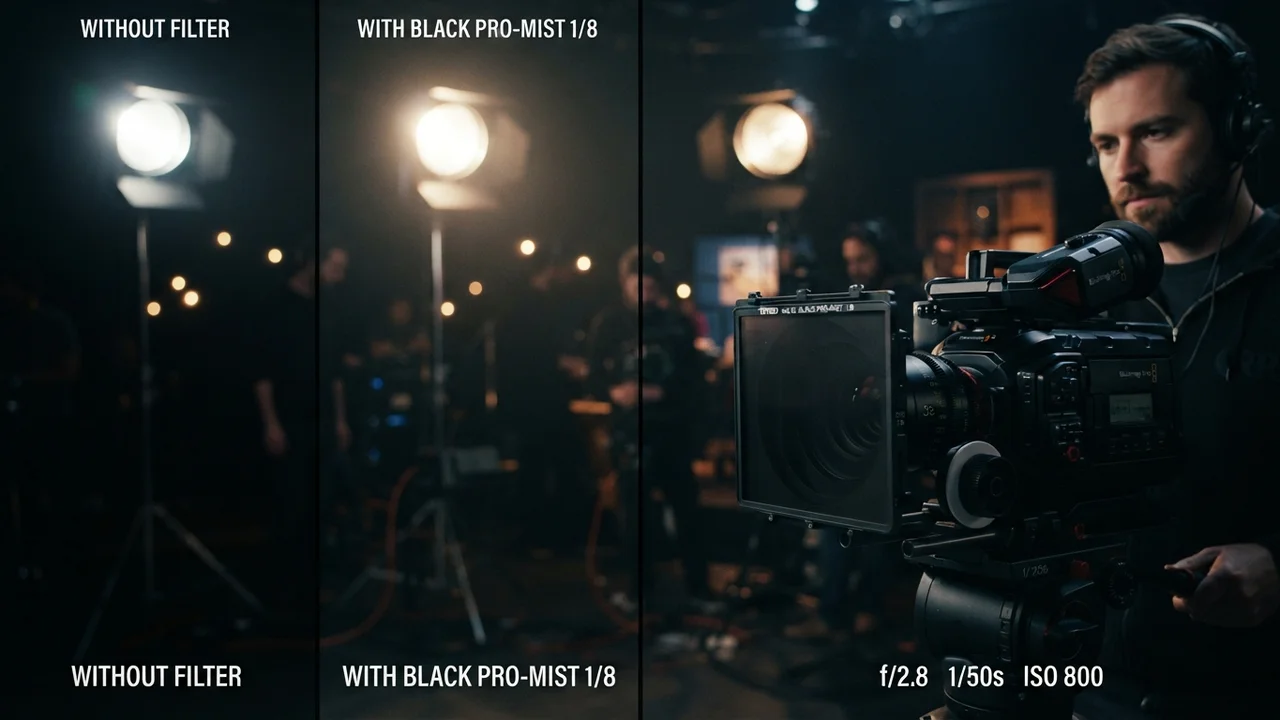
Black Pro Mist filters are available in strengths of 1/8, 1/4, 1/2, 1, 2, and 3, with higher numbers indicating stronger diffusion. The filter reduces effective sharpness by 10-40% depending on the strength, while diffusing highlights by 0.3-1.5 stops. The black particles are composed of carbon compounds with a size of 2-15 micrometers. Standard thread sizes range from 49mm to 127mm; for professional matte box systems, 4x4", 4x5.65", and 6.6x6.6" formats are available.
History & Development
Tiffen developed the Black Pro Mist in 1978 as an evolution of the classic Pro Mist filter from 1975. The addition of black particles was intended to solve the problem of color desaturation that occurred with pure diffusion filters. In the 1980s, the filter established itself as a standard in Hollywood, especially for portraits and romantic scenes. Digital technology amplified demand from 2000 onwards, as digital sensors often produce images that are too "clinically" sharp.
Practical Application in Film
Roger Deakins used Black Pro Mist 1/4 for the prison scenes in "The Shawshank Redemption" (1994) to soften harsh shadows. In "Euphoria" (2019-2022), Marcell Rév consistently employs Black Pro Mist 1/8 to 1/2 to create the series' characteristic glowing look. The filter is particularly effective with backlight and practical light sources, as it creates natural halos around points of light. In daylight, it reduces harsh contrasts without excessively affecting image sharpness.
Comparison & Alternatives
Unlike the classic Pro Mist, Black Pro Mist maintains original color saturation. Glimmer glass creates stronger streaks, while Black Pro Mist diffuses evenly. Digital post-production effects can create similar looks but do not achieve the natural light diffusion of true optical filters. Schneider Black Frost offers comparable properties but tends to reduce contrast more significantly. Newly emerging OLPF (Optical Low Pass Filters) in cameras partially replace weak diffusion but do not achieve the specific aesthetic of the Black Pro Mist.