Definition
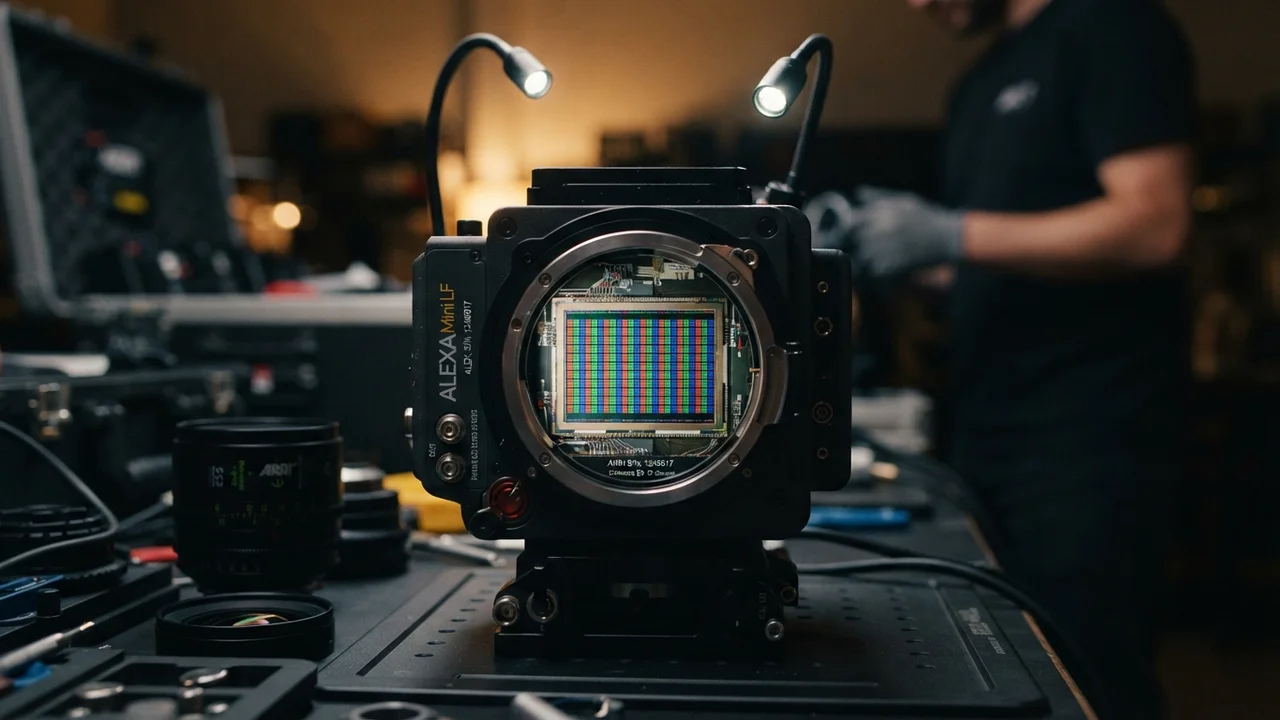
The Bayer pattern refers to a specific arrangement of color filters on digital image sensors, where red, green, and blue filters are distributed in a defined grid over individual photosites. The classic configuration consists of 50% green, 25% red, and 25% blue filter elements, with each 2x2 pixel group containing two green (diagonally arranged), one red, and one blue filter. It is named after Kodak engineer Bryce Bayer, who patented this method in 1976.
Technical Details
The standard RGGB (Red-Green-Green-Blue) distribution is based on the human eye's higher sensitivity to green light at a wavelength of 555 nanometers. Modern sensors use Bayer patterns with pixel sizes ranging from 1.4 μm (smartphone sensors) to 8.4 μm (high-end cinema cameras like the ARRI ALEXA LF). Variants include RGGB, BGGR, GRBG, and GBRG, where the arrangement defines the position of the first pixel in the upper left corner. Demosaicing algorithms interpolate a full RGB image from the raw data, employing modern methods such as AHD (Adaptive Homogeneity-Directed) or VNG (Variable Number of Gradients).
History & Development
Bryce Bayer developed the pattern in 1974 at Eastman Kodak and received US Patent 3,971,065 in 1976. Its first commercial application was in Kodak's DCS-100 in 1986, a modified Nikon F3. Canon implemented the Bayer pattern in 1995 with the EOS DCS 3, the first digital SLR camera under $10,000. In 2007, RED expanded the concept to 4K resolution with the RED ONE, while ARRI set new standards for Bayer-based cinema cameras in 2010 with the ALEXA.
Practical Use in Film
Productions such as "Skyfall" (2012, shot with ARRI ALEXA) or "Gone Girl" (2014, RED Epic Dragon) utilize Bayer sensors for their color science. The workflow requires RAW recording in formats like ARRIRAW or R3D, followed by debayering in post-production with software like DaVinci Resolve or ARRI Color Tool. Advantages include high resolution per sensor and established demosaicing algorithms. Disadvantages manifest in moiré effects with fine patterns and the necessity of computationally intensive interpolation.
Comparison & Alternatives
Foveon sensors (Sigma) use vertical RGB layering instead of lateral filter distribution, but achieve limited ISO values. Fujifilm's X-Trans pattern varies the classic Bayer scheme for moiré reduction. Three-chip systems, as found in the Sony FX9 or Panasonic Varicam, separate light through prisms onto separate RGB sensors, completely avoiding demosaicing, but they are more expensive and require larger housings. For documentary work on a limited budget, the Bayer pattern dominates due to proven processing pipelines.