Filmlexikon.
Support
Battery Plate
Camera · Terms

Battery Plate

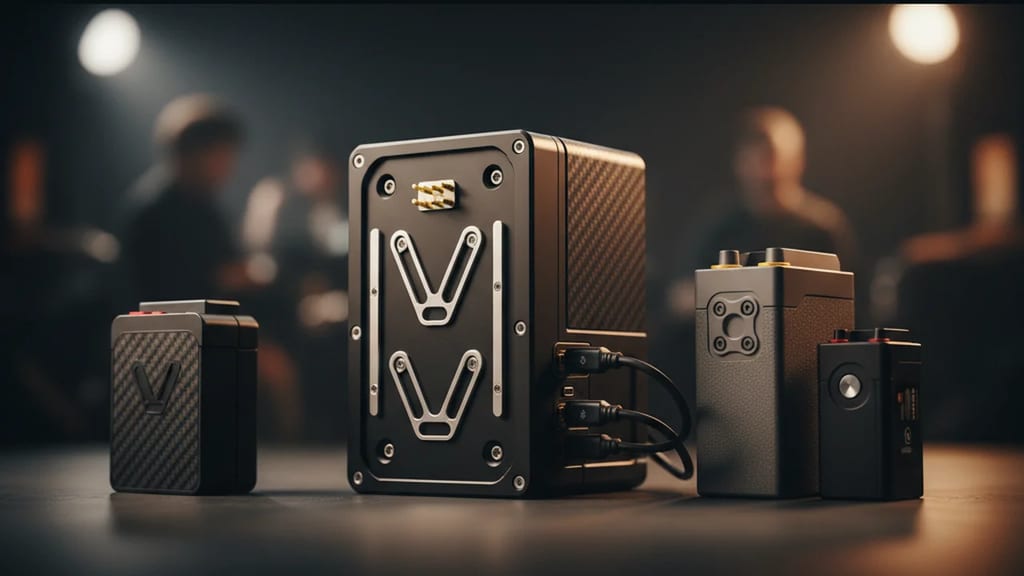
Murnau AI illustration
flow para roll take

Adapter plate for mounting V-Mount or Gold-Mount batteries on cameras and equipment, delivering 5V–15V via D-Tap, USB, or barrel connector.

Technical Details

Battery plates operate with 12V or 14.4V input voltage and deliver various voltages between 5V and 15V via D-Tap outputs (4-pin XLR), USB ports, or barrel connectors. V-Mount plates use three spring-loaded contact pins for power transmission, while Anton Bauer Gold Mount relies on four contacts. High-quality plates integrate voltage regulators, overload protection, and LED capacity indicators. Mounting is achieved via 1/4"-20 or 3/8"-16 threads, sometimes with additional 15mm rod mounts.

History & Development

Anton Bauer developed the first Gold Mount system for portable ENG cameras in 1970. Sony introduced the V-Mount system in 1999, characterized by a more robust locking mechanism and higher power capacities. RED digitized the market in 2007 with modular battery plates for their DSMC cameras. Since 2015, modern plates support intelligent battery communication via SMBus protocol for precise runtime displays.

Practical Application in Film

On "Mad Max: Fury Road" (2015), custom V-Mount plates enabled the operation of Blackmagic cameras on vehicles during over 12-hour shooting days. Steadicam operators prefer ultra-light carbon plates under 200g. Netflix productions rely on redundant dual battery plates for uninterrupted recording in 8K workflows. D-Tap outputs simultaneously power monitors, wireless systems, and follow-focus systems with up to 80W total output.

Comparison & Alternatives

V-Mount dominates digital cinema cameras (ARRI Alexa, RED), while Gold Mount is primarily used in ENG equipment. Core SWX developed the Nano Mount system in 2018 for drone cameras under 2kg. Permanently integrated batteries in consumer cameras offer no modularity but a more compact design. Hot-swappable plates allow battery changes without interruption, but cost 300-800 Euros compared to 80-200 Euros for standard versions.
From the crafts

Perspectives

Cinematographer

Ich brauche Akkuplatten mit mindestens zwei D-Tap-Ausgängen, um Monitor und Funkstrecke parallel zu versorgen. Bei Handheld-Aufnahmen achte ich auf das Gewicht – über 500g verschiebt sich der Schwerpunkt merklich und macht längere Takes anstrengend. Die Kapazitätsanzeige muss präzise sein, denn nichts ist schlimmer als ein Akkuausfall mitten in der perfekten Einstellung.

Director

Akkuplatten sind für mich unsichtbare Infrastruktur, aber sie bestimmen die Mobilität meiner Kamera. Mit leistungsstarken V-Mount-Systemen kann ich spontane 20-Minuten-Takes fahren, ohne über Stromversorgung nachzudenken. Bei intimen Szenen bevorzuge ich kompakte Setups – da entscheidet die Akkuplatte über die Kameraführung und damit über die emotionale Wirkung der Aufnahme.

Producer

Pro Kamerateam kalkuliere ich 2-3 Akkuplatten plus sechs Akkus für 12-Stunden-Drehtage. V-Mount-Akkus kosten 400-800 Euro, halten aber 3-5 Jahre bei professionellem Einsatz. Einheitliche Akkusysteme reduzieren Logistikkosten und Ausfallrisiken erheblich – verschiedene Standards bedeuten doppelte Lager und Ladegeräte.

More in the lexikon

Related terms

Test your knowledge

Quiz

1. Zu welchem Department gehört „Akkuplatte"?

2. Wie viele verschiedene Fachperspektiven bietet dieser Eintrag?

Report an error
From the Filmfarm ecosystem

Understand visual language, budget productions, connect crew.

The Lexikon is part of the Filmfarm ecosystem — alongside budgeting (FilmBalance), an industry magazine (FilmCircus) and crew networking (FilmCall, CrewMesh). One shared vocabulary for the whole production.

FilmFarm FilmRadarComing soonFilmPulseComing soonFilmNumbersComing soonFilmCapitalComing soonFilmLabComing soonFilmBalanceComing soonFilmCircusComing soon