Overview
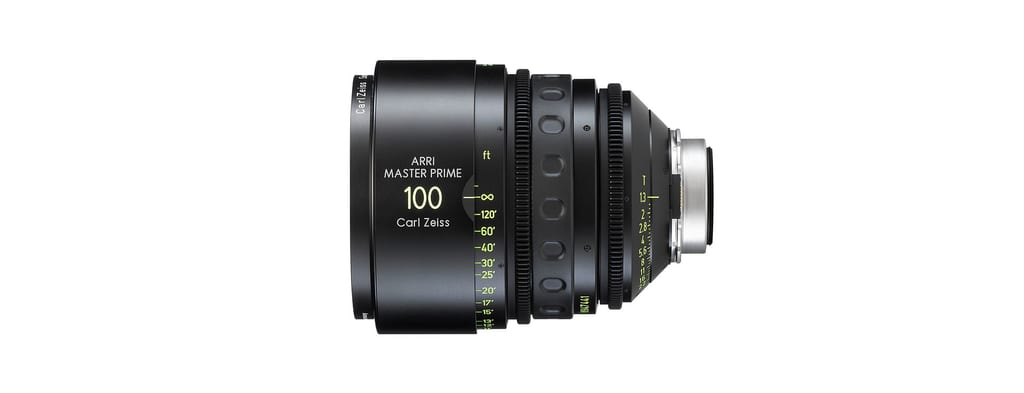
The Master Primes are a series of spherical prime lenses, jointly developed by ARRI and Carl Zeiss and introduced in 2005. For years, they have been among the most widely used high-end lenses in cinema and high-end commercial production. Key features include a consistent aperture of T1.3 across almost the entire focal length range, high contrast, very minimal focus breathing, and a uniform characteristic throughout the series. The lenses are designed for the Super 35 format and are attached to the camera via the standardized PL mount.
Technical Features
- Type: Spherical prime lenses for motion pictures
- Aperture: T1.3 (consistent across almost the entire focal length range)
- Mount: PL mount
- Image Circle: Super 35
- Diaphragm: Iris with at least nine blades for round, soft bokeh
- Coating: ZEISS T*XP coating to reduce reflections and stray light
- Construction: Aspherical elements and floating elements for good close-focus performance and minimal breathing
- LDS: Integrated ARRI Lens Data System for transmitting lens data (e.g., focus, aperture, focal length) to compatible cameras
Focal Length Set
The set comprises a total of 16 focal lengths, which were added over several years. The original series (2005) consisted of 16, 18, 21, 25, 27, 32, 35, 50, 65, 75, and 100 mm; 14 mm and 150 mm followed in 2007, the 12 mm in 2010, and the 135 mm was introduced in 2011.
| Specification | Value |
|---|
| Focal Lengths | 12, 14, 16, 18, 21, 25, 27, 32, 35, 40, 50, 65, 75, 100, 135, 150 mm |
| Maximum Aperture | T1.3 |
| Front Diameter | 114 mm standard (Exceptions: 12 mm with 156 mm and 150 mm with 134 mm) |
On-Set Usage
The high aperture of T1.3 allows for shooting in low light conditions and achieving very shallow depth of field for precise subject isolation. Due to minimal breathing, the lenses are particularly suitable for focus pulls and pans where a visible change in image size during focusing would be disruptive. The uniform 114 mm front diameter (with the exception of the 12 mm and 150 mm, which have different front diameters) simplifies the attachment of matte boxes, filters, and follow focus units in daily grip and camera work, as lens changes within the standard focal lengths usually do not require re-rigging. Through the LDS, lens data can be directly transferred to compatible ARRI cameras and metadata workflows, which is particularly relevant for VFX pipelines.