Overview
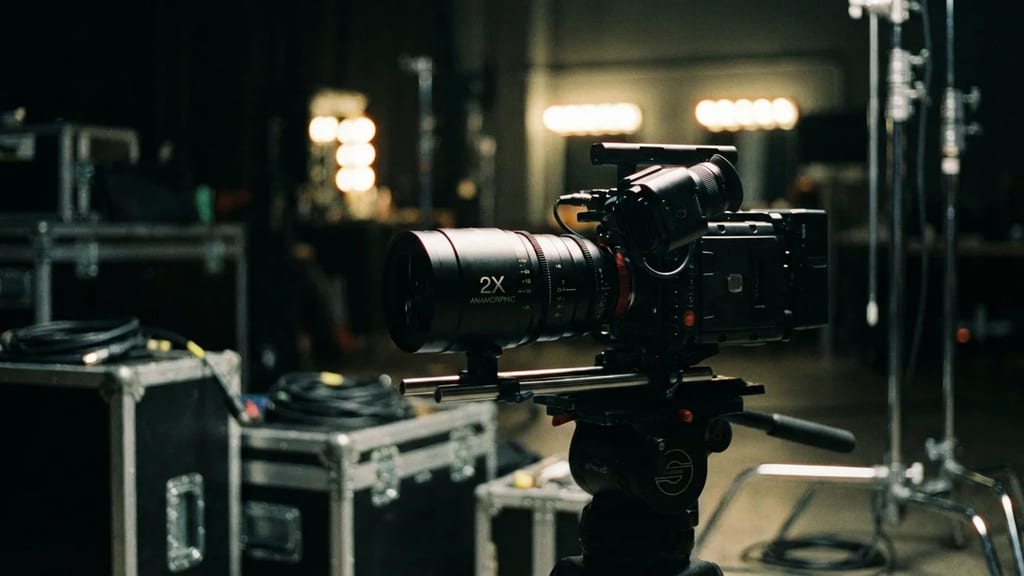
"2x Anamorphic" does not refer to a specific manufacturer or device, but rather to the squeeze factor of an anamorphic cinema lens optic. A 2x anamorphic lens compresses the image horizontally by a factor of 2 onto the sensor or film negative during recording. Only during "desqueeze" – in post-production or earlier in the projector – is the image stretched back to double its width, appearing in the wide cinema aspect ratio.
Practically, a 2x anamorphic lens captures twice the horizontal field of view of a spherical optic with the same focal length. The factor of 2.0 is considered the classic, "original" anamorphic standard and delivers the strongest anamorphic image characteristics.
Functionality and Aspect Ratio
The cylindrical elements within the lens compress only the horizontal axis. The squeezed image initially appears narrow and distorted in the viewfinder; the final widescreen image is created by stretching it by a factor of 2 (desqueeze).
The resulting aspect ratio depends on the recording format used:
| Recording Format | After 2x Desqueeze (approx.) |
|---|
| 4-perf 35mm (approx. 4:3 / 1.33:1 image area) | ~2.66:1, cropped to Scope |
| Open-Gate ~6:5 sensor | ~2.39:1 (Scope) |
| 16:9 sensor | ~3.55:1 (extremely wide) |
Modern digital cinema cameras can typically de-squeeze the 2x signal internally, so that the monitor image on set is already displayed with correct proportions.
Historical Background
The 2x squeeze is the historical starting point of anamorphic cinema. CinemaScope (20th Century Fox, 1953) used a 2x process on 4-perf 35mm, resulting in a 2.35:1 aspect ratio; in 1970, the SMPTE standardized the Scope aspect ratio to 2.39:1 by slightly reducing the image gate – this helped to better mask the splice points of the negative assembly (roll splices), which could otherwise appear as a brief "flash" at the top of the frame. Panavision's "Auto Panatar" optics subsequently established the 2x anamorphic lens as an industry standard.
On-Set Usage and Image Character
Compared to weaker squeezes (1.33x, 1.5x, 1.8x), the 2x factor delivers the most pronounced anamorphic characteristics: oval bokeh, emphasized horizontal lens flares, and the distinctive "Cinemascope look." Typical 2x anamorphic lenses are from Cooke, Panavision (G-, C-, E-Series), Hawk, Kowa, Arri/Zeiss (Master Anamorphic), and Atlas (Orion), among others.
- Due to the strong squeeze, 2x is particularly suitable for open-gate or 4:3 recording formats; on pure 16:9 sensors, the image becomes very wide and narrow.
- Depth of field, breathing, and the mumps effect are more pronounced with 2x than with lower squeeze factors.