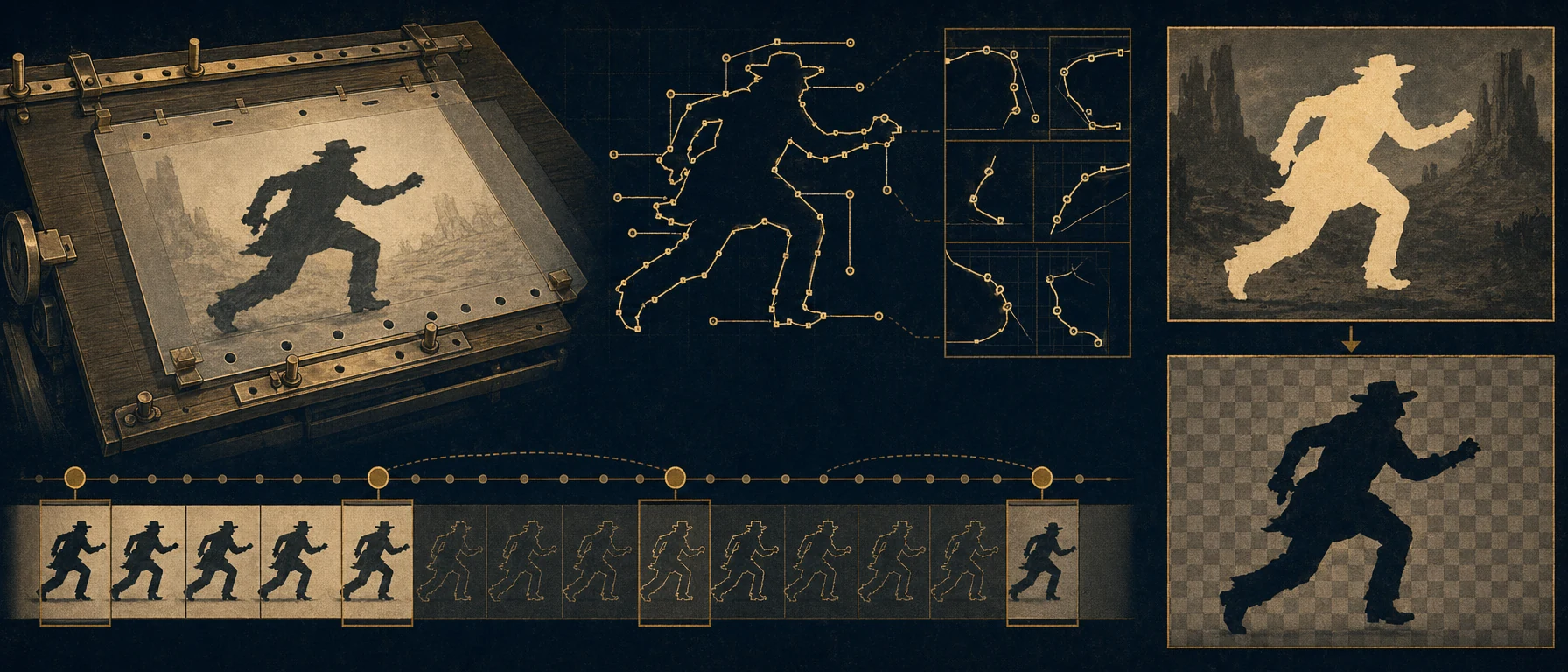
Short for rotoscoping - manually creating mattes frame by frame for compositing.
Technical Details
Modern roto software like Nuke, After Effects, or Silhouette works with Bézier curves and keyframe interpolation between distinctive image points. Professional roto artists create masks with a tolerance of ±0.5 pixels at 2K resolution. Standard workflows use 8-16 control points per simple contour; complex hair edges require up to 200 points. Motion blur is simulated by feathering of 2-8 pixels, up to 16 pixels for fast camera pans.
History & Development
Max Fleischer developed the mechanical rotoscope in 1917 for his "Out of the Inkwell" series. Disney perfected the technique in 1937 for "Snow White," using live actors as reference. Industrial Light & Magic digitized rotoscoping in 1977 for "Star Wars" for lightsaber animation. From 1993 onwards, digital compositing systems like Flame and Henry enabled more precise masks. Software developments such as Nukex (2007) and mocha Pro (2011) introduced planar tracking algorithms that reduced manual keyframe work by 60-80%.
Practical Use in Film
"Sin City" (2005) used complete rotoscoping for a stylized black-and-white aesthetic with selective color accents. "300" (2006) required 1,500 roto shots for greenscreen integration and blood effects. Marvel productions use roto as standard for costume replacements: "Iron Man" needed 800 roto shots for CGI suit integration. Documentaries use roto for facial anonymization – typical cost: 150-300 Euros per minute for simple geometries.
Comparison & Alternatives
Chroma keying offers more cost-effective object separation but requires controlled lighting conditions and special backgrounds. Machine learning tools like Runway ML or Adobe's Content-Aware Fill automate simple roto tasks with 85% accuracy but need manual post-processing for professional standards. Motion tracking-based roto tools reduce working time on planar objects by up to 70% but fail with complex deformations or occlusions. Depth map-based separation from stereoscopic cameras achieves sufficient precision for high-end compositing only with static subjects.