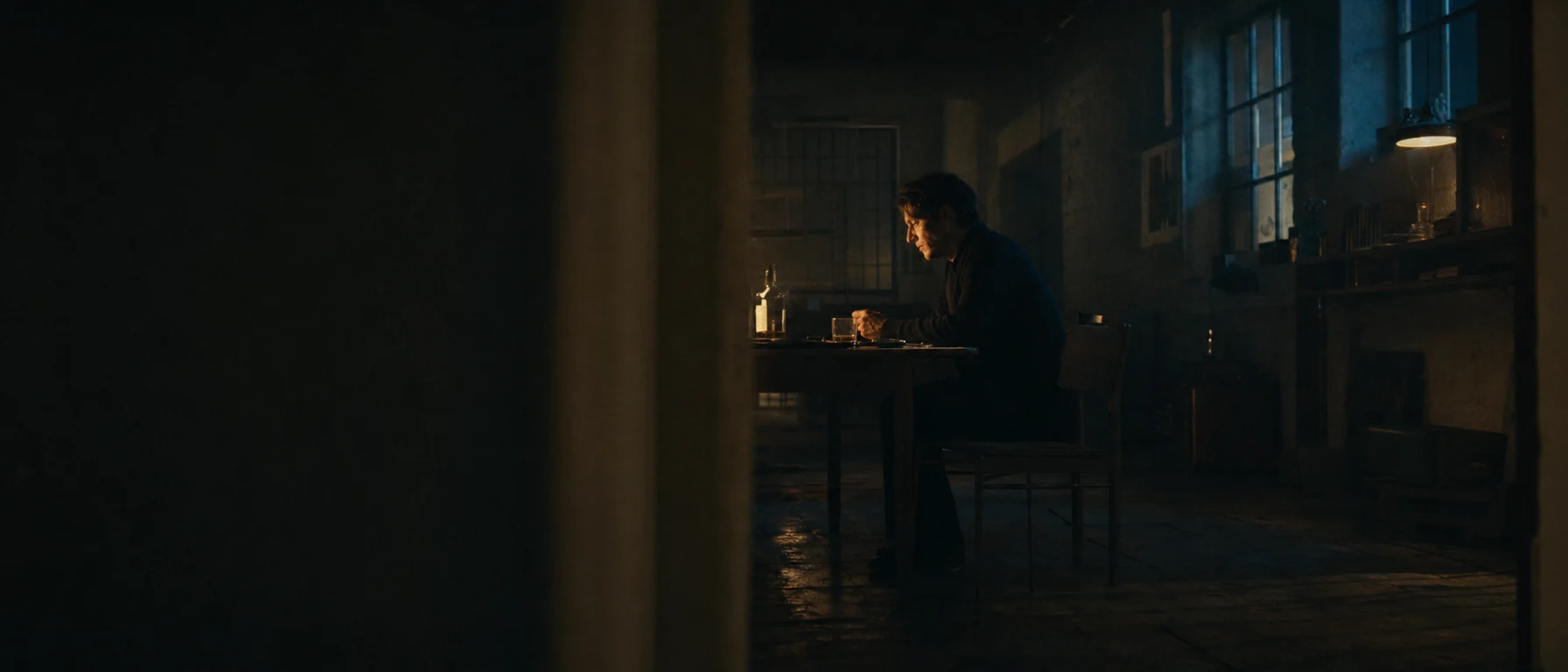
Camera movement via pan, tilt, or crane that progressively reveals new compositional elements and reframes spatial relationships.
Technical Details
Classic reveal shots utilize track dollies with speeds between 0.3-4 m/s, with the optimal reveal speed being 1.2-2.1 m/s. Modern Steadicam systems enable more complex movement patterns with up to 6 degrees of freedom. Crane shots for vertical reveals operate with lift speeds of 0.8-2.5 m/s at maximum reaches of up to 30m. Digitally, reveals are executed through programmed gimbal movements with precision control to an accuracy of ±0.1°. Three main variants: Horizontal Reveal (lateral movement), Vertical Reveal (crane/drone), and Rotation Reveal (pan of 90-270°).
History & Development
Orson Welles perfected the reveal shot in 1941 in "Citizen Kane" through 40-second crane movements that visually articulated narrative turning points for the first time. The technique gained new dimensions in 1958 with Hitchcock's "Vertigo" through the famous dolly zoom reveal in the bell tower. Steadicam developer Garrett Brown revolutionized the reveal in 1980 with fluid handheld movements in "The Shining." Digital camera systems since 2010 have enabled programmable motion-control reveals with millimeter-precise repeatability for VFX integration.
Practical Application in Film
Kubrick's 237-meter reveal in "The Shining" (hotel corridor sequence) required three Steadicam operators working in shifts. Scorsese combines a 184-second Steadicam shot with four reveal moments in "Goodfellas" (Copacabana sequence). Modern blockbusters utilize Technocrane reveals with 50m booms for establishing shots. Typical workflow: Previz animation → Motion-control programming → Rehearsal moves → Final take. Cost factor: Specialty dollies €800-€2,400/day, motion-control systems up to €15,000/day.
Comparison & Alternatives
Distinction from simple pan/tilt: Reveals alter spatial relationships, not just viewpoints. A push-in focuses on an object, a reveal expands the image space. Rack focus reveals work with shifts in focus rather than movement. Virtual reality cinematography since 2016 replaces mechanical reveals with 360° shots with selective masking. Drone reveals replace expensive crane shots for exterior shots, but rarely achieve the precision of mechanical systems for interior shots.