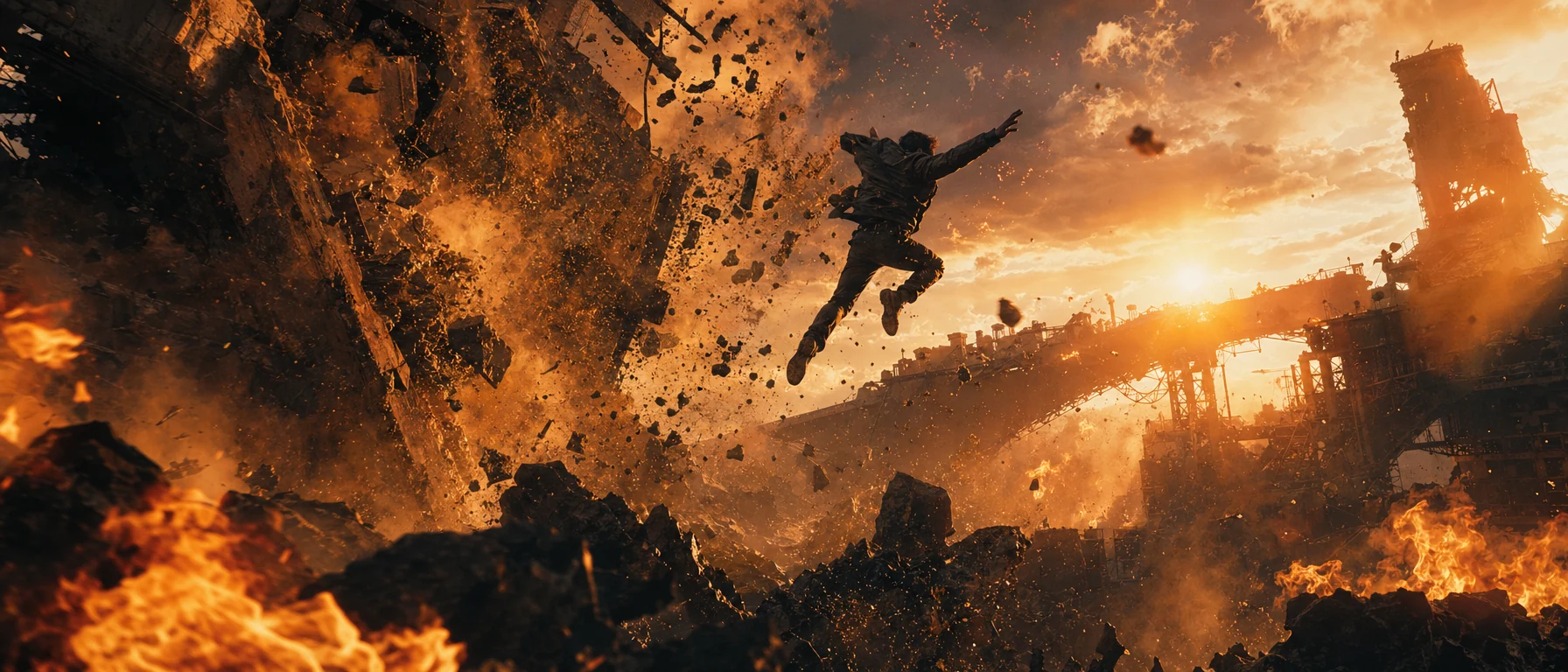
High-budget visual centerpiece consuming 15–40% of VFX budget; the most spectacular, resource-intensive sequence in a film.
Technical Details
Money shots typically require 15-40% of the total VFX budget and shooting durations of 3-8 weeks for a 10-90 second sequence. The shots are created using motion control cameras with repeatability values under 0.1mm, Phantom TMX high-speed cameras at 100,000-1,000,000 fps, or Technocrane systems with a 50-meter reach. Variants include the Stunt Money Shot (practical effects), VFX Money Shot (digital dominance), and Hybrid Money Shot (combination of both techniques).
History & Development
The first documented money shots emerged in 1975 with "Jaws" featuring Bruce, the mechanical shark, for $150,000. "Star Wars" (1977) established the VFX money shot with the Death Star attack for $2.5 million. "Terminator 2" (1991) introduced CGI money shots – the T-1000 liquid metal effects cost $17 million for a total film length of 63 minutes. Modern money shots, like the portal battle in "Avengers: Endgame" (2019), consume $200+ million and 2,900 VFX shots.
Practical Application in Film
"Mad Max: Fury Road" (2015) realized money shots through 80% practical stunts with polecats (panning camera arms) on moving vehicles. "Inception" (2010) mechanically rotated entire hotel corridors for the zero-gravity money shot. The shots are planned in pre-visualization with Maya/Houdini, shot in 6K-12K, and finalized in 2.5D/3D compositing pipelines. Disadvantage: Money shots consume 60-80% of post-production time for 15-25% of the film's length.
Comparison & Alternatives
Money shots differ from hero shots (product-focused object shots) and beauty shots (aesthetic landscape settings) by their narrative climax function. Practical money shots are increasingly replacing CGI-heavy variants – "Top Gun: Maverick" (2022) deliberately avoided green screen for authentic cockpit shots. Virtual production with LED walls (StageCraft technology) reduces money shot costs by 30-50% compared to traditional VFX pipelines.