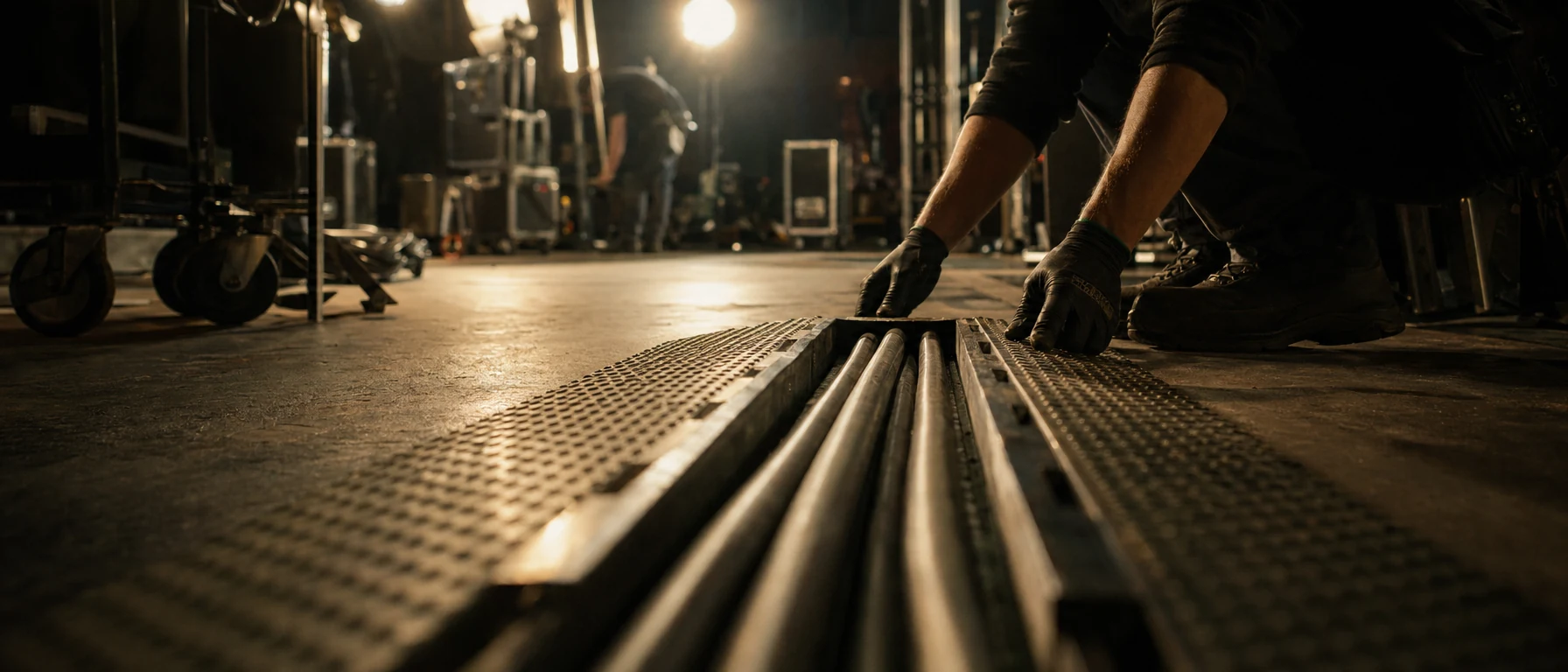
Rubber cable bridge with vulcanized channels for power cables, supporting up to 18 tonnes. Modular crossover system with Shore A hardness 70–90, protecting cable runs during camera moves and action sequences.
Technical Details
Professional film cable crossovers are made of vulcanized natural rubber or thermoplastic polyurethane with Shore A hardness between 70-90. Standard two-channel models (Type 2x25) accommodate cables up to 25 mm in diameter, while large versions (Type 5x50) offer five channels, each 50 mm wide. The surface structure features anti-slip profiles classified as R11. Modular systems connect via stainless steel connectors or interlocking plastic cams. Heavy-duty variants achieve compressive strengths of 400 N/cm² at operating temperatures from -40°C to +80°C.
History & Development
The first cable crossovers were developed by the US company Checkers Industrial Products in 1983 for industrial applications. Their use in film began in the late 1980s when Steadicam shots and more complex camera movements required longer cable runs. In 1995, Yellow Jacket introduced the modular FastLane system, which is now an industry standard. The integration of LED warning lights occurred in 2008, while current models have been using recyclable TPU compounds since 2018.
Practical Use in Film
In "1917" (2019), over 200 meters of cable crossovers secured the power supply for the seemingly continuous camera movement through the trenches. Action productions like the "Fast & Furious" films use heavy-duty models (Type LL-5) capable of withstanding camera trucks weighing 18 tons. Night shoots require reflective versions or LED-illuminated units powered by 12V DC. Setup takes 2-3 minutes per 10-meter section, while dismantling is accelerated by their stackable design.
Comparison & Alternatives
Neoprene cable mats offer larger coverage areas but only provide protection under light traffic. Cable trenches allow for invisible routing but require excavation and permits. Overhead rigging using truss systems eliminates ground obstacles but limits camera mobility. For interior shoots, carpet ramps or gaffer tape replace cable crossovers but offer no protection against heavy loads. Modern wireless video transmission reduces the need for cable crossovers, but they remain indispensable for power supply.